What are the most expensive and important design mistakes to avoid when going off-grid in 2026? When you plan your off-grid setup, you must think about your energy needs. You also need to check your site and see how each system works together. Many people have problems with off grid homesteading. They might not think about winter, forget about access, or skip legal steps. Solar, battery storage, and installation can cost a lot. This makes it hard to plan your budget for moving off the grid. If you want energy independence and better efficiency, you must focus on design. You also need to watch your energy use and do maintenance. Off grid living for beginners means you need to plan smart. It is not just about dreaming of living off the grid. Avoid these costly mistakes so you can enjoy your off grid power systems.
Key Takeaways
Always check how much energy you use. Look at your power bills from the last year. This helps you not guess too low about what you need.
Pick the right battery type and size for your off-grid system. The right battery gives you steady power and lasts longer.
Choose an inverter that fits your off-grid setup. Make sure it can handle the extra power your appliances need.
Plan your solar array size by checking local sun hours. Try to keep your panels out of the shade. This helps your system make enough energy all year.
Set up a regular maintenance plan for your system. Check your solar panels and batteries often. This keeps your off-grid system working well.
Underestimating Energy Needs
You might think you know how much energy you use, but many people make off grid living mistakes by guessing instead of checking. If you underestimate your energy needs, you can end up with a system that fails when you need it most. Let’s break down the common mistakes and how you can avoid them.
Seasonal Variations
Your energy needs change with the seasons. In winter, you may use more lights and heating. In summer, fans or air conditioning can increase your energy consumption. Many people forget to plan for these changes. If you don’t review at least 12 months of power bills, you might miss spikes in usage. This leads to off grid living mistakes like relying on backup generators or paying extra for grid power. You want your off-grid system to handle all seasons, not just the easy months.
Phantom Loads
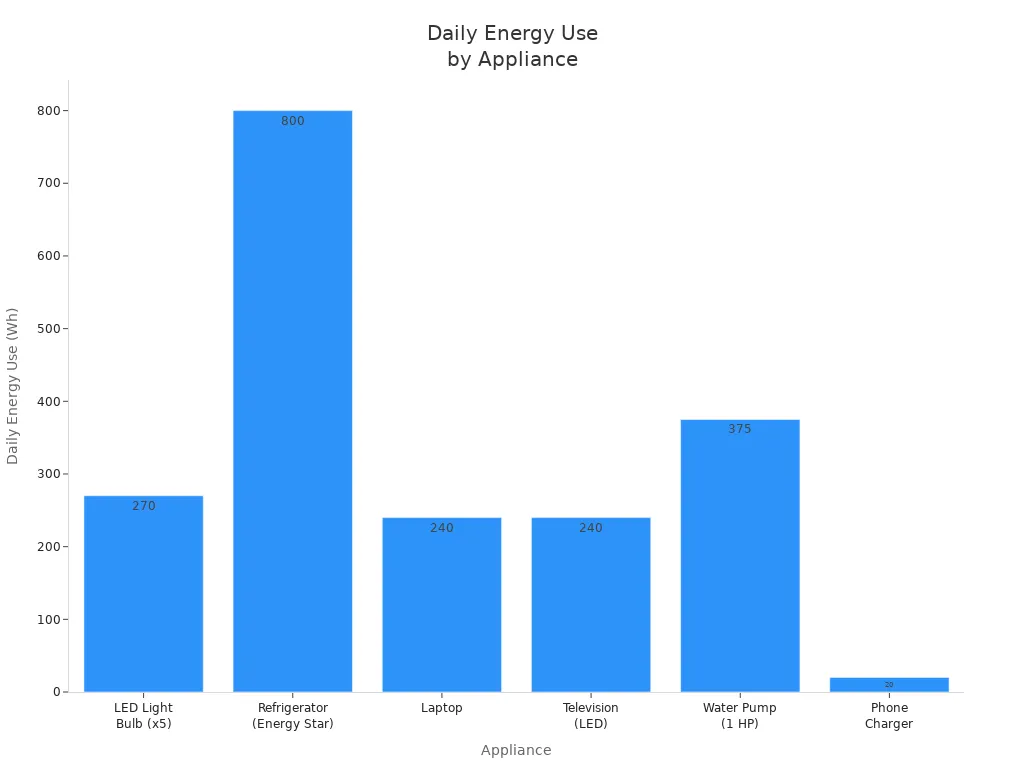
Phantom loads are sneaky. Devices like phone chargers, TVs, and even microwaves use energy when you think they are off. These hidden loads add up fast. If you ignore them, your off grid system can run out of power. Here’s a simple table to help you spot phantom loads and total energy needs:
Appliance
Wattage (W)
Hours Used/Day
Daily Watt-hours (Wh)
LED Light Bulb (x5)
45W
6 hours
270 Wh
Refrigerator (Energy Star)
100W
8 hours
800 Wh
Laptop
60W
4 hours
240 Wh
Television (LED)
80W
3 hours
240 Wh
Water Pump (1 HP)
750W
0.5 hours
375 Wh
Phone Charger
10W
2 hours
20 Wh
Total Daily Energy Consumption:
1945 Wh (or 1.945 kWh)
Misjudging Consumption
You can avoid off grid living mistakes by doing a load audit. Make a list of every device you use. Check the wattage for each one. Estimate how many hours you use them each day. This helps you see your real energy needs. If you oversize your system, you pay more upfront. If you undersize it, you risk outages and extra costs. Good planning means you get the right balance for your off-grid setup.
Tip: Write down your energy needs for each season. Check for phantom loads. Use your list to plan your off-grid system and avoid costly mistakes.
Battery Design Mistakes in Off-Grid Systems
Picking the right battery is very important for your off-grid setup. If you choose the wrong battery, you might lose power. If your battery is too small, it will not last long. Let’s talk about common battery mistakes and how to avoid them.
Wrong Battery Type
Not every battery works well in off-grid solar systems. Some batteries can handle deep discharges better. Others need more care and checking. If you pick the wrong battery, you might need more repairs. You could even need a new battery sooner. Make sure your battery fits your energy needs and your system. For example, lithium iron phosphate batteries last a long time. They do not need much care, but they cost more at first. Lead-acid batteries are cheaper. They need more care and do not last as long.
Insufficient Capacity
If your battery bank is too small, you can have problems. This is true on cloudy days or long nights. Here is what can happen if your battery is not big enough:
Your batteries might not charge all the way when there is not much sun.
Batteries that are not charged enough can lose power and wear out fast.
You might see your system lose power and not work well.
You want your battery bank to hold enough energy for a few days with no sun. Always plan for the worst days, not just the best.
Poor Chemistry Choice
The type of battery chemistry is important in off-grid design. Each battery type has good and bad points. Here is a simple chart to compare them:
Battery Type
Advantages
Disadvantages
Lithium Iron Phosphate
Lasts a long time, safe, works well
Costs more at first
Lead-Acid
Costs less, easy to find
Does not last long, needs care, not as efficient
Nickel Iron
Lasts a very long time, strong, needs little care
Not very efficient, loses power, costs a lot
Nickel-Cadmium
Strong, lasts long, works well
Bad for the environment, memory effect, expensive
Tip: Before you install your system, talk to a battery expert. They can help you pick the best battery for your off-grid system and your energy needs.
If you spend time picking the right battery and size, your off-grid system will work well and last longer.
Inverter Selection Errors for Grid-Tied Solar System Transition
Picking the right inverter is very important when you switch from a grid-tied solar system to an off-grid setup. If you make mistakes, you could lose power or break your equipment. Let’s see what problems you might have.
Grid-Tied vs. Off-Grid Inverters
Not all inverters are the same. Grid-tied inverters connect to the power company and must follow rules. Off-grid inverters work without the power company. Here is a table that shows how they are different:
If you use a grid-tied inverter for off-grid, it will not work. Grid-tied inverters need the power company to run. Off-grid inverters can make their own power and keep things working.
Surge Capacity Issues
Some appliances need extra power to start. If your inverter cannot handle this, your system might shut off or stop working. You should pick an inverter that is at least 25% bigger than your largest load. Make sure the surge capacity is strong enough for all your devices that start together.
Tip: Always check the surge rating for your inverter. Do not just look at the average power. This helps you stop outages and keeps your off-grid system safe.
Component Mismatch
Using the wrong parts can cause problems. Here are some things to watch out for:
Using grid-tied inverters instead of grid-forming inverters can make your system fail, because grid-tied inverters cannot make their own grid.
If you do not pick an inverter with enough surge capacity, you can lose power, especially when big appliances start.
If you match your inverter to your off-grid system and energy needs, you will have steady power and fewer problems.
Solar Array Sizing Mistakes
You might think bigger is always better when it comes to solar, but that’s not true. Many people make common solar mistakes by guessing the size of their solar array. If you get the sizing wrong, your off-grid setup can run into trouble. Let’s look at what happens when you ignore key factors.
Ignoring Sun Hours
Sun hours matter a lot for solar energy. If you don’t check how much sunlight your site gets, your solar systems might not make enough power. Peak Sun Hours (PSH) show you how many hours of strong sunlight your panels get each day. This number changes with the season and your location. You need to use it to figure out how much energy your solar array can produce.
Incorrect solar array sizing leads to power shortages during cloudy days.
Oversized systems cost more money without giving you extra benefits.
You can use this formula: Required Solar Array Size (Watts) = (Total Daily Energy Consumption in Wh / Peak Sun Hours) / System Efficiency Factor.
Tip: Always check your local sun hours before you design your solar array. This helps you avoid common solar mistakes and keeps your system running smoothly.
Shading Problems
Shading can ruin your solar efficiency. Trees, buildings, or even dust can block sunlight and lower your energy output. You need to check your site for anything that might cast a shadow on your panels.
Peak Sun Hours tell you how much sunlight you get.
System losses from shading, wiring, and temperature can cut your solar output.
If you ignore shading, your solar array sizing will be off. You might end up with less power than you need for your off-grid life.
Expansion Planning
You may want to add more panels or batteries later. Planning for future expansion is a smart move. Many people forget this step and make common solar mistakes.
Make sure you have enough space for more panels.
Choose modular components that let you grow your system without starting over.
Note: If you plan ahead, your off-grid solar systems can handle more energy needs as your lifestyle changes.
Table: Solar Array Sizing Mistakes and Their Impact
Mistake
Impact on Off-Grid System
Undersized Array
Frequent power shortages, battery strain
Oversized Array
Wasted investment, higher upfront cost
Ignoring Sun Hours
Not enough energy, unreliable system
Shading Problems
Lower efficiency, less power
No Expansion Planning
Hard to upgrade, limited energy growth
You can avoid these solar array sizing mistakes by checking sun hours, watching for shading, and planning for expansion. This helps your off-grid system stay reliable and efficient.
Site Evaluation and Solar Potential Oversights
Poor Site Assessment
You might think any sunny spot will work for your solar panels, but that’s not true. Many people skip a full site check and end up with less solar energy than they expected. If you don’t look at your land carefully, you can miss out on the best sunlight. Here are some common mistakes you want to avoid:
Not checking for trees or buildings that block the sun.
Forgetting to measure peak sun hours for your location.
Placing panels where shadows fall during the day.
When you ignore these steps, your solar systems won’t make enough energy. You could end up with a system that doesn’t meet your needs. Always walk your site and watch how the sun moves before you start your off-grid design.
Inadequate Clearance
You need to give your panels enough space. If you put them too close to the roof or each other, you can run into problems. Not enough airflow can make your panels overheat. This lowers their efficiency and can even cause damage. You might see more breakdowns and need repairs more often. Here’s what happens when you skip proper clearance:
Panels get too hot and lose power.
Parts wear out faster.
You spend more time and money on maintenance.
Give your panels room to breathe. This keeps your off-grid system running strong and helps you get the most energy possible.
Panel Quality Choices
Not all panels are the same. High-quality panels last longer and work better in tough weather. You want panels that can handle hail, wind, and years of sun. Take a look at this table to see why quality matters:
Aspect
Value
Lifespan
25 to 30 years or more
Degradation Rate
0.5% to 1% per year
Efficiency after 25 years
About 80% of original output
Panels with strong frames and tempered glass stand up to storms. Good panels keep making energy for decades. If you pick cheap panels, you might save money now but pay more later. Choose wisely for your off-grid setup.
Tip: Spend time on site checks and pick quality panels. This helps your solar system stay reliable and efficient for years.
Safety and Protection Design Mistakes
You want your off-grid system to be safe. It should also protect your home. Many people forget important safety steps when they design their system. If you skip these steps, you could have a fire or get shocked. Your equipment might also break and cost a lot to fix.
Missing Fuses and Breakers
Fuses and breakers are like guards for your wires. They stop too much electricity from flowing. This keeps wires from getting too hot. If you do not use them, a short circuit can start a fire. Your equipment can also get ruined. You need fuses and breakers on both the DC and AC sides. Here is a table that shows what each device does:
Protection Device
Description
DC Circuit Breakers
Protect the PV array and stop high current between panels and charge controller.
Fuses
Cut off bad circuits and stop overheating or fire.
AC Breakers (after the inverter)
Keep home appliances safe and make sure AC power works right.
Battery Protection (DC Disconnect + Fuse)
Let you safely turn off batteries and protect from short circuits.
Tip: Always check that every wire has the right fuse or breaker. This easy step keeps your off-grid system safe.
Improper Grounding
Grounding gives electricity a safe way to go into the earth. If you do not ground your system, you could get shocked. Your equipment could break or catch fire. You must connect all metal parts to a grounding rod. Make sure you follow the rules in your area. Good grounding also helps protect your system from lightning and big voltage jumps.
Put in grounding rods the right way.
Connect all metal parts to a grounding wire.
Grounding lowers shock risk and keeps your equipment safe.
Lack of Lightning Arrestors
Lightning can hit anywhere, especially in the country. If you do not use lightning arrestors or surge protectors, one storm can break your system. Surge protection devices should be on both the DC and AC sides. They block big voltage spikes and keep your equipment safe.
Best Practice
Description
Surge Protective Devices (SPDs)
Put these on DC and AC sides to stop lightning and voltage spikes.
Proper Grounding
Gives a safe path for bad currents to go into the ground.
Callout: Protect your system by adding surge protection and grounding. These steps help your off-grid system last through storms and keep your power on.
If you focus on safety and protection when you design, you will avoid big mistakes. Your system will work well for many years.
Cable Sizing and Voltage Drop Errors
Undersized Wiring
You might not think much about the wires in your off-grid system, but they play a huge role in how well everything works. If you use wires that are too thin, you can run into big problems. Let’s talk about why cable sizing matters and what can go wrong if you get it wrong.
When you use undersized wiring, your system loses power before it even reaches your appliances. This means your solar panels work hard, but you don’t get all the energy they make. You might notice your lights dim or your fridge not running as cold as it should. Sometimes, your batteries won’t charge all the way, which can make them wear out faster. In the worst cases, your inverter or other electronics might stop working or shut down.
Here’s what can happen if you don’t pick the right cable size:
Reduced power output: Less voltage gets from your solar panels to your inverter, so your system runs less efficiently.
Inefficient battery charging: Big voltage drops can keep your batteries from charging fully, which hurts their lifespan.
Equipment malfunction: Inverters and electronics might underperform or even shut off if the voltage drop is too high.
You want to avoid these headaches. Picking the right wire size is key, especially in off-grid setups where every bit of power counts. Here are some tips to help you get it right:
Choose the correct cable diameter to stop power loss, especially in low-voltage systems.
Use thicker cables if your system has high current. This helps prevent voltage drops that can mess up your system.
If you have to run wires a long way, try using multiple parallel wires. This can make installation easier and keep cables from getting too thick.
Tip: Always double-check your cable sizing before you finish your off-grid design. A little planning now saves you a lot of trouble later.
If you pay attention to your wiring, your off-grid system will run smoother, last longer, and give you the power you need.
Regulatory and Permitting Mistakes
Ignoring Local Codes
You might feel excited to start your off-grid project, but skipping local building codes can cause big problems. Local codes set safety standards for solar systems and other electrical work. If you ignore these rules, you could face fines or even have to remove your setup. Some towns or counties require you to get a permit before you install anything. They want to make sure your system is safe for you and your neighbors.
Here’s what you need to watch for:
Some places have laws that say you must stay connected to the city power grid. This can make it hard to go fully off-grid.
Inspectors may check your wiring, panels, and batteries to see if they meet the National Electrical Code (NEC).
Insurance companies might ask for proof that your system follows all safety rules.
Tip: Always call your local building office before you start. They can tell you what permits you need and what rules to follow.
Legal and Compliance Issues
Legal problems can stop your off-grid dream fast. You need to know the laws in your area before you spend money on equipment. Some states or cities have strict rules about solar panels and batteries. You might need extra insurance for your solar gear. If you skip these steps, you could lose your investment.
Check out this table to see what you should review:
What to Check
Why It Matters
Building Codes
Keeps your system safe and legal
Grid Connection Laws
May require you to stay on the grid
Insurance Requirements
Protects your home and equipment
You want your off-grid system to last for years. Following the rules helps you avoid trouble and keeps your power on.
Backup Power Planning Mistakes
When you live off-grid, you need to plan for days when your solar setup cannot meet your energy needs. Many people forget about backup power. This mistake can leave you in the dark when the weather turns bad or your battery runs low.
No Generator Backup
You might think your solar panels and battery bank will always keep your lights on. Sometimes, clouds block the sun for days. Your battery can run out of charge. If you do not have a generator, you risk losing power for your whole system. A backup generator can save you during long storms or winter months. It can also help when you need to do battery maintenance or repairs.
Tip: Choose a generator that matches your system sizing. Make sure it can charge your battery bank and run your most important appliances.
Insufficient Redundancy
Redundancy means having a backup for your backup. If you only have one battery bank or one way to make energy, you could face trouble. Batteries can fail. Solar panels can break. You need more than one way to keep your system running. Here are some ways to add redundancy:
Use two or more battery banks. If one fails, the other keeps working.
Add a second energy source, like wind or hydro, to support your solar.
Keep spare parts for your system, such as fuses or cables.
A table can help you see the value of redundancy:
Redundancy Option
Benefit
Extra battery bank
Keeps power on if one fails
Generator backup
Provides energy in emergencies
Multiple energy types
Less risk from weather changes
If you plan for backup and redundancy, your off-grid system will stay strong. You will not worry about losing power when you need it most.
Maintenance and Monitoring Oversights in Off-Grid Living
No Real-Time Monitoring
Some people think their off-grid system will always work well after they set it up. But if you do not watch your system in real time, you might miss problems that lower your energy. Real-time monitoring helps you see how much power your solar panels make and how much energy your battery stores. If you check your system every day, you can find problems early and fix them fast.
Here’s how real-time monitoring helps you:
Evidence
Explanation
You get data all the time about your energy use
This lets you change settings and fix problems quickly, so your solar panels and battery work better.
You can spot problems early
This helps you stop outages or damage before they happen to your battery bank.
Checking your system often
This keeps your solar panels working well, so you get more energy and your system lasts longer.
You can use apps or smart meters to see your battery charge and solar power. If you notice less energy, you can clean your panels or check for snow. Watching your system live is important for a strong off-grid setup.
Tip: Turn on alerts in your monitoring app. You will know right away if your battery or solar panels need help.
Neglecting Maintenance Schedule
Many people forget to do regular maintenance on their off-grid system. If you do not clean your solar panels or check your battery, you could lose power. Dirt, snow, or cracks can make your panels work less. Your battery can stop working if you ignore it for too long.
Here’s a table that shows what to check and how often:
Component
Maintenance Task
Frequency
Solar PV Modules
Clean the panels
Weekly/Bi-weekly/Monthly
Look for cracks, hot spots, or PID effect
Annually
Test the IV curve
Once Annually
Inverter
Update firmware and check how it works
As needed
Check the cooling system
As needed
Balance of System
Check the SCADA system
Regularly
Inspect the weather station
Regularly
If you follow a schedule, your battery will last longer and your solar panels will keep making energy. You can stop big problems and keep your off-grid system working well.
Callout: Make a checklist for your battery, solar panels, and other parts. Stick to your schedule and you will have steady power all year.
You can stop off grid living mistakes by checking your energy use. Pick the right panels for your system. Make sure you plan for regular maintenance. Good planning helps you solve homesteading problems. It also helps you get energy independence. If you watch for grid-tied and off-grid mistakes, you spend less money. Your system will work better and be more reliable. Living off the grid means you must change and learn new things. To do well, choose panels carefully. Look for grid-tied errors and keep learning. Do not let mistakes keep you from enjoying your panels and living off the grid.
Stay positive and keep learning new skills. You can fix grid-tied and off grid living mistakes with smart planning and good panels.
Strategy
Description
Modular Designs
Add more panels and batteries as your needs grow.
Weatherproofing
Keep panels safe from bad weather for a strong off-grid system.
Good planning stops grid-tied and off grid mistakes.
Picking the right panels saves money.
Paying attention makes off grid living safer and better.
FAQ
What is the first step to designing an off-grid system?
You should start by listing all your appliances and checking how much energy they use. This helps you plan your system and avoid surprises.
How often do I need to clean my solar panels?
You should clean your panels every month. If you live in a dusty area, check them more often. Clean panels make more energy.
Can I add more batteries or panels later?
Yes, you can expand your system. Choose modular parts so you can add more batteries or panels when your energy needs grow.
What happens if my off-grid system fails during bad weather?
You need a backup plan. A generator or extra battery bank can keep your lights on when the weather is rough.
Do I need special permits for an off-grid setup?
Most places require permits. Check with your local building office before you start. Permits help keep your system safe and legal.