You want your building to be smart and not waste energy. Picking efficient building products, like building-integrated photovoltaics, can help you do this. BIPV products put solar technology into roofs, windows, and walls. This means you save energy and help the planet. In the EU, 65% of new public buildings used BIPV in 2023:
Region
Percentage of New Buildings with BIPV
EU
65% of new public buildings in 2023
With building-integrated photovoltaics, you can use less energy and get more value from your building for a long time.
Key Takeaways
Pick BIPV products to use less energy and help the planet. They put solar technology right into your building.
Check efficiency numbers like energy cost and performance index. This lets you compare different solar products easily.
Think about how strong and long-lasting BIPV is. Most systems work for 25 to 50 years. You get energy savings for a long time.
Plan for maintenance and support. BIPV systems need special care. Make sure you can clean and fix them easily.
Find trusted manufacturers with good support. A strong company helps you avoid delays and keeps quality high.
Efficiency in Building Products
Defining Efficient Building Products
When you look for efficient building products, you want items that help your building use less energy and save money. These products do more than just work well—they help you create energy-efficient buildings that last. You might see solar panels on roofs or solar glass in windows. These products turn sunlight into power, which means you use less from the grid. Efficient building products also keep your space comfortable and lower your bills. You get more value from your building when you choose the right products.
Key Metrics for Efficiency
You can measure efficiency in many ways. Here are some common metrics you might see:
Metric Name
Description
ENERGY COST
Shows how much you spend on energy each year.
PEAK DEMAND
Tells you when your building uses the most power.
PERFORMANCE COST INDEX (PCI)
Compares your building’s energy cost to a standard building.
TDV ENERGY & DEER DEMAND
Looks at real-time energy costs, often used in California.
POWER USAGE EFFECTIVENESS (PUE1)
Measures how much energy goes to equipment versus the whole building.
THE 2030 CHALLENGE BENCHMARK
Sets a goal for energy use, aiming for zero net energy by 2030.
THERMAL ENERGY DEMAND INTENSITY (TEDI)
Shows how much energy you need for heating.
You can use these numbers to compare solar products and see which ones help you reach your goals.
Why Efficiency Matters for BIPV
You want your solar products to work hard for you. In homes, BIPV systems can turn 8-12% of sunlight into power and let in 20% of the light. This means you get 50-150 watts per square meter, which can cover 10-30% of your energy needs. In bigger buildings, BIPV can reach 10-18% efficiency and make 100-250 watts per square meter. Sometimes, these systems can meet up to half of your building’s energy demand.
Homeowners like BIPV because it lowers their carbon footprint and uses solar power.
Businesses choose BIPV for high energy needs and cost savings, especially when they use solar on facades and roofs.
You see more solar products in new buildings because they help you save money and energy. When you pick efficient building products, you make your building smarter and greener.
Criteria for Choosing BIPV and Solar Products
Energy Performance and Output
When you pick building integrated photovoltaics, you want good results. The energy performance and output of BIPV depend on many things:
Building energy needs matter. You must check if your building can use only solar energy or still needs the grid.
Solar system design is important. It should fit your building’s needs and look right with your space.
Building use and direction change how much sunlight you get. Rooftops and south walls get sunlight in different ways. South-facing façades may help lower carbon and show a green image more than making the most power.
Looks and design goals matter too. Color, texture, and how much light comes through should match your plans.
Building rules and fire codes are important. BIPV modules have different ratings than other building materials. You should talk to experts early.
Heat control and strength are key. BIPV modules are part of your building’s outside. They must last through hot, cold, and wet weather.
Electrical setup and repairs need planning. Make sure you can reach panels and wires for fixing later.
You also need to think about some technical things:
Insolation means how much sunlight your building gets each day.
Weather and climate matter. Hot days can make photovoltaics work less well. Clouds and rain can lower how much solar energy you get and mean you clean panels more often.
Shade is a big deal. Even a little shade from trees or buildings can cut your solar power a lot. Check for shadows before you put in panels.
Latitude is where your building is on Earth. This changes the best angle for your solar panels.
Tip: Hot weather can lower the voltage and efficiency of your solar modules. Even small shadows can make a whole row of panels work less. Always check for shade and pick the best angle and direction for your panels.
Durability and Lifespan
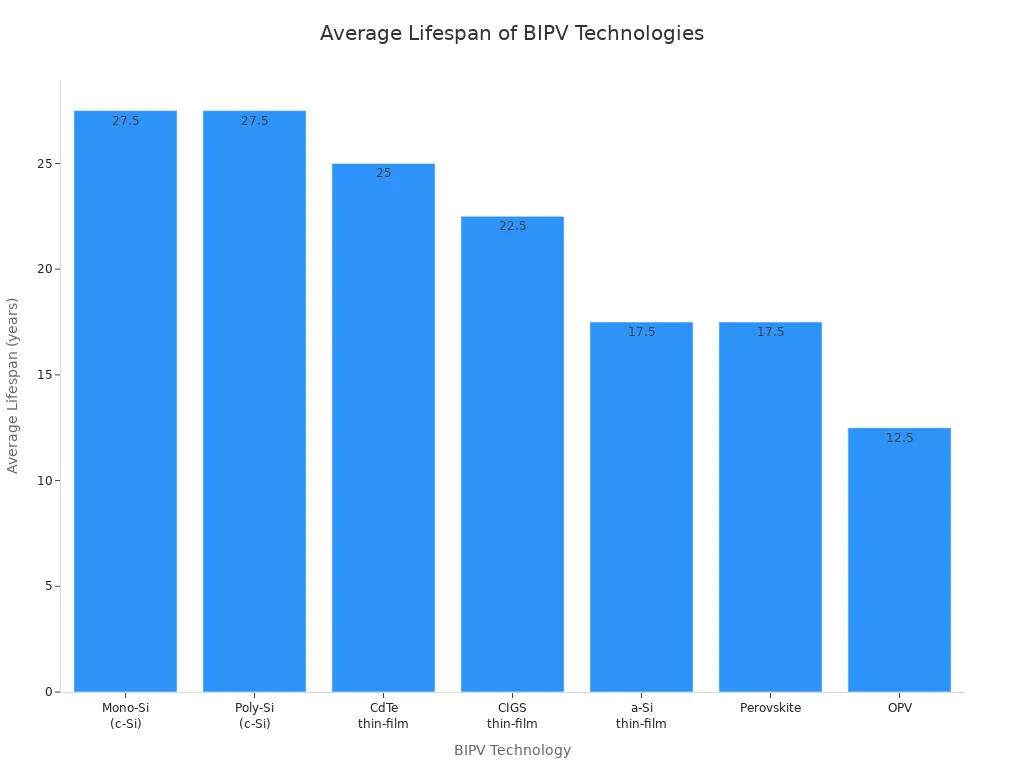
You want your BIPV products to last as long as your building. Most BIPV modules last 25 to 50 years. After 25 years, they usually still make about 80% of their first power. This means you get clean electricity for many years. BIPV products often last longer than regular roofs or walls, so you save money on repairs and new parts.
Here is how long different BIPV types last:
Technology
Typical Lifespan
Mono-Si (c-Si)
25–30 years
Poly-Si (c-Si)
25–30 years
CdTe thin-film
25+ years
CIGS thin-film
20–25 years
a-Si thin-film
15–20 years
Perovskite
15–20 years
OPV
10–15 years
BIPV modules are strong. They use safety glass and PVB, so they stand up to fire, water, sun, and wind. They get tested for wind, water, heat, and hits. You can trust them in tough places like cities by the sea, deserts, or stormy areas.
Feature
Normal Solar Panels
BIPV
Fire Resistance
Low (plastic-based)
High (glass + PVB, fire rated)
Waterproofing
Moderate (bracket seal)
High (sealed integration)
UV Resistance
Poor (EVA yellows/cracks)
Excellent (PVB is UV stable)
Structural Strength
Weak (non-load-bearing)
High (tempered glass core)
Cost Savings and ROI
You want your solar investment to pay you back. BIPV can give you good returns, especially in Europe. The Internal Rate of Return for BIPV is usually 13% to 28%. This is higher than regular solar systems, which get 7% to 9%. In places like Germany and France, BIPV can make your building worth 15% to 30% more. You save money on energy bills and your property value goes up too.
Maintenance and Support
BIPV systems are part of your building, so they need special care. You may need things like gondolas or cradles to clean and check façade BIPV. Regular solar panels are easier to reach, but BIPV modules do two jobs—they protect your building and make energy. This can make repairs and replacements harder. You should plan for easy access and work with people who know BIPV.
BIPV systems need special ways to get to them for care.
Facade BIPV may need gondolas or cradles for cleaning.
Regular solar panels are easier to fix.
BIPV modules are both building parts and energy makers.
Environmental Impact
If you care about the planet, BIPV is a smart pick. These products help you lower your carbon footprint. The carbon from BIPV is about 20–50 grams of CO₂ per kilowatt-hour. This is much less than natural gas (450 gCO₂/kWh) or coal (820 gCO₂/kWh). BIPV also replaces the carbon from normal building materials, so you get double the good.
Environmental Benefit
Description
Reduced Carbon Footprint
BIPV systems have a lifecycle carbon intensity of 20–50 gCO₂eq/kWh, compared to 450 gCO₂eq/kWh for natural gas and 820 gCO₂eq/kWh for coal. They also replace the embodied carbon of conventional materials.
Urban Heat Island Mitigation
Dark BIPV roofs use sunlight for power instead of turning it into heat. They run 8–15°C cooler than regular dark roofs, which helps cool cities.
You help make cities greener and support clean energy when you choose BIPV. You also get clean power and lower your building’s effect on the environment.
Evaluating Building-Integrated Photovoltaics
When you want your building to stand out and save energy, you need to look closely at building-integrated photovoltaics. These products do more than just make power—they become part of your building’s skin. You can swap out regular roofs, walls, or windows for solar materials that look great and work hard. Let’s break down what you should check before you choose.
Technical Specifications
You want your solar system to fit your building and work well for years. Here are the most important technical specs to look for:
Specification Type
Description
Efficiency and Performance
BIPV systems usually reach 10% to 20% efficiency. The cell type and your local weather can change this.
Integration and Installation
These products are made to blend with your building. You need architects, engineers, and installers to work together.
Compliance with Industry Standards
Good BIPV products meet strict safety and performance rules, like IEC 61215:2021 and IEC 61730:2023.
You should also check for:
Power output per square foot or meter.
How well the solar modules handle heat, cold, and storms.
The best angle and direction for your solar shingles or solar windows.
Tip: Always ask for a data sheet. This will show you how much energy the solar system can make and how it will look on your building.
Certifications and Standards
You want your building integrated photovoltaics to be safe and legal. Different countries have their own rules, but some standards are used worldwide. Here’s a quick look:
Region
Standards/Certifications
Details
Global
IEC 61730
Checks electrical safety, fire resistance, and strength.
Global
IEC TS 63092 series
Looks at water tightness, load, and fire tests for BIPV.
US
UL 61730
Main safety rule for new BIPV products in the US.
US
UL 2703
Covers how you mount and rack solar modules.
US
NEC Article 690
Sets rules for wiring, shutdown, and fire safety.
US
IBC/IRC
Makes sure your solar shingles or solar windows meet building codes.
US
UL 790
Rates fire safety for roofs.
US
NFPA 285
Tests fire spread on walls with BIPV.
You should always check that your BIPV products have these certifications. This keeps your building safe and helps you pass inspections.
Architectural Integration
You want your building to look good, not just work well. Building-integrated photovoltaics let you keep your design style while adding solar power. You can pick from many colors, shapes, and sizes. This means your solar shingles can match your roof, or your solar windows can blend with your glass walls.
BIPV products give your building a modern, sleek look.
You don’t have to worry about ugly panels sticking out.
Solar technology becomes part of your building, not just something added on.
Note: BIPV solves the old problem of solar panels looking out of place. Now, you can have solar shingles, solar windows, or even solar skylights that fit right in.
Compatibility with Building Design
You need your solar system to work with your building’s shape and structure. Not every product fits every building. Here’s what to check:
Standard
Description
UL 7103
Checks if solar shingles work as roof coverings.
UL 61730-1
Sets rules for how solar modules are built.
UL 61730-2
Tests how strong and safe the modules are.
UL 790
Rates fire safety for flat solar panels.
UL 580
Tests how well your roof stands up to wind.
You should talk to your architect and installer early. Make sure your solar shingles, solar windows, or solar skylights will fit your building’s design. This helps you avoid problems later.
Manufacturer Reputation
You want to buy from a company you can trust. Not all BIPV makers are the same. Here’s how you can spot a good one:
Evaluation Criteria
Red Flags (Avoid)
Green Flags (Shortlist)
BIPV Production Focus
Only makes regular solar panels
Has special lines for BIPV and makes lots of them
Quality Control
Only checks by hand, lots of defects
Uses machines to check every module, follows ISO 9001
Lead Times
Can’t promise delivery dates
Gives clear delivery times and tracks orders
Logistics
Makes you handle all shipping
Offers help with shipping and has warehouses nearby
Supply Chain
Uses only one supplier
Has many suppliers and keeps extra stock
68% of buyers had delays because of supply or shipping problems with solar roof tiles. You should pick a company with a good track record and strong support.
Popular Types of BIPV Products
You have lots of choices when it comes to BIPV. Here are some of the most popular:
Solar shingles: These look like regular roof tiles but make solar energy. You can cover your whole roof with them.
Solar windows: These work as windows and make power at the same time. You can use them in offices, schools, or homes.
Solar skylights: These let in sunlight and make energy, perfect for bright rooms.
Façade systems: These cover the outside of your building with solar panels, either as solid walls or as ventilated panels.
You can mix and match these products to get the look and performance you want. Solar shingles and solar windows are especially popular in sustainable architecture because they help you save energy and keep your building looking sharp.
If you want a building that is both beautiful and sustainable, building-integrated photovoltaics are the way to go. You get solar power, lower energy bills, and a modern look—all in one package.
Comparing Efficient Building Products
Product Labels and Data Sheets
You want to make good choices when picking building products. Start by looking at product labels and data sheets. These papers tell you how much solar energy a product can make. They also show how long it will last and if it is safe. Look for certifications like UL 61215, UL 61730, CSA C22.2 No. 61730, and IEC 61730. These mean the solar modules passed hard safety tests. Mitrex’s BIPV solar modules have CSA, UL, and IEC certifications. You can trust these products to work well and be safe.
Tip: Always ask for a data sheet before buying. It helps you compare how well different photovoltaics work.
Reviews and Case Studies
You can learn from reviews and case studies. These stories show how BIPV products work in real buildings. One review looked at 35 BIPV outdoor test systems. About 60% did not meet their expected performance. This means you should check reviews before you buy.
Here are some examples:
Installation
Capacity (kWp)
Annual Energy Generation (kWh)
Notes
Keble College
77
60,000
Integrated into heritage buildings, minimal impact
Bullitt Center
575
Net-positive energy
Surplus energy exported, highly efficient design
Installation
Capacity (kW)
Annual Electricity Consumption
Notes
School
700
50%
Supports sustainability in education
Performance Data
You need to look at performance data to see if a solar product is right for you. Performance and cost are very important for BIPV. These products should last as long as your building, sometimes over 50 years. Solar panels usually lose some power after 25 years. BIPV modules may not always face the best way, so they can make less energy. Maintenance and replacement can be hard because BIPV products do two jobs. The payback period is important when you think about cost and performance.
BIPV products should last as long as your building.
Solar modules must pass strict safety and reliability rules.
You should check if the energy output fits your building’s needs.
Pick products that help you make a green building.
Note: Performance data helps you find which building products give you the best value and energy savings.
Installation and Maintenance for BIPV
Installation Requirements
When you install solar products like bipv, you need to think about more than just putting panels on your roof. These systems become part of your building, so you want them to look good and work well for years. Here’s a quick look at what matters most:
The system should match your building’s style. You can pick colors and shapes that blend in.
Process integration
Good design and planning make installation easier. You want your solar system to fit right the first time.
Reliability, durability, and safety
Your bipv must pass safety tests and last through storms, heat, and cold. Getting certified can take time, but it keeps your building safe.
Supply chain integration
You want your solar products to arrive on time. A strong supply chain helps avoid delays and missing parts.
Tip: Work with installers who know bipv. They can help you avoid mistakes and get the best results.
Maintenance Needs
Solar products like bipv do more than make energy. They also protect your building. This means you need to care for them in special ways. Here’s how maintenance compares:
Repairs need experts who know both roofing and solar
Simple fixes with regular materials
Replacement Process
You need both roofing and electrical teams
Easy panel swaps
Cost of Replacement
Higher, because of the extra steps
Lower, since it’s just standard parts
You should plan for regular cleaning and checks. If you see a problem, call someone who knows both roofing and solar. This keeps your system safe and working.
Long-Term Reliability
You want your bipv to last as long as your building. Here’s what helps:
Good testing shows how solar products handle real weather, like rain, snow, and heat.
Strong materials make your photovoltaics last longer.
Tough environments, like salty air or big storms, can wear down solar systems. Picking the right products helps them stand up to these challenges.
Note: When you choose quality solar products and plan for care, you get more energy and fewer problems over time.
Cost vs. Value in Building Integrated Photovoltaics
Upfront Costs vs. Savings
When you think about building integrated photovoltaics, the price stands out. BIPV systems cost more at first because they are built into your building. You pay extra for special designs and materials. Here is a simple comparison:
Type of System
Cost Comparison
BIPV
Higher upfront costs due to integration and specialized design
Traditional Materials
Lower upfront costs, no integration required
Conventional Solar Panels
Moderate upfront costs, separate installation required
A BIPV glass wall can cost 30-50% more than a normal glass wall. You do not have to pay extra to add solar panels later, which can cost $1.80 to $3.00 per watt. You pay more at the start, but your building makes clean electricity right away.
You save because you do not need a separate solar setup.
The system is part of your building, not just added on.
Payback Period
You may wonder how long it takes to get your money back. The payback period for BIPV depends on how much solar energy you use, your local energy prices, and how well your system works. Many people get their money back in 8 to 15 years. If you live where it is sunny or pay a lot for energy, you might save money even faster. Your building keeps making solar power, so you save money every year.
Tip: If you use more solar energy, you get your money back faster.
Total Value
You should think about everything you get with building integrated photovoltaics. The total value is more than just saving on energy. Your building can meet green goals and earn certifications like LEED or BREEAM. You also use BIPV instead of regular building materials, which adds value. In new buildings, BIPV often gives you a good return, especially if you want a green building. You get energy savings for many years, a modern look, and clean electricity for a long time.
When you add up all the good things, building integrated photovoltaics give you more than just solar power. They help you make your building smarter and greener.
Making the Final Choice
Synthesizing Information
You have learned a lot about efficient building products and building-integrated photovoltaics. Now, it is time to bring everything together. Start by looking at your building’s needs. Think about how much energy you want to save. Check how much sunlight your building gets each day. Review the data sheets and labels for each product. Compare how much solar energy each option can make. Look at the cost, the lifespan, and how easy it is to keep everything working.
You should also think about how the products will look on your building. Some solar products blend in with roofs, windows, or walls. Others stand out and make a bold statement. Ask yourself what fits your style. Talk with your architect or builder. They can help you match the right solar system to your design.
Confident Selection
You want to feel good about your choice. Here are some strategies that can help you pick the best solar products for your building:
People want homes that use less energy and help the planet. You can choose solar products that make your building more self-reliant.
New solar technology, like thin-film cells and semi-transparent modules, lets you add solar power to more parts of your building.
Smart energy systems and special coatings make solar products last longer and work better.
Check if the company has a good reputation and offers strong support.
Make sure your solar system meets safety and building codes.
Tip: When you mix new technology with smart planning, you get a building that saves energy and looks great.
You do not have to rush. Take your time. Review all the facts. Ask questions. When you feel ready, you can choose a solar solution that fits your needs and gives you value for years.
You want to make the best choice for your building. Start by checking how solar products fit your needs and building design. Look at how solar can work with your roof or walls. Think about how solar can help you save money and energy. Make sure your solar system meets all codes and safety rules. Stay updated on new solar technology and market changes. When you follow these steps, you can pick solar products that give you value and confidence.
Ready to make your building smarter? Use these steps to choose solar solutions that last.
FAQ
What is BIPV and how does it work?
BIPV stands for Building-Integrated Photovoltaics. You use BIPV products as part of your roof, walls, or windows. These materials turn sunlight into electricity right where you need it.
Can BIPV products replace regular building materials?
Yes! You can use BIPV instead of standard roofing, glass, or wall panels. These products protect your building and make solar power at the same time.
How long do BIPV systems last?
Most BIPV systems last 25 to 50 years. You get clean energy for decades. After 25 years, your system still makes about 80% of its original power.
Are BIPV products hard to maintain?
You clean BIPV modules like regular windows or roofs. Sometimes, you need special tools for high walls or tall buildings. Always ask your installer about maintenance tips.
Will BIPV help me save money?
You save money on energy bills. Your building uses less power from the grid. Over time, BIPV can pay for itself and even increase your property value.