Building-Integrated Photovoltaics (BIPV) refers to solar PV systems incorporated directly into a building’s envelope — replacing or serving as conventional building materials such as roofing, facades, windows, or cladding — while simultaneously generating electricity. Unlike bolt-on solar panels (BAPV), BIPV components perform a dual function: structural or aesthetic building element plus power generation.
This guide covers everything architects, engineers, building owners, and researchers need to know about BIPV in 2026:
The global BIPV market reached approximately $3.7 billion in 2023 and is projected to hit $18.9 billion by 2032 (CAGR ~19.6%)
Top-tier BIPV components achieve conversion efficiencies of 12–24%, comparable to conventional solar panels
A well-designed BIPV system can offset 20–80% of a building’s electricity demand, depending on available surface area and geographic location
Whether you are evaluating BIPV for a new construction project, comparing it with rack-mounted solar, or researching the latest technology, this guide provides authoritative data, real project examples, and an 11-step system design process to guide your decisions.
A BIPV (Building-Integrated Photovoltaic) system is a solar energy technology where photovoltaic materials are incorporated into the building envelope itself — functioning as roofing, facades, windows, or cladding — while generating electricity. Unlike rack-mounted panels added after construction (BAPV), BIPV replaces conventional building materials, serving a dual structural and energy-generating purpose.
The Dual-Function Nature of BIPV
The defining characteristic of BIPV is that the photovoltaic component is the building material. A BIPV roof tile replaces a conventional clay or asphalt tile. A BIPV glass curtain wall replaces standard architectural glazing. This dual functionality creates both economic and aesthetic advantages — the cost of the building material is partially offset by the solar energy system investment.
A well-oriented south-facing BIPV glass facade in a temperate climate generates approximately 80–150 kWh per square meter per year, depending on module efficiency, orientation, and shading conditions (Source: IEA PVPS Technical Report). A comparable rooftop system at optimal tilt typically yields 130–200 kWh/m²/year, illustrating the efficiency trade-off inherent in facade integration.
The key distinction between BIPV and BAPV is architectural: BAPV is added on top of existing structure; BIPV is the structure.
A Brief History of BIPV
The first commercial BIPV installation was completed in 1991 in Luzern, Switzerland — a 3 kWp system integrated into a residential roof as part of the Swiss Federal Office of Energy’s demonstration program (Source: IEA PVPS historical archive). From that single demonstration project, the global BIPV industry has grown into a multi-billion-dollar market spanning commercial towers, airport terminals, historic buildings, and residential homes.
The technology has matured substantially since the 1990s. Early systems relied exclusively on crystalline silicon with limited form factors. Today’s BIPV portfolio includes flexible thin-film membranes, semi-transparent glazing units, custom-colored facades, and perovskite-based cells approaching commercial readiness — giving architects unprecedented design freedom.
How Does BIPV Work?
BIPV systems generate electricity through the same photovoltaic effect as conventional solar panels — but their integration into the building envelope introduces unique engineering considerations around orientation, thermal management, and system connectivity.
The Photovoltaic Effect in BIPV
At the cell level, BIPV works identically to any silicon or thin-film PV system. When photons from sunlight strike the semiconductor junction (PN junction) within a solar cell, they excite electrons, creating electron-hole pairs and generating a direct current (DC). A standard BIPV module — depending on its size, cell type, and configuration — produces between 80 and 400 peak watts (Wp) under Standard Test Conditions (STC: 1,000 W/m² irradiance, 25°C cell temperature, AM1.5 spectrum). Larger facade panels can exceed this range.
The 4 Key Components of a BIPV System
Every BIPV installation, from a 10 kWp residential roof to a 2 MW commercial facade, relies on four core subsystems:
PV-Integrated Building Elements — The BIPV modules themselves: solar roof tiles, photovoltaic curtain wall panels, semi-transparent glazing units, or thin-film membrane laminates. These elements serve as the building’s weather barrier, structural cladding, or glazing while generating DC electricity.
Inverter(s) — Converts the DC output from the BIPV array into alternating current (AC) suitable for building loads or grid export. BIPV systems may use string inverters, microinverters (mounted at each module), or power optimizers — the choice depends on shading patterns and system size.
Monitoring System — Real-time performance monitoring tracks energy yield, specific performance ratio (PR), and fault detection. Modern BIPV systems integrate with building management systems (BMS) via Modbus or BACnet protocols.
Grid Connection or Storage Interface — Most BIPV systems operate grid-tied, feeding surplus generation to the utility grid. Increasingly, BIPV systems are paired with battery energy storage systems (BESS) to maximize self-consumption and provide resilience during outages.
Orientation, Tilt, and Annual Yield
Building orientation has a decisive impact on BIPV performance. A south-facing roof at 30° tilt in Phoenix, AZ generates approximately 40–60% more annual energy than a flat or north-facing roof installation of the same area (Source: NREL PVWatts Calculator). In Seattle, WA — with lower irradiance — the orientation penalty is proportionally smaller but still significant.
For facade-mounted BIPV, vertical south walls typically capture 60–70% of the energy of an optimally tilted rooftop system at the same location. East and west facades generate 40–55% of optimal. North facades are generally not viable for energy generation in northern hemisphere climates.
Thermal Management Challenges
BIPV faces a thermal management constraint that distinguishes it from rack-mounted BAPV: restricted airflow behind the module. Standard BAPV installations on pitched roofs maintain a ventilated air gap (typically 50–100 mm), allowing convective cooling. BIPV modules integrated flush into walls or roofs often lack this gap.
The consequence is elevated operating temperatures. Crystalline silicon cells lose approximately 0.3–0.5% of their rated efficiency for every 1°C rise above 25°C — a specification called the temperature coefficient (listed in every module datasheet). BIPV modules in poorly ventilated facade applications routinely operate 5–15°C above ambient temperature, compared to well-ventilated BAPV at 2–8°C above ambient (Source: ScienceDirect BIPV thermal performance literature). In practical terms, this can reduce annual energy yield by 3–10% relative to rated output — a factor that must be accounted for in system sizing calculations.
Types of BIPV Systems
BIPV technology spans five distinct product categories, each suited to different building elements, architectural styles, and performance requirements:
BIPV Roofing — Solar shingles and tiles that replace conventional roofing materials while generating electricity
BIPV Facades & Cladding — Photovoltaic panels integrated into vertical exterior walls and curtain wall systems
BIPV Glazing & Windows — Semi-transparent PV modules embedded in architectural glass for windows, skylights, and glass facades
BIPV Canopies & Skylights — PV-integrated overhead structures including parking canopies, walkway covers, and building skylights
BIPV Flooring & Pavements — Emerging photovoltaic surfaces integrated into walkways, roads, and plaza paving
BIPV Roofing (Solar Shingles & Tiles)
BIPV roofing products replace conventional shingles, tiles, or membrane roofing with photovoltaic-generating equivalents. The product range spans two main formats:
Solar Shingles and Tiles replace individual roofing units. Tesla Solar Roof is the most widely recognized product in the residential market, with an installed cost of approximately $21.85 per watt (full roof replacement including non-solar tiles), or $21–35 per square foot installed (Source: Tesla, 2025). Third-party crystalline silicon BIPV roof tiles from manufacturers such as SunRoof and Luma Solar typically cost $4–8 per watt for the module alone, with installation adding $3–6/W.
Thin-Film Roofing Membranes laminate flexible amorphous silicon or CIGS cells directly onto commercial flat-roof membranes. These products are especially suited to large, low-slope commercial roofs and avoid the structural penetrations required by rack-mounted arrays.
BIPV Facades & Cladding
BIPV facade systems integrate photovoltaic panels as the primary cladding layer of a building’s exterior wall, replacing conventional materials such as glass, metal composite panels, or stone cladding. South-facing vertical facades typically generate approximately 60–70% of the annual energy output of an equivalently sized south-facing rooftop system, due to their perpendicular angle to the sun’s path (Source: IEA PVPS Task 15).
Commercial high-rise buildings with substantial south-facing facade area can generate meaningful energy quantities. A 1,000 m² south-facing BIPV facade in a mid-latitude U.S. city generates approximately 80,000–130,000 kWh annually, depending on local irradiance and module efficiency.
BIPV Glazing & Windows
BIPV glazing incorporates photovoltaic cells into architectural glass units — either as thin-film coatings, crystalline cell arrays within laminated glass, or organic PV layers. The key performance parameters are:
Visible Light Transmittance (VLT): 5–50%, allowing designers to balance daylight, solar shading, and power generation
Module Efficiency: 6–15% for semi-transparent products (vs. 18–24% for opaque crystalline BIPV), reflecting the trade-off between transparency and cell density
BIPV glazing is suitable for curtain walls, atriums, skylights, and windows where daylighting is required alongside energy generation. Products from Onyx Solar, Metsolar, and AGC Solar offer fully custom dimensions and transparency levels.
BIPV canopies and overhead structures serve dual functions as weather protection and power generation. Parking canopies (solar carports) represent the most commercially mature segment, with installed costs of $3–6 per watt depending on structural complexity, canopy size, and geographic location (Source: SEIA Solar Carport Market Data, estimates vary).
Building-integrated skylights using semi-transparent BIPV glazing (15–30% VLT) are increasingly specified in commercial atriums and transit terminals, where they provide diffused natural light while generating electricity from the absorbed solar fraction.
BIPV Flooring & Pavements
BIPV flooring is an emerging and technically challenging application. The most prominent example is Wattway, the solar road project developed by French manufacturer Colas with support from INES (Institut National de l’Énergie Solaire). Real-world deployments in Normandy, France measured efficiency of approximately 5–6% — substantially below laboratory conditions due to soiling, shading from vehicles, non-optimal tilt (horizontal), and surface abrasion (Source: Wattway official performance data; INES research reports). Current BIPV flooring is best suited to low-traffic pedestrian areas rather than high-speed roads.
BIPV vs. Traditional Solar Panels (BAPV): Key Differences
Understanding the distinction between BIPV and building-attached (or bolt-on) photovoltaics is fundamental to making the right system choice. The comparison below covers the six dimensions that matter most in project decision-making.
Visible racking; less suited to design-led projects
Installation
Complex; requires coordinated architectural, structural, and electrical design
Simpler; standardized racking onto existing roof or wall
Cost (installed)
$4–15/W depending on type
$2.50–4.00/W residential; $1.80–3.00/W commercial
Efficiency
Typically 5–15% lower annual yield than BAPV due to thermal constraints and sub-optimal tilt
Higher yield per installed watt; better thermal management
Best application
New construction; design-led projects; green building certification targets
Retrofit on existing buildings; highest-ROI solar applications
Note: Cost ranges based on 2025 market data. BAPV cost per NREL U.S. Solar Photovoltaic System and Energy Storage Cost Benchmark, Q1 2024.
When to Choose BIPV Over BAPV
The choice between BIPV and BAPV is primarily driven by three factors: project stage, architectural requirements, and financial constraints.
Choose BIPV when:
The project is new construction or a complete facade/roof replacement — the building material cost offsets the BIPV premium
Architectural design quality is a primary requirement (landmark buildings, LEED Platinum targets, historic district proximity)
The project is pursuing LEED v4 or BREEAM Excellent certification — BIPV contributes credits under Energy & Atmosphere categories that rack-mounted BAPV may not
The building envelope does not easily accommodate rack-mounted systems (curved surfaces, complex geometry, heritage-sensitive contexts)
Choose BAPV when:
Retrofitting an existing building with an intact roof or wall structure in good condition
Maximizing energy yield per dollar of investment is the primary goal
The project timeline is short — BAPV permitting and installation typically takes 4–12 weeks vs. 3–18 months for BIPV in new construction
The “33% Rule” and Grid Export Limits
Some BIPV project teams encounter references to the “33% rule” during grid connection planning. This rule — most commonly associated with network operators in South Australia and some UK distribution networks — limits the export capacity of a solar system to 33% of the local transformer’s rated capacity, to prevent voltage rise on low-voltage networks. It is not a universal regulation and has no direct relationship to BIPV technology itself. However, any BIPV system sized to export significant surplus generation must verify local network operator export limits before finalizing system design. In the U.S., similar rules apply under individual utility interconnection agreements rather than a national standard.
BIPV Technology: Solar Cell Types Used
BIPV systems are available with multiple photovoltaic technology types, each offering a different combination of efficiency, transparency, flexibility, aesthetics, and cost. Understanding these trade-offs is essential for matching technology to application.
Crystalline Silicon (c-Si)
Crystalline silicon dominates the global PV market with approximately 85% market share (Source: IEA Renewables 2024). In BIPV applications, two c-Si variants are used:
Monocrystalline silicon (mono-Si) cells are cut from a single silicon crystal, achieving efficiencies of 20–24% in commercial BIPV modules (NREL Best Research-Cell Efficiency Chart, 2024). Their uniform black or dark blue appearance suits minimalist architectural aesthetics. Mono-Si is the standard choice for BIPV roofing tiles and opaque facade panels where maximum power density is required.
Polycrystalline silicon (poly-Si) cells — cut from multi-crystal silicon ingots — achieve 17–20% efficiency and are recognizable by their speckled blue appearance. While lower in efficiency, they carry a modest cost advantage. Their use in new BIPV products has declined as mono-Si prices have fallen.
The main limitation of crystalline silicon in BIPV is rigidity. Standard c-Si modules require rigid glass or backsheet substrates and cannot conform to curved building surfaces. Some manufacturers offer “shingled” or sliced-cell formats that enable more flexible mounting geometries.
Thin-Film (CdTe, CIGS, a-Si)
Thin-film technologies deposit photovoltaic materials in layers only a few micrometers thick onto glass, metal, or flexible substrates. This enables BIPV products with properties impossible to achieve with crystalline silicon:
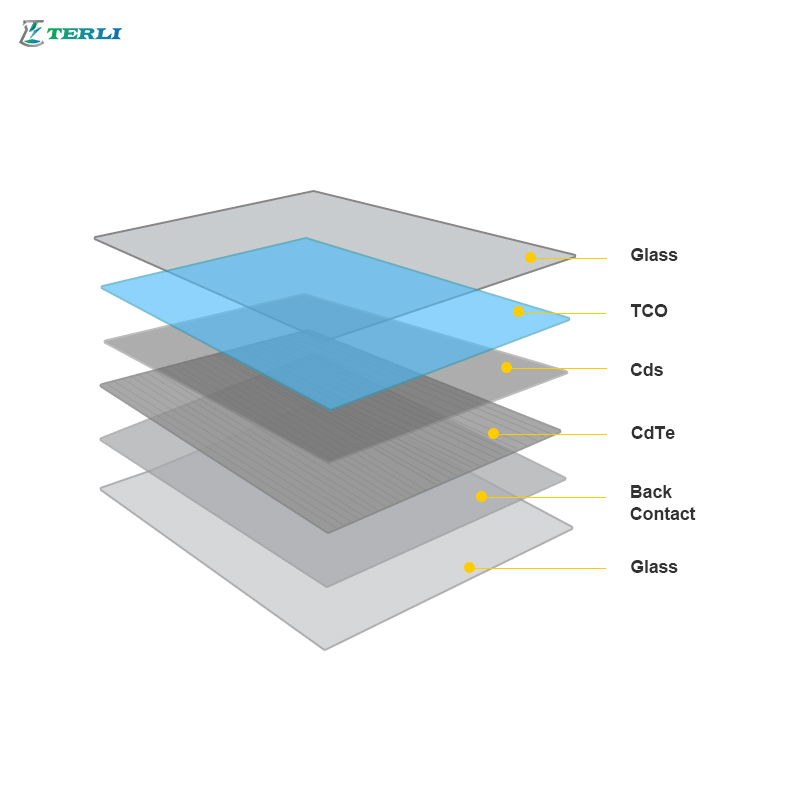
Cadmium Telluride (CdTe): Commercial module efficiency 18–22% (First Solar Series 6 Pro, 2024). CdTe is the leading thin-film technology by installed capacity. Its uniform dark appearance and superior performance in diffuse light make it attractive for large commercial BIPV facades.
Copper Indium Gallium Selenide (CIGS): Laboratory record efficiency 23.6% (Source: NREL); commercial BIPV products typically 14–18%. CIGS can be deposited on flexible substrates, enabling rollable roofing membranes and curved facade applications.
Amorphous Silicon (a-Si): Efficiency 6–12% — the lowest of the three — but excellent for semi-transparent applications. a-Si films can be tuned to various transparency levels and tints, making them well-suited to BIPV glazing where aesthetic color customization is required.
Thin-film technologies generally show better high-temperature performance than crystalline silicon (lower temperature coefficient), partially offsetting the thermal disadvantage of BIPV’s restricted airflow.
Emerging Technologies: Perovskite & OPV
Two emerging photovoltaic technologies are advancing toward BIPV commercial deployment:
Perovskite Solar Cells have achieved laboratory efficiencies exceeding 25% (NREL certified record, 2024), with tandem perovskite-silicon cells surpassing 33%. Commercial BIPV products using perovskite are expected to enter the market between 2026 and 2028, with initial efficiencies around 18–22%. The primary remaining challenges are long-term stability (current commercial-grade modules demonstrate 15–20 year lifetimes under accelerated testing) and lead-content regulations in some markets. Perovskite’s ability to be tuned to a wide range of colors and transparency levels makes it particularly exciting for BIPV glazing applications.
Organic Photovoltaics (OPV) use carbon-based semiconductor materials printed or coated onto substrates. OPV’s key BIPV advantages are high transparency (available in a wide visible spectrum palette), extremely lightweight construction, and processability on large flexible substrates. Current commercial OPV efficiency stands at 12–15% (Source: Heliatek GeoPower product datasheet). The main limitation is durability: OPV modules typically carry 10–15 year product warranties, compared to 25–30 years for crystalline silicon. Heliatek is the leading commercial OPV supplier for building applications, with installations on commercial and industrial roofs in Europe.
Technology
Efficiency Range
Transparency
Flexibility
Typical Lifespan
BIPV Best Use
Mono-Si (c-Si)
20–24%
Opaque
Rigid
25–30 yr
Roofing tiles, opaque facades
Poly-Si (c-Si)
17–20%
Opaque
Rigid
25–30 yr
Opaque facades (cost-driven)
CdTe thin-film
18–22%
Opaque
Semi-rigid
25+ yr
Large commercial facades
CIGS thin-film
14–18%
Low
Flexible
20–25 yr
Curved roofs, membranes
a-Si thin-film
6–12%
5–40%
Flexible
15–20 yr
Tinted glazing, skylights
Perovskite
18–22%*
Tunable
Flexible*
15–20 yr*
Glazing, facades (* emerging)
OPV
12–15%
High
Very flexible
10–15 yr
Transparent facades, skylights
Applications of BIPV: Roofs, Facades, Glazing & More
BIPV’s ability to serve as both building material and power source makes it applicable across a wide spectrum of building types and infrastructure categories.
Commercial Buildings
Commercial buildings represent the largest and most economically viable BIPV market segment. Large south-facing facades on office towers, retail centers, and industrial facilities can host substantial BIPV installations. A well-designed BIPV system covering the available facade and roof area of a typical mid-rise commercial building can contribute 10–40% of annual electricity demand, depending on building type (energy intensity), geographic location, and available sun-facing surface area (Source: IEA PVPS Report Task 15; estimates vary by building type).
High-rise office buildings with glass curtain walls present an ideal opportunity: the building’s skin already requires an expensive glazing system, and BIPV glazing replaces that cost while adding generation capacity. Commercial projects also benefit from the federal Investment Tax Credit (ITC) and accelerated depreciation under the Modified Accelerated Cost Recovery System (MACRS).
Residential Homes
For residential applications, BIPV most commonly takes the form of solar roofing tiles or shingles replacing a conventional roof. A typical 2,000 sq ft U.S. home with a south-facing roof in a moderate-climate zone (e.g., Denver or Atlanta) can install 4–8 kWp of BIPV roofing capacity, sufficient to meet approximately 60–80% of average household electricity consumption (Source: DOE SunShot Initiative data; estimates vary by climate and consumption). In high-irradiance states such as Arizona or California, coverage rates above 80% are achievable with available roof area.
BIPV is particularly compelling for homeowners who are replacing an aging roof: the incremental cost of the solar capability over a conventional roof replacement is lower than purchasing a new roof plus a separate rooftop PV system.
Historic & Heritage Buildings
Historic buildings present a unique BIPV opportunity and challenge. Conservation authorities in many jurisdictions prohibit rack-mounted solar panels on heritage structures due to visual impact. Thin-film BIPV and BIPV glazing can integrate solar generation with minimal visual disruption to historic facades.
In the UK, Historic England has published guidance endorsing carefully designed BIPV for heritage buildings, particularly using in-roof or flush-mounted systems that preserve the roofline profile. Projects in continental Europe — notably in Germany, the Netherlands, and Belgium — have successfully incorporated semi-transparent BIPV glazing into listed buildings with conservation authority approval. These projects typically require pre-application consultation with planning authorities and use of color-matched or custom-tinted modules.
Transportation & Infrastructure
Beyond buildings, BIPV technology has been applied to transportation infrastructure:
Solar Canopies at Transit Stations: Rail platforms and bus stations use BIPV canopies to shelter passengers while generating electricity for station lighting and operations.
Highway Noise Barriers: Several European countries have piloted BIPV noise barriers along motorways, where the vertical wall orientation and large surface area offer viable energy yields.
Solar Cycle Paths: The Netherlands’ SolaRoad project — a solar bicycle path in operation since 2014 — has demonstrated real-world performance in a pavement context, generating measurable electricity while sustaining heavy cycle traffic (Source: SolaRoad/TNO operational reports).
Net-Zero Buildings & Green Certifications
BIPV is a key enabling technology for net-zero energy buildings (NZEBs) and green building certifications:
LEED v4: BIPV contributions are eligible under the Energy & Atmosphere Optimize Energy Performance credit, potentially contributing up to 5 additional points for on-site renewable energy generation. BIPV’s material replacement value can also contribute to Materials & Resources credits.
BREEAM Excellent/Outstanding: The Ene 04 credit rewards on-site low-carbon energy generation. BIPV systems that reduce regulated energy consumption qualify for this credit, supporting the Excellent (70%+) and Outstanding (85%+) achievement levels.
EDGE Certification: The World Bank’s EDGE green building standard for emerging markets includes on-site renewable energy as a pathway to the required 20% energy reduction threshold.
Advantages and Disadvantages of BIPV
A balanced assessment of BIPV is essential for sound investment decisions. The technology offers compelling benefits but also carries real limitations that every project team must evaluate honestly.
Key Advantages of BIPV
1. Dual Economic Value BIPV replaces conventional building materials — glass, metal cladding, roofing tiles — that would be purchased regardless of the solar investment. This material substitution offsets a portion of the BIPV system cost. For a new commercial project, BIPV facade panels replace a conventional curtain wall system that might cost $80–150/m²; the net additional investment for the photovoltaic capability is lower than the gross system cost suggests. NREL economic analysis indicates that well-designed residential BIPV projects carry a net additional investment of approximately $5,000–20,000 over the combined cost of a conventional roof replacement plus separate solar PV system.
2. Architectural Aesthetics BIPV eliminates the visual bulk of rack-mounted panels — no aluminum rails, no tilt frames, no penetrations through finished roofing. Manufacturers including Onyx Solar, Fassadenkraft, and AGC Solar offer custom colors, transparency levels, and module geometries that integrate with architectural intent rather than compromising it. For signature buildings, LEED Platinum targets, or projects in design-sensitive locations, this aesthetic advantage is often decisive.
3. Reduced Carbon Footprint The lifecycle carbon intensity of a BIPV system — from manufacturing through 25 years of operation — is approximately 20–50 gCO₂eq/kWh, compared to approximately 450 gCO₂eq/kWh for natural gas-fired generation and 820 gCO₂eq/kWh for coal (Source: IEA PVPS LCA Task; IPCC AR6). In addition, BIPV partially replaces the embodied carbon of conventional building materials, providing a double carbon benefit in new construction.
4. Urban Heat Island Mitigation Dark BIPV roofing systems absorb solar radiation for electricity generation rather than re-radiating it as heat into the urban environment. Research from Lawrence Berkeley National Laboratory (LBNL Heat Island Group) has measured BIPV rooftops running 8–15°C cooler than conventional dark asphalt roofing under peak summer conditions — a meaningful contribution to urban cooling in dense city environments.
Key Disadvantages & Challenges of BIPV
1. High Upfront Cost BIPV carries a significant cost premium over both conventional building materials and rack-mounted BAPV systems. Installed costs of $4–15/W (depending on BIPV type) compare unfavorably to BAPV at $2.50–4.00/W. Residential BIPV payback periods typically range from 12–20 years in temperate climates, compared to 7–12 years for BAPV — a material difference for owner-occupiers with shorter investment horizons.
2. Maintenance and Replacement Complexity When a BIPV module fails or is damaged, replacement requires work on the building envelope itself — not simply swapping a panel on a rack. A cracked BIPV roof tile may require roofing contractor coordination alongside an electrical technician. A failed BIPV curtain wall unit may require scaffolding and specialist glazing contractors. Manufacturers are addressing this through modular “plug-and-play” designs with standardized electrical connectors, but replacement costs remain higher than for rack-mounted systems.
3. Efficiency Losses from Thermal Constraints As detailed in the technology section, BIPV’s restricted airflow leads to elevated operating temperatures and efficiency penalties of 3–10% relative to rated output. Over a 25-year system life, this cumulative energy loss is a real economic factor — a 7% annual yield reduction on a 100 kWp system represents roughly 7,000 kWh/year in unrealized generation.
4. Design and Installation Complexity A BIPV project requires coordinated input from the architectural team, structural engineer (loading calculations), electrical engineer (NEC 690 compliance), and the BIPV manufacturer’s technical team — plus the general contractor and specialist installer. In many U.S. markets, contractors with BIPV installation experience are scarce, extending project timelines and introducing quality risks. Proper design integration is non-negotiable: BIPV installed incorrectly can compromise both the building envelope’s weather performance and the electrical system’s safety.
BIPV Cost & Pricing: What to Expect
BIPV costs vary substantially by system type, building application, and project scale. This section provides current price ranges, a comparison with conventional building materials, available incentives, and a worked ROI example.
Cost by BIPV Type
The table below summarizes 2025 installed cost ranges for each major BIPV category:
BIPV Type
Module Cost
Installed Cost
Notes
Solar Roof Tiles/Shingles
$3–8/W (module only)
$21–35/sq ft
Tesla Solar Roof ~$21.85/W installed (full roof)
BIPV Facade Panels (opaque)
$8–20/sq ft (module)
$30–80/sq ft
Includes structural framing and weatherproofing
BIPV Glazing (semi-transparent)
$30–80/sq ft (module)
$50–150/sq ft
Highly dependent on transparency level and custom specs
BIPV Canopy/Carport
$2–4/W (module)
$3–6/W installed
Simpler structural integration than building facades
Thin-Film Roofing Membrane
$1.50–3/W (module)
$3–5/W installed
Best suited to large flat commercial roofs
Sources: EnergySage 2025; manufacturer public pricing; NREL cost benchmarks. All figures USD, estimates vary by project scope and location.
BIPV vs. Conventional Building Materials: Is the Premium Worth It?
The correct financial comparison for BIPV in new construction is not “BIPV vs. BAPV” but “BIPV vs. conventional building material + separate PV system.” When evaluated this way, the economics improve substantially.
A BIPV glass curtain wall costs approximately 30–50% more than a standard architectural glass curtain wall system of equivalent specification. However, this premium eliminates the need for a separate rack-mounted solar installation, which for a commercial building would typically cost $1.80–3.00/W installed. The net additional investment for the photovoltaic capability — after crediting the conventional material cost — for a residential project is typically $5,000–20,000, and for commercial projects the economics scale with facade area and local electricity rates (Source: NREL BIPV economic analysis; Dodge Data construction cost database).
The payback calculation must also account for the avoided cost of conventional building materials. A project team replacing a failing curtain wall system is not comparing BIPV to “no curtain wall” — they are comparing it to a new conventional curtain wall plus (potentially) a separate solar installation.
Federal & State Incentives for BIPV
Federal Investment Tax Credit (ITC): BIPV systems installed on commercial or residential buildings in the United States qualify for the federal ITC at a rate of 30% of system cost through 2032, stepping down thereafter under the Inflation Reduction Act (IRA). The ITC applies to the full installed system cost, including modules, labor, inverters, and balance-of-system components. One important nuance: for BIPV glazing products, the IRS requires that the primary function of the component be electricity generation (not building material substitution) for full ITC eligibility. IRS Notice 2023-22 provides guidance; consult a tax professional for project-specific eligibility (Source: IRS; DOE SETO).
State and Utility Incentives: Many states offer additional solar incentives applicable to BIPV — including California’s Net Energy Metering (NEM 3.0), New York’s NY-Sun Megawatt Block incentive, Massachusetts SMART program, and various state property tax exemptions for solar systems. DSIRE (Database of State Incentives for Renewables & Efficiency) at dsireusa.org is the authoritative source for state-level incentives.
ROI & Payback Period Estimates
Commercial Example: A 1,000 m² south-facing BIPV facade on a commercial office building in Phoenix, AZ:
System installed cost: ~$400,000 (at $40/sq ft mid-range)
Annual energy generation: ~100,000 kWh (based on NREL PVWatts: Phoenix irradiance ~5.5 peak sun hours/day, 15% system efficiency, 10% performance derating)
After 30% federal ITC ($120,000 credit): Net cost $280,000; payback ~23 years
With MACRS 5-year depreciation: Effective payback for a taxpaying entity approximately 15–18 years
Residential Example: Tesla Solar Roof on a 2,000 sq ft home in San Diego, CA:
System cost: ~$65,000 (240 sq ft active solar tiles; full roof replacement)
Annual generation: ~9,500 kWh
Residential electricity rate: ~$0.30/kWh (California residential average 2024)
Annual savings: ~$2,850
After 30% ITC ($19,500 credit): Net cost $45,500; payback ~16 years
Get a Custom BIPV Quote for Your Project → /contact/
BIPV System Design Process: 11-Step Guide
Designing a BIPV system requires coordinated input across architecture, structural engineering, electrical engineering, and energy modeling disciplines. The following 11-step process — adapted from the Whole Building Design Guide (WBDG) framework and refined with current best practices — provides a complete design roadmap.
Project Feasibility Assessment — Evaluate building orientation (south, east, west facade availability), shading analysis (neighboring structures, trees, overhangs), and net solar-accessible surface area. Tools: NREL PVWatts Calculator (free), Google Sunroof (residential), Helioscope (commercial), or SketchUp with solar analysis plugins.
Energy Needs Analysis — Collect 12 months of utility bills to establish baseline annual electricity consumption (kWh). Set a BIPV coverage target (e.g., “offset 50% of annual consumption”) that drives system sizing. Identify peak demand and time-of-use rate structures to optimize self-consumption.
Select BIPV System Type — Based on building type, available surfaces, architectural requirements, and budget, select from roofing tiles, facade panels, glazing, or canopy systems. For new construction, this decision happens at schematic design stage in coordination with the architect of record.
Select PV Technology — Choose the photovoltaic technology (crystalline silicon, thin-film, semi-transparent) based on efficiency requirements, transparency needs, color/aesthetic preferences, and surface geometry. Review manufacturer product datasheets for efficiency, temperature coefficient, warranty terms, and IEC certification status.
System Size Calculation — Use the formula: Required area (m²) = Target annual generation (kWh) ÷ Annual peak sun hours ÷ Module efficiency (decimal). For example: 50,000 kWh target ÷ 1,825 peak sun hours (Phoenix) ÷ 0.18 efficiency = ~152 m² required.
Structural Engineering Assessment — BIPV modules add dead load to the building structure. Standard BIPV glass facade panels weigh approximately 15–25 kg/m² (including glass substrate and framing); thin-film membranes are lighter at 3–7 kg/m². A licensed structural engineer (PE stamp required in most U.S. jurisdictions) must verify that the existing or planned structure can support BIPV loads per ASCE 7 load combinations. Wind uplift forces on facade BIPV panels can be significant and must be assessed per local wind zone.
Electrical System Design — Specify inverter type (string, micro, or central), conductor sizing, conduit routing, overcurrent protection, and rapid shutdown compliance. All PV electrical systems in the U.S. must comply with NEC Article 690 (Solar Photovoltaic Systems). The 2023 NEC edition includes updated requirements for microinverter systems, energy storage integration (Article 706), and arc-fault circuit interrupter (AFCI) protection for PV circuits.
Fire Safety and Building Code Compliance — Verify that selected BIPV roofing products carry UL 790 Class A (or B/C as required by local code) fire resistance ratings. BIPV facade systems on buildings over 40 feet in height must comply with NFPA 285 (Standard Fire Test for Exterior Wall Systems). Obtain confirmation from the AHJ (Authority Having Jurisdiction) on applicable fire code requirements before specifying products.
Permit Applications and Grid Interconnection — Submit building permit drawings (architectural + electrical) to the local building department. Simultaneously initiate the utility interconnection application — the process for a net-metering agreement typically takes 4–12 weeks for residential systems and 3–6 months for commercial projects. Confirm local grid export limits with the utility before finalizing system sizing.
Construction and Installation — Coordinate the general contractor, BIPV manufacturer’s installation team (most manufacturers require or recommend factory-trained installers), and electrical contractor. Typical installation sequence: structural substrate preparation → weatherproofing/flashing → BIPV module installation → electrical wiring and conduit → inverter and monitoring equipment → utility interconnection.
Commissioning, Testing & Monitoring Activation — Conduct IEC 62446-1 commissioning tests: insulation resistance (IR) testing of all string circuits, I-V curve measurement to verify module and string performance against rated values, and performance ratio (PR) baseline measurement. Activate the monitoring system and establish PR benchmarks for ongoing performance tracking. PR values below 0.75 indicate investigation is warranted.
BIPV products and installations must satisfy multiple overlapping regulatory frameworks — international product standards, U.S. electrical codes, and building codes. The table below summarizes the primary standards applicable to U.S. BIPV projects.
Standard
Type
Issuing Body
Scope
IEC 61215
Product qualification
IEC
Design qualification for crystalline silicon PV modules
IEC 61646
Product qualification
IEC
Design qualification for thin-film PV modules
IEC 61730
Safety qualification
IEC
Safety qualification for all PV module types
UL 61730
Safety certification
UL
U.S. harmonized version of IEC 61730 (replaces UL 1703)
UL 790
Fire resistance
UL
Fire classification for roof covering systems
UL 2703
Mounting systems
UL
Racking and mounting systems for PV modules
NEC Article 690
Electrical installation
NFPA
U.S. electrical code for solar PV systems
IBC Chapter 16
Structural loads
ICC
Structural load requirements for building elements
IRC Section R324
Residential PV
ICC
Residential building code for solar energy systems
LEED v4.1 EA Credit
Green certification
USGBC
On-site renewable energy contribution to LEED score
BREEAM Ene 04
Green certification
BRE
Low-carbon energy generation credit
International Standards (IEC)
IEC 61215 (crystalline silicon) and IEC 61646 (thin-film) define the design qualification test sequence for PV modules — including thermal cycling, damp heat, UV exposure, mechanical load, and hail impact testing. IEC 61730 adds a safety qualification layer covering electrical safety, fire resistance, and mechanical robustness. Together, these three standards form the baseline product certification required for any BIPV component entering major global markets.
An important note for BIPV: standard IEC module tests were designed for rack-mounted panels. IEC Technical Committee 82 has been developing BIPV-specific addenda (IEC TS 63092 series: Photovoltaics in Buildings) that address the additional requirements of building-integrated applications — including water tightness, structural load performance, and fire testing relevant to building envelope integration.
US Standards (UL, NEC)
UL 61730 (the U.S. harmonized version of IEC 61730) has replaced UL 1703 as the primary U.S. safety standard for PV modules. The transition period ended in 2022; all new BIPV products entering the U.S. market must carry UL 61730 listing. UL 2703 covers the mounting and racking systems used to attach BIPV modules to building structures.
NEC Article 690 governs all PV electrical system installations in the U.S. The 2023 NEC edition includes specific provisions for rapid shutdown (Section 690.12), ground-fault protection, arc-fault circuit interruption, and energy storage integration. Most U.S. jurisdictions have adopted the 2020 or 2023 NEC; a few states remain on older editions.
Building Codes (IBC, IRC)
In the U.S., BIPV installations must comply with the International Building Code (IBC) for commercial projects and the International Residential Code (IRC) for single-family homes. IBC Chapter 16 covers structural load requirements including dead loads, wind loads, and seismic loads — all relevant to facade-mounted BIPV. IRC Section R324 specifically addresses solar energy systems on residential structures and specifies fire classification, structural attachment, and electrical requirements.
Green Building Certifications (LEED, BREEAM)
LEED v4.1 awards points under the Energy and Atmosphere “Renewable Energy Production” credit for on-site generation. BIPV systems contributing at least 1% of total building energy can earn 1–3 points, with higher contributions earning more. BREEAM’s Ene 04 credit similarly rewards buildings that generate renewable energy on site, with the credit weighting contributing to the overall BREEAM score — supporting the Excellent (70%) and Outstanding (85%) rating thresholds most relevant to BIPV-equipped commercial buildings.
Fire Safety in BIPV Systems
Fire safety is a non-negotiable compliance requirement for any BIPV installation. BIPV’s integration into the building envelope — particularly on roofs and facades — introduces fire hazard considerations distinct from rack-mounted solar systems.
Fire Ratings for BIPV Roofing (UL 790)
UL 790 defines three fire resistance classes for roof covering systems:
Class A: Effective against severe fire exposure. Required by most U.S. building codes for all new residential and commercial roofing in wildfire-risk areas (California, for example, mandates Class A for nearly all buildings). Tesla Solar Roof has achieved UL 790 Class A certification.
Class B: Effective against moderate fire exposure. Acceptable for lower-risk applications in many jurisdictions.
Class C: Effective against light fire exposure. Some thin-film BIPV roofing membranes fall in this category; verify with the local AHJ whether Class C is acceptable for the specific project.
BIPV facade systems are not subject to UL 790 (a roofing standard) but must comply with NFPA 285 (Standard Fire Test Method for Evaluation of Fire Propagation Characteristics of Exterior Wall Assemblies) for buildings over 40 feet in height. NFPA 285 testing evaluates the entire facade assembly — substrate, insulation, BIPV panels, and attachment system — as an integrated unit. Manufacturers must provide NFPA 285 test reports for their facade BIPV assemblies.
Rapid Shutdown Requirements for BIPV (NEC 690.12)
NEC Article 690.12 requires that rooftop PV systems implement rapid shutdown — reducing PV circuit conductors to 30 volts or less within 30 seconds of rapid shutdown initiation — to protect firefighters working on or near an energized PV roof. This requirement was introduced in the 2014 NEC and has been progressively strengthened.
BIPV creates a unique rapid shutdown challenge: because BIPV modules are integrated into the roof structure, there is no simple way to physically remove or reposition them during a fire. Rapid shutdown systems (RSS) for BIPV typically use module-level power electronics (MLPEs — microinverters or DC power optimizers with integrated shutdown capability) to de-energize individual modules. Project teams must specify compliant MLPE products and verify system design with the AHJ before installation.
Additionally, some U.S. jurisdictions and fire departments require a minimum 3-foot setback from roof ridges and edges for BIPV roofing, providing a clear path for firefighter access. These setback requirements apply regardless of the rapid shutdown system and must be incorporated into BIPV layout design.
The combustion properties of EVA (ethylene vinyl acetate) — the most common encapsulant in crystalline silicon BIPV modules — should also be noted: at elevated temperatures, EVA can release acetic acid vapors. Newer POE (polyolefin elastomer) encapsulants offer improved fire performance and are increasingly specified for BIPV applications in fire-sensitive contexts.
Real-World BIPV Project Examples
Real project data grounds the cost and performance numbers discussed throughout this guide. The following examples span commercial, residential, historic, and infrastructure BIPV applications.
Commercial BIPV Projects
EDGE Amsterdam West, Netherlands EDGE Technologies’ Amsterdam West office campus integrates BIPV across approximately 2,800 m² of south-facing facade and roof area. The system generates an estimated 350,000 kWh annually — meeting approximately 10% of the building’s total electricity consumption. The building achieved BREEAM Outstanding certification, with the BIPV system contributing to the Ene 04 credit (Source: EDGE Technologies project report).
Bullitt Center, Seattle, WA, USA The Bullitt Center — designed to Living Building Challenge standards — uses a rooftop BIPV array of 575 kWp to achieve net-positive energy status on an annual basis. The system generates more electricity than the six-story commercial office building consumes, with surplus exported to the grid. The building’s highly efficient design (EUI of ~16 kBtu/sq ft/yr, vs. a U.S. commercial average of ~90) makes net-positive operation achievable with a realistic BIPV array size.
Residential BIPV Projects
California LEED Platinum Residence (San Diego, CA) A custom home designed for LEED Platinum certification incorporated Tesla Solar Roof tiles across 240 sq ft of south-facing roof area. System installed cost: approximately $65,000. Annual generation: ~9,500 kWh. At California’s average residential electricity rate of ~$0.30/kWh, annual savings approximate $2,850. After the 30% federal ITC credit ($19,500), net cost is ~$45,500, yielding a simple payback of approximately 16 years (Source: project data via EnergySage case study database).
Historic Building BIPV Projects
Keble College, University of Oxford, UK A sensitive BIPV installation on the Grade II listed Victorian Gothic buildings of Keble College integrated approximately 77 kWp of in-roof BIPV panels, generating an estimated 60,000 kWh annually. The project required close collaboration with Oxford City Council’s conservation officers and Historic England. Flush-mounted, dark-framed modules were specified to minimize visual impact on the ornate Victorian brickwork — demonstrating that heritage building constraints can be navigated with careful module selection and stakeholder engagement (Source: Historic England case studies; Onyx Solar project portfolio).
Infrastructure & Transportation BIPV
Zurich Airport, Switzerland — BIPV Facade Zurich Airport integrates BIPV across portions of its terminal facade, with a combined installed capacity exceeding 1 MW. The airport’s south-facing glass facade panels generate electricity for terminal operations while maintaining transparency for passenger daylighting — a flagship example of large-scale commercial BIPV in a high-traffic public building.
SolaRoad, Krommenie, Netherlands The world’s first public solar bicycle path, opened in 2014, embedded crystalline silicon cells in tempered glass road surface panels. Over seven years of operation, the path generated measurable electricity while sustaining millions of bicycle passes. Real-world efficiency measured approximately 70% of equivalent rooftop capacity, constrained primarily by horizontal orientation and surface soiling (Source: TNO/SolaRoad operational data). The project provided invaluable data on BIPV flooring durability and maintenance requirements for future infrastructure applications.
BIPV Market Trends & Future Outlook
The BIPV market is entering a period of accelerated growth, driven by tightening building energy codes, falling technology costs, and expanding green building mandates globally.
Global BIPV Market Size & Growth
The global BIPV market was valued at approximately $3.7 billion in 2023 and is projected to reach $18.9 billion by 2032, growing at a compound annual growth rate (CAGR) of approximately 19.6% (Source: Grand View Research; MarketsandMarkets BIPV market report 2024). This growth rate substantially exceeds the broader solar PV market (CAGR ~9–12%), reflecting the accelerating intersection of construction activity, renewable energy mandates, and architectural integration demand.
Regional breakdown:
Europe: Approximately 35% of global BIPV market, led by Germany, the Netherlands, France, and Switzerland. European growth is driven by the EU Energy Performance of Buildings Directive (EPBD) and strong green building certification markets.
Asia-Pacific: Fastest-growing region (CAGR ~23%), led by China’s large new construction volume, Japan’s solar mandate programs, and South Korea’s green building incentives.
North America: Strong growth supported by the U.S. Inflation Reduction Act (IRA), which extended the 30% ITC through 2032 and introduced new manufacturing tax credits favoring U.S.-made BIPV components.
Key Market Drivers
Three macro forces are driving BIPV market expansion through the late 2020s:
EU Energy Performance of Buildings Directive (EPBD 2024): The revised EPBD, adopted in 2024, requires all new buildings in EU member states to achieve near-zero energy performance (nZEB) standard by 2028 for commercial and 2030 for residential. New public buildings larger than 250 m² must incorporate solar installations (including BIPV-eligible systems) by 2026. This regulatory driver is expected to be the single largest demand catalyst for European BIPV over the next five years (Source: EU Official Journal, EPBD Directive 2024/1275).
Falling Technology Costs: BIPV module costs have declined approximately 60% over the past decade, broadly tracking the decline in standard PV module costs. Thin-film and semi-transparent BIPV products — historically the most expensive — have seen the fastest cost reductions as manufacturing scale has increased.
Carbon Neutrality Targets: Corporate net-zero commitments and national carbon neutrality targets (EU 2050, U.S. 2050, China 2060) are driving demand for building-integrated renewable generation in commercial real estate portfolios.
Emerging Technologies to Watch
Perovskite BIPV: Perovskite solar cells are approaching commercial viability for BIPV applications, with multiple manufacturers targeting 2026–2028 product launches. The technology’s color tunability and processability on flexible substrates make it particularly well-suited to BIPV glazing and facade applications. Key remaining milestones: field-proven 20-year stability data and lead-free formulations meeting European RoHS regulations.
BIPV + BESS Integration: Building-integrated storage (battery energy storage systems co-designed with BIPV) is emerging as a premium market segment, enabling higher self-consumption ratios, demand charge management, and resilience during grid outages. Systems combining BIPV facade generation with building-integrated battery walls are in early commercial deployment in Scandinavia and Germany.
BIM-Integrated BIPV Design: Building Information Modeling (BIM) platforms — particularly Autodesk Revit — are adding BIPV-specific object libraries and energy simulation capabilities that allow architects to model BIPV performance at the design development stage rather than as a post-design add-on. This integration reduces design coordination friction and is expected to accelerate BIPV adoption in the architecture community.
BIPV (Building-Integrated Photovoltaics) is a solar energy technology where photovoltaic materials are incorporated directly into the building envelope — including roofs, facades, windows, and canopies — functioning simultaneously as a building material and an electricity generator. Unlike conventional rack-mounted solar panels (BAPV) that are added onto a building after construction, BIPV components replace conventional building materials such as glass, roofing tiles, or cladding panels, performing a dual structural and energy-generating role.
What is the difference between PV and BIPV?
Conventional PV (photovoltaics), often called BAPV (Building-Attached PV), refers to solar panels installed on racking systems mounted on top of an existing building roof or wall — they are an addition to the building structure. BIPV (Building-Integrated PV) means the solar cells are embedded within the building material itself, replacing conventional components. BIPV costs more upfront but offers superior aesthetics, eliminates rack-mounting hardware, and substitutes the cost of conventional building materials. BAPV typically offers a higher energy yield per dollar and shorter payback period for retrofit applications.
What is the 33% rule in solar panels?
The “33% rule” refers to a grid export limitation applied by some regional network operators — most notably in South Australia and parts of the UK — that restricts a solar system’s grid export capacity to no more than 33% of the local transformer’s rated capacity. This rule is designed to prevent voltage rise on low-voltage distribution networks. It is not a universal standard and does not apply in most U.S. states, where individual utility interconnection agreements govern export limits. Any BIPV project designed to export surplus generation should verify local network operator export policies before finalizing system sizing.
What is BIPV glass?
BIPV glass is architectural glazing with photovoltaic cells integrated into the glass structure — either as a thin-film coating, crystalline silicon cells embedded in a laminated glass interlayer, or organic PV films. BIPV glass products offer visible light transmittance (VLT) ranging from 5% (nearly opaque) to 50% (lightly tinted), allowing designers to balance natural daylighting, solar shading, and on-site electricity generation in curtain walls, skylights, atriums, and windows. Leading manufacturers include Onyx Solar, AGC Solar, Metsolar, and Brite Solar.
How much does BIPV cost compared to regular solar panels?
BIPV system costs range from approximately $4–15 per watt installed, depending on system type — substantially higher than rack-mounted BAPV at $2.50–4.00/W. However, BIPV partially offsets the cost of conventional building materials (glass curtain wall, roofing tiles, cladding panels) it replaces. For new construction projects, the net additional investment for BIPV capability — after crediting the displaced material cost — is typically $5,000–20,000 for residential scale. The U.S. federal Investment Tax Credit (30% through 2032) significantly improves the economics for qualifying BIPV installations.
What are the main types of BIPV systems?
BIPV systems are classified into five main types based on their building element integration: (1) BIPV Roofing — solar shingles and tiles replacing conventional roofing materials; (2) BIPV Facades & Cladding — photovoltaic panels integrated into vertical exterior walls; (3) BIPV Glazing & Windows — semi-transparent PV modules in architectural glass; (4) BIPV Canopies & Skylights — overhead solar structures including parking canopies and skylights; (5) BIPV Flooring & Pavements — emerging PV-integrated walking and driving surfaces. Each type has different efficiency, cost, and aesthetic characteristics suited to different project contexts.
Is BIPV worth the investment?
For new commercial construction, BIPV generally delivers positive ROI when the building material substitution credit is factored in — particularly for projects pursuing LEED Platinum or BREEAM Outstanding certification where BIPV contributes meaningful green certification points alongside energy savings. For residential applications, payback periods of 12–20 years are typical in temperate climates, which is longer than conventional solar (7–12 years). BIPV is best evaluated not as a standalone energy investment but as part of a holistic building design decision that values aesthetics, sustainability certification, and long-term energy cost reduction. For retrofit projects on existing buildings, BAPV typically offers a better financial return; reserve BIPV for new construction or complete envelope replacement.
What is BIPVT (Building-Integrated Photovoltaic-Thermal)?
BIPVT is a hybrid technology that combines building-integrated solar electricity generation with active heat capture. In a BIPVT system, the heat absorbed by the solar cells — which would otherwise be lost as waste heat — is captured by a fluid circuit (air or water) circulating behind the PV layer and used for space heating or domestic hot water. Total energy efficiency of a BIPVT system can reach 60–80% (electrical + thermal), compared to approximately 15–22% for electricity alone from a standard BIPV module. BIPVT is most economically attractive in cold-climate applications (Scandinavia, Canada, northern Europe) where both electricity and heating demand are high.
Get a Custom BIPV Quote for Your Project → /contact/