Crystalline silicon modules are the main choice in solar.
Amorphous silicon pv glass is growing fast and gives more design choices.
Feature
Crystalline PV Glass
Amorphous Silicon PV Glass
Installed Power per Square Foot
Higher (more than twice in direct sunlight)
Lower
Energy Production on Overcast Days
Lower
Higher
Design Flexibility
Customizable in shape
Customizable for architecture
Application Suitability
Best for maximum energy generation
Best for thin films and unique surfaces
Temperature Performance
Strong under direct sunlight
Strong in high heat and cloudy weather
You should think about what is most important: efficiency, cost, durability, or flexibility.
Key Takeaways
Crystalline PV glass works better and makes more energy when it is sunny. This helps get the most power from the sun.
Amorphous silicon PV glass can bend and fit different shapes. It is good for buildings with curves or special designs.
Think about your weather before picking panels. Amorphous silicon works well when it is not very bright or when it is hot. Crystalline works best when the sun is shining directly.
Crystalline PV glass usually saves more money over time. It makes more power and costs less to make.
Look at what your project needs. Pick crystalline if you want more energy and strong panels. Pick amorphous if you want cool designs or need panels that work in low light.
Efficiency & Output
Crystalline PV Glass Efficiency
Crystalline pv glass is known for being very efficient. Many solar projects use it because it gives strong and steady energy. Monocrystalline panels usually work at 20% to 23% efficiency. Polycrystalline panels are a bit lower, at 15% to 17%. The best monocrystalline panels can reach 24.8% efficiency. This means you get more power from each square foot.
Type of Panel
Efficiency (%)
Power Output (Watts)
Monocrystalline
20-23
300-550
Polycrystalline
15-17
300-400
Crystalline pv glass uses special silicon cells to make more power. This technology has been used for a long time and keeps getting better. It is a good choice for big solar projects that need lots of energy. Most solar panels in the world use crystalline pv glass. It gives a good mix of efficiency, power, and lasting performance.
Amorphous Silicon PV Glass Efficiency
Amorphous silicon pv glass works differently. Its efficiency is usually between 6% and 12%. Some lab cells can reach 15%, but most big panels stay under 8%. These panels can work well in real life, especially if you need light or bendy solar panels.
Amorphous silicon pv glass does not make as much power per square foot as crystalline pv glass. But it has special uses. You can put it on curved places or where regular panels do not fit. This makes it good for custom solar designs, even if it is less efficient.
Performance in Low-Light
You might wonder how these panels work when it is cloudy. Crystalline pv glass is great in bright sun, but it does not do as well on cloudy days. Amorphous silicon pv glass keeps a steadier output when there is less sunlight. This means you get more even energy when the weather is not sunny.
Crystalline pv glass gives more power per square foot in strong sunlight. Amorphous silicon pv glass works better in shade or on cloudy days. This can help you pick the right panel for your needs.
Tip: If you want the most energy from a small area, pick crystalline pv glass. If you want steady power in low light or need flexible panels, amorphous silicon pv glass is a good choice.
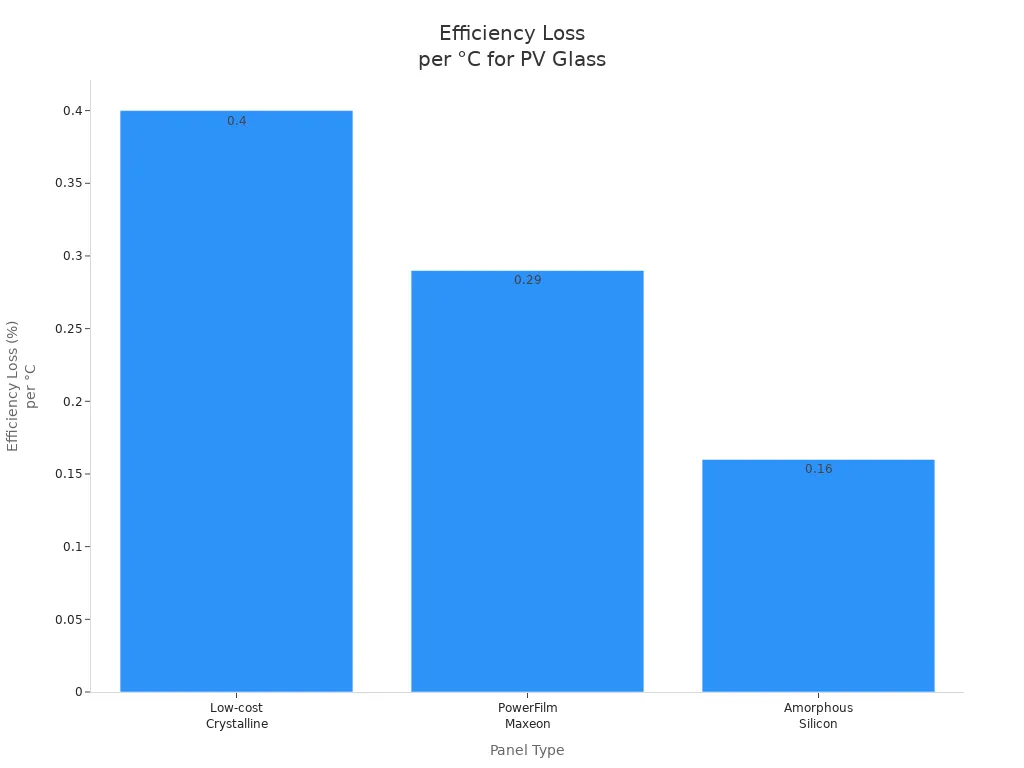
You should also think about how heat changes efficiency. Crystalline pv glass loses about 0.40% efficiency for each degree Celsius it gets hotter. Amorphous silicon pv glass only loses 0.16%. This means amorphous silicon pv glass keeps its power more steady when it is hot.
Durability & Heat Performance
Weather Resistance
You want your solar panels to last through storms, hail, and rain. Crystalline PV glass and amorphous silicon PV glass both offer strong weather resistance, but there are some differences. Thicker glass panels protect better against hail. For example, a 4 mm thick panel only loses about 1.1% of its power after a hail impact. A 3.2 mm panel loses 11.74%, and a 2.8 mm panel loses 21.8%. If you live in a place with heavy hail, you should choose thicker panels for better protection.
Hailstone Size (mm)
Hailstone Weight (gm)
Hailstone Speed (m/s)
25–55
7.5–80
23–34
Both types of PV glass can handle strong winds and moisture. Manufacturers test these panels to make sure they work well in tough weather. Crystalline PV glass often uses thicker glass, which gives it an edge in harsh conditions. Amorphous silicon PV glass also stands up to weather, but you may need to check the thickness if you want the best protection.
These panels can still operate at 80% to 92% of their initial efficiency even after 25 years.
The IEC 61215 standard shows that crystalline PV glass can last a very long time, possibly up to 110 years in lab tests.
Tip: If you want your solar panels to last for decades, look for panels that meet the IEC 61215 standard.
Heat Tolerance
Heat can change how well your solar panels work. Crystalline PV glass loses about 0.40% efficiency for each degree Celsius the temperature rises. Amorphous silicon PV glass only loses about 0.16%. This means amorphous silicon PV glass keeps making power even when it gets hot outside.
You should think about your local climate. If you live in a hot area, amorphous silicon PV glass may give you more steady energy. Crystalline PV glass works well in most places, but it can lose more power on very hot days.
Amorphous silicon PV glass has a lower degradation rate in high heat.
Crystalline PV glass gives strong performance but loses more efficiency as temperatures climb.
Note: Both types of PV glass are built to last, but amorphous silicon PV glass handles heat better over time.
Cost & ROI
Crystalline Silicon PV Modules Cost
Crystalline silicon pv modules are much cheaper now than before. In 2010, they cost about $7.50 for each watt. By 2024, the price dropped to about $1 for each watt. This happened because factories got better and there is more competition. Governments also helped lower the price. Now, making crystalline silicon pv modules costs only $0.10 to $0.15 per watt. This makes crystalline silicon glass a favorite for many solar projects.
Making crystalline silicon pv modules does not cost much.
Amorphous silicon pv modules are more expensive to make. The average cost to make them is about $0.73 for each watt. This is more than crystalline silicon glass. You might also pay more to install them, especially if your project needs special shapes or curved panels. Amorphous silicon pv modules do not make as much power per square foot. You may need more panels to get the energy you want.
Amorphous silicon pv modules cost more to make.
Installation can cost more if you need custom shapes.
These panels work well in low light, but each watt costs more.
Type of Module
Manufacturing Cost per Watt
Crystalline silicon pv modules
$0.10–$0.15
Amorphous silicon pv modules
$0.73
ROI Comparison
Crystalline silicon glass usually gives you the best value for your money. You pay less for each watt and get more power from each panel. Over time, you save more on your energy bills. Crystalline pv glass lasts a long time, so you get clean energy for many years.
Amorphous silicon pv modules are good if you need flexible panels or want to cover curved places. You pay more at first, but you get steady power in low light and hot weather. If your project needs special shapes or faces tough weather, amorphous silicon pv modules can still give you good value.
Tip: If you want the lowest price and most power, pick crystalline silicon pv modules. If you need flexible designs or better power in low light, amorphous silicon pv modules might be better for you.
Application & Flexibility
Space & Design Needs
Think about your space and design before picking solar glass. Crystalline PV glass works best on big, flat places. You can put it on roofs or in solar farms. It also fits well in building-integrated photovoltaic systems. These panels use space well and give lots of energy each year. If you want to cover a large area and get lots of power, crystalline PV glass is a good pick.
Amorphous silicon glass lets you be more creative. You can use it on curved roofs or places where normal panels do not fit. This solar glass can bend and shape to match your building. You can put it on windows, walls, or even cars. Amorphous silicon glass is thin and light, so you can use it in many ways. You do not need a flat roof or perfect spot.
Tip: If you want a flexible solar option for a special building or a moving project, amorphous silicon glass is a smart choice.
Best Solar Applications
Each type of solar glass works best for different uses. Crystalline PV glass is great for:
Rooftops and city homes with little space or weak roofs.
Portable and mobile solar uses, like camping gear, boats, cars, and RVs. Its flexible design lets you put it on curved or moving places.
Pick crystalline PV glass for high-power bipv projects where you want the most energy and long life. Amorphous silicon glass is best for projects that need to bend, fit curves, or work well in low light. You can choose the right solar glass for your project to get the best results.
Picking crystalline or amorphous silicon photovoltaic glass depends on what your project needs. Check this table to help you compare:
Factor
Crystalline PV Glass
Amorphous Silicon PV Glass
Efficiency
Higher efficiency, good for small spaces
Lower efficiency, may need more panels
Budget
Usually costs more
Often costs less at first
Environmental Factors
Works well in many climates
Does better in hot weather
Aesthetics
Looks sleek and modern
Has a classic bluish color
If you want the most energy and long-lasting value, crystalline technology is best. Amorphous silicon photovoltaic glass is good for flexible designs or places that get very hot. Choose the type that fits your space, budget, and style.
FAQ
How long do crystalline and amorphous silicon PV glass panels last?
You can expect crystalline PV glass panels to last 25 to 30 years or more. Amorphous silicon PV glass panels usually last 15 to 25 years. Both types keep working, but their power output drops slowly over time.
Can you install amorphous silicon PV glass on curved surfaces?
Yes, you can. Amorphous silicon PV glass is flexible. You can use it on curved roofs, vehicles, or other unique shapes. Crystalline PV glass works best on flat surfaces.
Which type of PV glass needs more maintenance?
You do not need much maintenance for either type. Just clean the panels a few times each year. Check for dirt, leaves, or snow. Both types work best when you keep them clean.
Is one type of PV glass better for the environment?
Amorphous silicon PV glass uses less silicon and energy during production. Crystalline PV glass lasts longer and gives you more power over its lifetime. Both help you lower your carbon footprint.