You need a 12V deep cycle marine battery with at least 110Ah (Group 27 or bigger) for most trolling motors. The right marine battery depends on your motor voltage, amp-hour rating, and boat size. If you pick a marine battery that matches your setup, you get longer run time, safer use, and better performance. New data shows that a lithium marine battery gives steady voltage, weighs much less, and lasts many years longer than a lead-acid marine battery. The table below shows how these options compare:
When you pick the best battery for trolling motor, you keep your equipment safe and spend more time on the water.
Key Takeaways
Pick a 12V deep cycle marine battery with at least 110Ah. This gives your trolling motor more time to run and works better.
Lithium batteries are the best choice. They weigh less, last longer, and give steady power almost until empty. This makes them great for long trips.
Always match your battery's amp-hour rating to your motor's power use. This stops you from losing power while you are out.
For 24V systems, connect two 12V batteries in series. For 36V systems, connect three 12V batteries in series to get the right voltage.
Check and take care of your battery often. Clean the connections and charge it after each use. This helps your battery last longer and keeps you safe.
Battery for Trolling Motor: Types and Options
Deep Cycle Battery Overview
You need a deep cycle battery for your trolling motor. This battery gives steady power for a long time. It is the best choice for running your trolling motor and electronics. Starting batteries are not the same. They give a quick burst of power to start the engine. They do not last long if used for trolling motors.
Here is a simple chart to show the difference:
Feature
Trolling Motor Battery (Deep Cycle)
Starting Battery
Purpose
Power trolling motor & devices
Start the boat engine
Current Output
Steady, long-duration
Short burst, high peak
Design
Deep cycle
High cranking amps
Recharge Cycle
Handles deep discharges
Stays near full charge
Some popular deep cycle battery brands are Li-Time, Dakota Lithium, BLUETOP, and ORANGETOP. These brands make good batteries for your boat.
AGM vs. Lithium vs. Lead-Acid
There are three main types of batteries for trolling motors. These are flooded lead-acid, AGM, and lithium iron phosphate (LiFePO4). Each type has good and bad points.
Flooded lead-acid batteries are cheaper. They are heavy and need you to check them often. They do not last as long as other batteries.
AGM batteries are sealed and do not need much care. They last longer than flooded batteries and work better. They cost more but are worth it over time.
Most trolling motors work well with a 12V lithium battery that has 100Ah to 110Ah. Group 27 or Group 31 sizes fit most boats. Lithium batteries give you more power and weigh less. This helps your boat go faster and easier. You also get more charge cycles—up to 2,500 or more. AGM batteries only last for 300-500 cycles.
If you want the best battery for trolling motor, pick lithium. It lasts the longest, weighs the least, and works the best. AGM is a good choice if you want less work and longer life than lead-acid. Flooded lead-acid is good if you want to save money and do not mind extra work.
Trolling Motor Battery: Amp-Hour and Group Size
Understanding Amp-Hour Ratings
When you choose a trolling motor battery, you need to look at the amp-hour (Ah) rating. This number tells you how much energy the battery can store and deliver over time. A higher Ah rating means your trolling motor can run longer before the battery needs a recharge.
A 12-volt deep cycle marine battery with at least a 110 amp-hour rating is best for most trolling motors.
This rating gives you enough run time for the motor’s power draw.
Many experts suggest using a battery with at least a 100 amp-hour rating for trolling motor use.
A Group 27 size battery is a common choice for this purpose.
If your trolling motor draws 20 amps, a 100Ah battery can run for about 5 hours. If your motor draws 27 amps, the same battery will last around 3.7 hours. You get more time on the water with a higher Ah rating.
Tip: Always check your motor’s amp draw and match it with the battery’s Ah rating. This helps you avoid running out of power during your trip.
Group 24 vs. Group 27 vs. Group 31
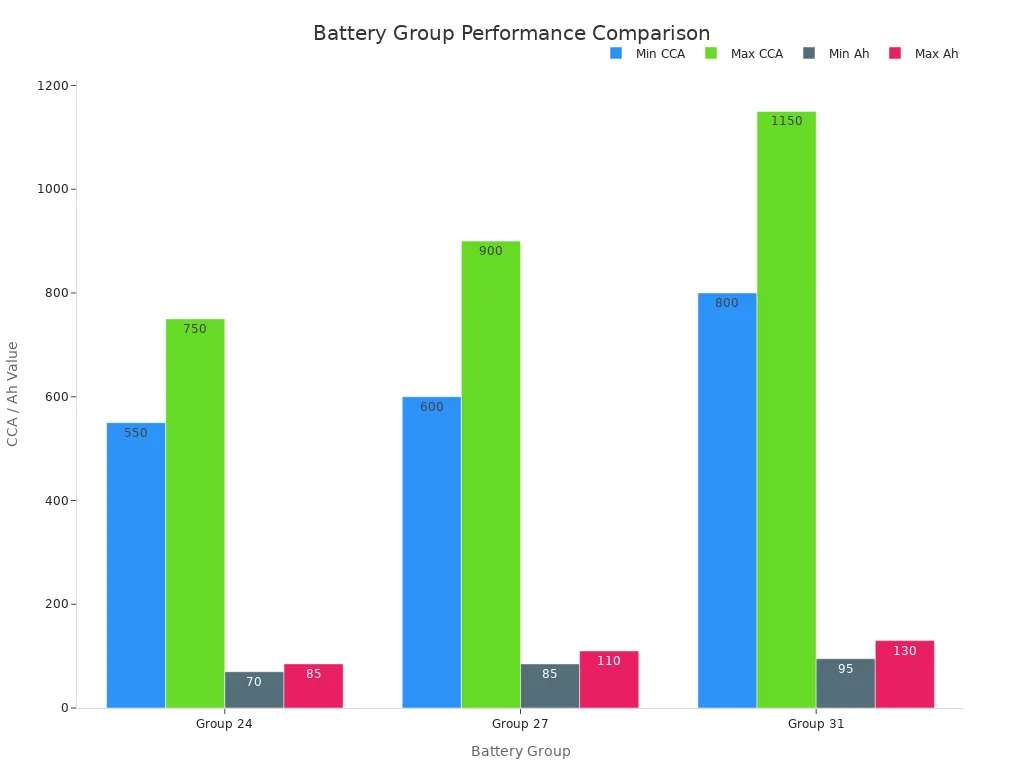
You will see batteries labeled as Group 24, Group 27, or Group 31. These group sizes show the battery’s physical size and how much energy it can hold. Larger group numbers mean bigger batteries with more power.
Group
Dimensions (L×W×H)
Typical Ah capacity
Weight
Best application
24
10.3" × 6.8" × 8.9"
70–85 Ah
42–54 lbs
Small boats, electronics, short trips
27
12.4" × 6.8" × 8.9"
85–110 Ah
54–68 lbs
Mid-size boats, most trolling motor battery setups
31
13.0" × 6.8" × 9.4"
95–130 Ah
60–75 lbs
Large boats, long trips, high power needs
You should pick a Group 27 or Group 31 trolling motor battery for most fishing boats. These sizes give you enough power and run time. Group 24 batteries work for small boats or short trips, but they may not last as long. Always match the group size to your boat and how you use your trolling motor.
Battery Size by Motor Thrust
Choosing the right battery size for your trolling motor depends on the thrust of your motor and the voltage system you use. You need to match your battery setup to your motor’s power needs. This helps you get the best run time and performance on the water.
12V Systems (30-55 lb Thrust)
Most small trolling motors use a 12 volt battery. These motors give you 30 to 55 pounds of thrust. You often see these motors on inflatable boats, kayaks, and small aluminum boats under 14 feet. A single deep-cycle battery works well for these setups.
You should use a 12 volt battery with at least 80Ah for light use. For moderate or heavy use, pick a 12 volt battery with 100Ah to 120Ah. If you want the best performance and longest life, choose a lithium battery. A 12V 100Ah lithium battery gives you steady power, lighter weight, and more charge cycles than lead-acid or AGM batteries.
Tip: For most 12V trolling motors, a 12V 100Ah lithium battery is the best choice. It fits well in small boats and gives you enough run time for a full day of fishing.
A 12 volt battery setup saves space and weight. It also costs less than higher voltage systems. You only need one battery, but you must check your power often. If you use your motor in strong wind or current, the battery may drain faster.
24V and 36V Systems
Medium and large trolling motors need more power. You see these motors on bigger boats that need more thrust. A 24 volt motor gives you 62 to 86 pounds of thrust. A 36V system can give you 100 pounds or more. You must connect two or three 12 volt batteries in series to reach the right voltage.
For a 24 volt motor, you need two 12 volt batteries wired in series. Each battery should have at least 100Ah. If you want longer run time, you can use four 12 volt batteries (two in series, two in parallel) to double your amp-hour capacity. This setup gives you 24V 200Ah, which is great for long trips or heavy use.
For a 36V system, you need three 12 volt batteries in series. Each battery should also have 100Ah or more. For extra run time, you can use six 12 volt batteries (three in series, two in parallel) to get 36V 200Ah.
Note: Always use the same type, size, and age of battery when you connect them together. This keeps your system safe and balanced.
24V systems: Use two 12 volt batteries in series. Good for medium boats. Delivers 55 to 90 lbs of thrust.
36V systems: Use three 12 volt batteries in series. Best for large boats. Provides 80 to 115 lbs of thrust.
If you want a lithium setup for your 24 volt motor, use two 12V 100Ah lithium batteries in series. This gives you a lightweight, long-lasting power source. For heavy use, double up to four batteries for 200Ah total capacity.
Tip: Lithium batteries work well for both 12V and 24V trolling motors. They give you more usable power, faster charging, and less weight. You spend more at first, but you save money over time because they last much longer.
You should always match your battery setup to your motor’s thrust and your boating style. If you fish all day or use your trolling motor in tough conditions, pick a higher amp-hour setup. This keeps you on the water longer and protects your equipment.
Run Time Estimates for Trolling Motor Battery
Calculating Run Time
You can estimate how long your trolling motor battery will last by checking the amp-hour rating and the motor’s power draw. The amp-hour (Ah) rating tells you how much energy the battery stores. The motor’s draw shows how much power it uses each hour. You divide the battery’s amp-hour rating by the motor’s amp draw to get the run time.
Lithium batteries last longer and weigh less than lead-acid or AGM batteries.
Construction
Strong cases and sturdy cells help prevent damage and corrosion.
Amp Hours
Higher amp-hour ratings mean longer run time.
Usage
Boat size and power needs affect which battery works best.
Other important factors include:
Temperature: Extreme heat or cold can lower battery performance.
Humidity: High humidity can cause corrosion and shorten battery life.
Wind and Current: Strong wind or water current makes your motor work harder and drains the battery faster.
Water Temperature: Cold water can reduce battery output, especially for lead-acid batteries.
If you want your battery to last longer, store it in a cool, dry place and avoid harsh conditions. Check your battery often and keep it clean.
Choosing the Right Deep Cycle Battery
Sizing for Your Usage
Pick a battery size that fits your boat and how you use your trolling motor. Think about where you fish and how long you stay out. If you fish in calm ponds, a 100Ah battery is usually enough. For longer trips or rough water, use a battery with 120Ah or more. Always check your trolling motor’s voltage and make sure your battery matches it. Look at your motor’s thrust rating in pounds to help pick the right battery. Wind and currents can drain your battery faster, so keep these in mind.
Tip: If your battery is too small, you might get stuck. If your battery is too big, your boat could be heavier and not balance well.
Balancing Weight, Cost, and Performance
Choose a battery that lasts, fits your budget, and does not make your boat too heavy. Bigger amp-hour batteries last longer but weigh more. Good design and strong build help batteries last longer. Expensive batteries use better parts and last more cycles. Lithium trolling motor batteries are light and small, so they work well for small boats. They do not need care and can be used until almost empty without losing power. AGM batteries last longer than flooded lead-acid batteries and give steady power.
Battery Type
Weight
Lifespan
Maintenance
Cost
Lead-Acid
Heavy
2-4 yrs
Regular
Low
AGM
Moderate
Up to 4 yrs
Low
Moderate
Lithium
Light
Up to 20 yrs
None
High
Note: One lithium battery can take the place of many lead-acid batteries. This saves money and space over time.
Upgrading or Adding Batteries
When you upgrade or add batteries, make sure your battery matches your trolling motor’s voltage. Think about how you fish to pick the right battery size. For all-day trips or tough conditions, use a battery with 120Ah or more. If you fish in calm water, a 100Ah battery is usually fine. Always check the weight, because big batteries can make your boat use more fuel and lose balance. Look at your needs and where you fish before you change your battery setup.
Tip: People who fish a lot or fish for work should use lithium or AGM batteries. These batteries last longer, give steady power, and need less care.
Safety, Compatibility, and Maintenance
Installation and Connections
It is important to put your trolling motor battery in the right way. This keeps your boat safe and helps your motor work well. Always make sure your battery matches your motor’s voltage and power needs. Use a deep cycle battery so you get steady power. Put the battery somewhere safe so it does not slide or tip over. Make all the connections tight so nothing comes loose. Keep the cables away from metal parts to stop short circuits. Clean the battery ends before you hook them up. This stops rust and keeps power strong. Use cables that are the right size for your motor. This helps stop the wires from getting too hot.
Charging and storing your battery the right way helps it last longer. Always charge your battery after you use it. Do not let it go all the way dead. Use a charger made for your battery type. Lead-acid batteries need a charger with bulk, absorption, and float steps. AGM batteries need a charger made for AGM. Lithium batteries need a charger that stops overcharging and undercharging.
Charge your battery all the way before you store it.
Use a trickle charger if you will not use the battery for a long time.
Clean the battery ends and check the fluid in lead-acid batteries often.
Note: Charging your battery often and keeping it clean stops most battery problems.
Common Mistakes
Many people make easy mistakes that hurt their battery or make it not work right. Try not to do these things:
Using a battery that does not match your motor’s voltage or power.
Not checking if the battery is the right weight or type.
Forgetting to look for rust or loose wires.
Letting the battery go empty before charging it again.
Using the wrong charger for your battery.
You can keep your trolling motor battery working well if you follow these tips. Checking your battery and taking care of it helps it last longer and keeps you safe on the water.
Quick Reference Table: Battery Size by Thrust
You can use this table to quickly find the right battery for your trolling motor. The table shows the best battery size based on thrust, voltage, amp-hour rating, and group size. You will see which battery fits your boat and how long you want to fish.
Thrust (lbs)
System Voltage
Recommended Amp-Hour (Ah)
Group Size
Typical Boat Type
30–40
12V
60–80
Group 24
Kayak, small inflatable
45–55
12V
80–110
Group 27
Small aluminum, bass
62–86
24V
100–120 (each battery)
Group 27/31
Medium fishing, pontoon
100+
36V
100–120 (each battery)
Group 31
Large pontoon, offshore
Tip: Always check your motor’s voltage and thrust before you buy a battery. If you want longer run time, pick a battery with a higher amp-hour rating.
You can use one battery for a 12V system. For a 24V system, connect two batteries in series. For a 36V system, connect three batteries in series. Make sure all batteries have the same amp-hour rating and group size.
If you fish all day or use your motor in strong wind, choose a battery with more amp-hours.
If you have a small boat, a Group 24 battery works well. For bigger boats, use Group 27 or Group 31.
You can use lithium batteries for lighter weight and longer life. AGM batteries give you steady power and need less care. Lead-acid batteries cost less but need more maintenance.
Note: Always match your battery setup to your motor and boat. This keeps your equipment safe and helps you stay on the water longer.
You need a 12-volt deep cycle marine battery with at least 110Ah for most trolling motors. Pick Group 27 or a bigger size. If you have a 24V or 36V system, change your battery setup to match. The table below gives you the main tips:
Recommendation
Details
Battery Type
12-volt deep cycle marine battery
Minimum Amp Hour
At least 110 Ah (Group 27 or larger)
Voltage Compatibility
12, 24, or 36 volts based on your motor
Pick your battery size by looking at your motor’s thrust, how you use your boat, and how big your boat is. Use the quick reference table to help you choose. For the best results, always do these things:
Taking care of your battery helps it last longer and keeps you safe when you are on the water.
FAQ
What battery type works best for trolling motors?
You get the best performance from lithium batteries. They last longer, weigh less, and charge faster. AGM batteries also work well and need less maintenance than lead-acid batteries.
How do you connect batteries for a 24V or 36V trolling motor?
You connect two 12V batteries in series for 24V. For 36V, you connect three 12V batteries in series. Always use batteries with the same amp-hour rating and age.
How often should you charge your trolling motor battery?
You should charge your battery after every use. Keeping your battery fully charged helps it last longer and keeps your trolling motor running strong.
Can you use a car battery for your trolling motor?
You should not use a car battery. Car batteries are made for short bursts of power. Deep cycle marine batteries give steady power and last longer for trolling motors.