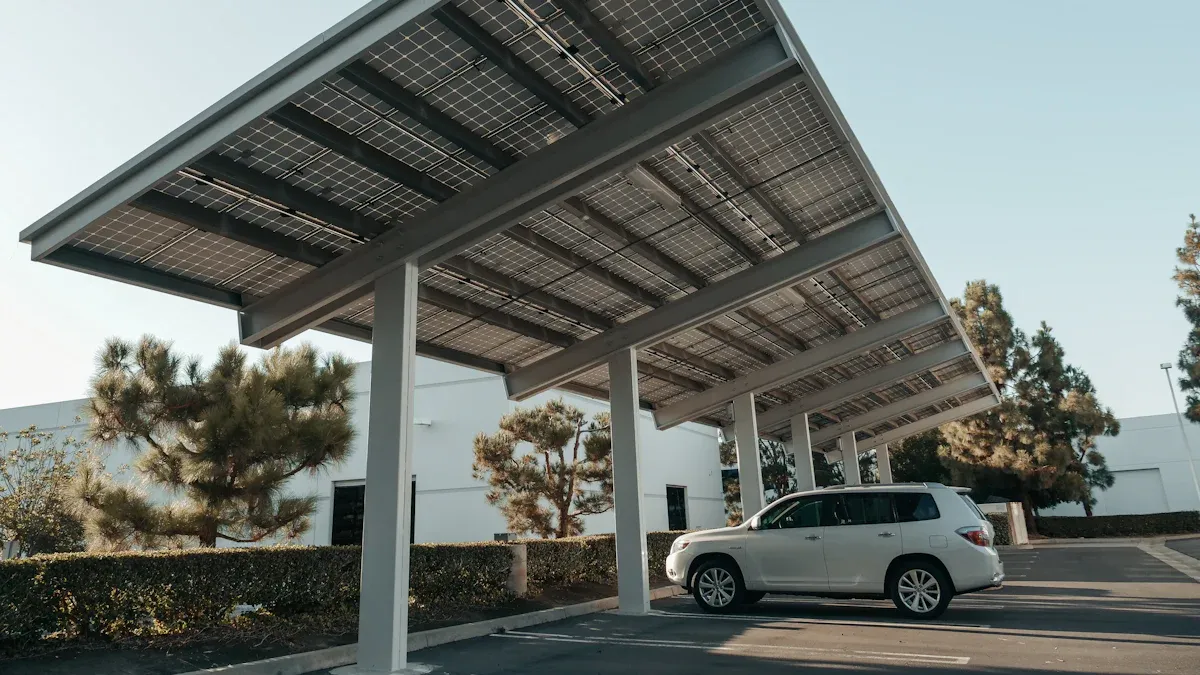
You want the perfect carport for your house, right? A solar panel carport keeps your car safe from bad weather while providing you with clean energy at the same time. The perfect carport utilizes panels to capture solar power, which helps the environment and saves you money. You gain another advantage too—clean energy benefits the planet. Before you begin, assess your energy needs and see how new technology can assist you. The perfect carport complements your style and matches your house, offering you the most benefit for your space.
Key Takeaways
A solar carport keeps your car safe from bad weather. It also makes clean energy. This helps you save money and helps the Earth.
Pick strong materials and a good design for your weather. This makes your carport last long and work well.
Think about how it looks and works when you choose a solar carport. This can make your house look nicer and use energy better.
Figure out how much energy you need before you start. Check the rules in your area too. This helps you set up your solar carport the right way.
Clean the panels and check the wires often. This helps your solar carport work well for a long time.

What Makes the Perfect Carport
Key Design Elements
When you plan a solar carport, you want it to do more than just cover your car. The right design keeps your car safe and helps you get lots of solar energy. You should think about how each part works together. Here are the most important things to look at:
| Design Element | Description |
| Solar Panel Selection | Pick solar panels that work well for your sunlight. This helps you get the most energy. |
| Panel Layout | Place panels so they get lots of sun and little shade. This gives you more energy. |
| Drainage Design | Make sure panels have a small slope. This lets water run off and stops puddles. |
| Waterproofing | Use waterproof stuff to seal panel joints. This keeps water out and stops damage. |
| Electrical System Design | Add charging spots for electric cars and smart controls for energy use. |
| Safety Measures | Put in grounding and lightning protection. This keeps everyone safe and lowers electrical risks. |
Your solar carport should work well in your weather. Weather changes how you build and use your carport. Here is how climate affects your choices:
| Climate Type | Design Considerations |
| Tropical Climate | Use strong materials that handle heat and last long. Make sure air can move to keep things cool. |
| Temperate Climate | Keep warm in winter and cool in summer. Use clear films to let in light and save energy. |
| Cold Climate | Add insulation and ways to stop snow from piling up. This helps your carport work in cold weather. |
If you live where it rains a lot, you need good drainage and waterproofing. In hot places, pick materials that stay cool and protect your car. Cold places need insulation and ways to keep out snow. The right solar carport design helps a lot.
Balancing Style and Function
You do not have to pick between style and function. The best solar carports have both. There are many styles, and each has good points. Here are some popular choices:
| Style Type | Description |
| Single-Row Solar Carports | Good for small spaces. They fit one row of cars and use space well. |
| Double-Row Solar Carports | Great for big areas. They fit two rows and make more power. |
| Cantilever Solar Carports | Have fewer columns. This makes it easier to drive and looks nice. |
| Integrated Solar Carports | Mix solar panels with design. They fit many needs for space, looks, and energy. |
| T-shape | Used in big parking lots. They give strong support and good coverage. |
| Y-shape | Slanted shape helps water drain and gets more sun. Good for rainy places. |
| L-shape | Fits in corners or along edges. Saves space in tight spots. |
| V-shape | Looks modern and is very stable. Good for places that want style and strength. |
Different styles change how you set up your solar panels. Some, like cantilever or Y-shape, help you get more sun and better drainage. If you want lots of solar energy, pick a style that lets you change the panel angle or use tracking. In sunny places, choose a style that makes lots of power.
Tip: Think about how your solar carport looks next to your house. You want it to match your home and still work well for solar energy.
You can pick a solar carport that fits your space, matches your style, and gives you the energy you need. When you balance style and function, you get a carport that works well and looks good.

Solar Carport Overview
Dual Purpose: Shade and Energy
A solar carport does more than just keep your car safe from rain or sun. You get two big benefits at once. First, you protect your vehicle from harsh weather. Second, you use solar panels to make clean energy for your home or business. You can park your car under the shade and know you are helping the planet at the same time.
When you install a solar carport, you use space that might just sit empty. You turn it into a spot that works for you every day. You do not need to put panels on your roof. You can use the carport for solar power instead. This makes it easier to clean and check your panels. You also get more control over how much energy you make.
Tip: If you want to save money on your electric bill, a solar carport can help you do that. You use the sun’s power and lower your costs.
Residential vs. Commercial Use
You might wonder if solar carports work better for homes or businesses. Both can use solar carports, but they have some differences. Residential solar carports usually cover one or two cars. They use smaller systems and fit in driveways or small lots. Commercial solar carports cover many cars and use bigger systems. You see them in parking lots at stores, schools, or offices.
Here is a quick look at how energy output changes between the two:
| System Type | Panel Output (Watts) | Annual Energy Generation (kWh/kW) |
| Residential | 300 | 1,000 |
| Commercial | 350–400 | 800–1,400 |
You get more energy from commercial solar carports because they use more panels and bigger systems. If you want a solar carport for your home, you still get plenty of energy for your needs. Businesses can use solar carports to power lights, signs, or even charge electric cars.
Solar carports work for everyone. You choose the size and style that fits your space. You get shade, energy, and a smart way to use solar power.
Solar Carport Styles
Cantilever and Row Designs
You see cantilever and row designs in many places. These styles make solar carports strong and simple to use. Cantilever designs have fewer columns. This gives you more room to park and move cars. Row designs are good for big spaces like parking lots. They cover many cars with solar panels.
Here’s a table that shows what these solar carports offer:
| Feature | Specification |
| Wind Load | 90 MPH minimum |
| Ground Snow Load | 30 psf minimum |
| Columns | HSS ASTM A-500 Grade B A-500 |
| Beams | Wide Flange A-992 Grade 50 Steel |
| Purlins | 16 GA. Cold Rolled G-90 Galvanized Steel |
| Racking | Pre-punched to receive solar panels directly |
| Standard Features | Fixed tilt slope up to 5º, hot dip galvanizing, site-specific layout |
| Options | Fixed tilt slope up to 10º, roof sheeting |
These solar carports can handle strong wind and heavy snow. The steel parts are tough and last a long time. You can pick the tilt of your panels. This helps you get more solar energy. These carports work for homes and businesses.
Waterproof and Custom Options
Waterproof solar carports keep your car dry and safe. They protect your car from rain, snow, and sun. This helps your car last longer. You also stop water stains from forming. Custom solar carports let you choose what fits your space and style.
Mechanically watertight solar roof
Internal wire chaseways protect wiring
No dangling wires, so you stay safe
Galvanized and powder-coated steel for extra durability
Note: The price of a solar carport depends on the materials, support, and electrical parts. You pay for preparing the site, putting it together, and wiring. These things change the total cost, but you get a solar carport that lasts for years.
Custom solar carports let you pick the look and size you want. You choose the features that work for you. There are many types, so you can find one that matches your style.
Carport Materials
![Carport Materials]()
Steel vs. Aluminum
When you pick materials for a solar carport, you often see steel and aluminum. Both have their own strengths. Steel makes your carport very strong. It holds up heavy solar panels and stands up to big loads. Aluminum is lighter than steel. This makes it easier to put together. Aluminum also looks modern and does not rust much.
Here’s a table to help you compare:
| Material | Advantages | Disadvantages |
| Steel | Cheap, strong, hard to break, holds heavy weight, easy to find, does not burn easily. | Rusts if not treated, heavier than aluminum. |
| Aluminum | Light, does not rust, looks new, cools off fast, good for the planet, needs little care. | Costs more at first, not as tough as steel. |
Steel is good if you want your carport to handle bad weather and lots of snow. You need to treat steel so it does not rust. If you do, it will last a long time. Aluminum gives you a carport that looks nice and stays cool. You pay more at first, but you do not have to fix it much. Both steel and aluminum help your solar panels work well and keep your car safe.
Other Material Choices
You can use other materials for your solar carport too. Wood and composite materials are options. Wood carports look natural and fit in with your yard. They can stand up to strong winds and lots of snow. Some wood carports have a 30-year warranty. This means you do not have to worry about fixing them for a long time.
Composite materials are also good for solar carports. They do not rot or get bugs. Your carport stays strong and does not need much work. When you pick a material, think about how it looks and how much work you want to do later.
Tip: Choose a carport that fits your style and gives good support for your solar panels. You want it to last and look nice.
Solar Panel Carport Functionality
Energy Output and Performance
You want your solar carport to make lots of energy. The panels take sunlight and turn it into power for your home or business. Solar carport technology gets better every year. This means you get more energy over time. You can use smart technology to see how much energy you make. This helps you find ways to make even more power. If you live where it is sunny, your carport will make more energy. In cloudy places, new technology helps you still get good results. You can look at this table to see how different panels work:
| Panel Type | Efficiency (%) | Energy Generation (kWh/year) |
| Monocrystalline | 20 | 1,200 |
| Polycrystalline | 16 | 1,000 |
| Thin Film | 12 | 800 |
Tip: Pick panels with high efficiency. This helps your carport make more energy and helps the planet.
Vehicle Protection and Security
Your solar carport does more than make energy. It keeps your car safe every day. The carport acts like a roof over your car. It blocks rain, snow, and sun. Your car stays dry and the paint does not fade. Waterproof carports keep water out, even in big storms. You also get more safety than open parking. Here is what you get:
A solar carport helps your car and the environment at the same time.
EV Charging Integration
You can add EV charging stations to your solar carport. This lets you charge your electric car with solar energy. You plug in your car and use the power from your carport. Many carports have smart controls. These help you manage charging and see how much energy you use. You save money and help the planet. New technology makes it easy to add EV charging and get more energy. If you want a carport for the future, pick one that works with renewable energy and EV charging.
Planning Your Solar Carport
Energy Needs Assessment
Before you start your solar carport project, you need to figure out how much electricity you use. This step helps you pick the right system size and avoid spending too much. Ask yourself a few questions. How many kilowatt-hours do you use each month? Do you plan to buy an electric car soon? Will your energy needs grow in the future? You should also think about your budget. Most solar carports cost about $3.17 per watt plus installation. Check if your site has enough space and good sunlight. Make sure you know about local rules, permits, and any restrictions from your HOA.
Here’s a quick checklist to guide you:
Review your monthly electricity bills.
Decide if you want to add EV charging.
Plan for future energy growth.
Set your budget.
Check local regulations.
Site and Size Considerations
Your site matters a lot when you design a solar carport. The way your carport faces the sun changes how much solar energy you get. South-facing carports get the most sunlight at midday. East or west-facing carports give you steady power all day, which works well for charging cars. North-facing carports used to be less popular, but new solar panels work better even with low tilt angles. If you have limited space or some shade, you can use custom designs.
| Orientation Type | Description |
| South-Facing | Maximum solar exposure around midday. |
| East- or West-Facing | More even power generation throughout the day, ideal for charging infrastructure. |
| North-Facing | Once considered uneconomical, now viable due to low tilt angles and bifacial modules. |
| Custom Intermediate | Ideal for limited space or partial shading. |
Some public projects use north-facing carports because of existing buildings. With smart design and semi-transparent solar modules, these carports can still reach about 75% of the energy yield compared to south-facing ones.
Equipment Selection
Picking the right equipment makes your solar carport work better. You want solar panels that give you high efficiency and good value. Monocrystalline panels offer over 22% efficiency and cost between $1 and $1.50 per watt. These panels help you get more solar energy from your carport. Look for strong mounting racks and safe wiring. If you want to charge an electric car, choose a system that supports EV charging. Make sure your inverter matches your system size and energy needs.
Tip: Choose equipment that fits your budget and future plans. Good planning now saves you money and trouble later.

Solar Carport Installation and Engineering
Permitting and Regulations
You must follow local rules before you install a solar carport. Each city has its own steps for projects like this. You need to make sure your carport follows all codes. Here is what happens when you install a solar carport:
| Step | Description |
| Site Assessment | An expert looks at your property to find the best place for solar panels. |
| Design and Engineering | Professionals make plans with details about electricity and structure. |
| Permit Application | You fill out forms to get building and electrical permits from the city. |
| Permit Review | The city checks your plans to make sure they are safe and follow the rules. |
| Inspections | Inspectors come during and after installation to check for safety. |
You might also need to think about these things:
Building permits for solar panel work
Electrical permits for connecting to the grid
Zoning rules for where you can build
HOA approval if you live in a neighborhood with an association
Tip: Start getting permits early. Waiting too long can slow down your solar carport project.
Structural Engineering
You want your solar carport to be strong and last many years. Structural engineering helps your carport stand up to wind, snow, and rain. Engineers use tough materials and test for safety. They check if the ground can hold heavy weight, sometimes over 3,000 PSF in bad weather. Many solar carports use steel-reinforced concrete piers or helical anchors to stay steady. Your carport must follow ASCE 7-22 rules and the International Building Code. These steps keep your solar carport safe and strong.
Engineers set rules for strength and how long it lasts.
They test for weather, fire, and material safety.
Good design helps your solar carport work well for many years.
Professional vs. DIY
You may wonder if you should hire someone or do it yourself. Here is a quick look at the differences:
| Aspect | Professional Installation | DIY Installation |
| Upfront Costs | Costs more because you pay for expert help | Costs less since you do the work yourself |
| Quality Assurance | Better quality and you get a warranty | Quality may not be as good and no warranty |
| Safety Risks | Safer because experts do the job | More risky since you do it yourself |
| Warranty Coverage | Warranties are valid with certified installers | You might lose warranty if not done right |
A professional solar carport installation gives you peace of mind. You get a warranty and know the job is done right. Doing it yourself saves money, but you might risk safety and lose warranty coverage. Think about your skills and if you need expert help before you choose.
Solar Carport Cost and ROI
Cost per Watt
When you check the price of a solar carport, you see cost by watt. This makes it easy to compare different systems. In the United States, the average cost per watt is $3.72. Most solar carports cost between $3.45 and $3.99 per watt. You pay for panels, hardware, labor, and permits. The size and type of panels change the price. If you want more energy, you need a bigger system. Bigger systems cost more at first but save more later.
Tip: Ask your installer for a full list of costs before you start.
Incentives and Tax Credits
You can save money with incentives and tax credits. The federal tax credit lets you take 30% off your solar costs on your taxes. This covers panels, inverters, hardware, permits, and labor. States and cities offer extra help too. Some programs give rebates for batteries or help you pay for solar. These incentives make solar carports cheaper and can raise your property value.
| Incentive Type | Description |
| Federal Tax Credits | ITC/PTC with extra savings for location and labor rules. |
| Accelerated Depreciation | MACRS helps businesses save more money. |
| Utility/Local Programs | Extra help for commercial solar carports and connecting to the grid. |
| Tariff Strategies | Save money with time-of-use and demand charges, especially with batteries. |
SGIP gives rebates for batteries.
SASH Program helps families pay for solar.
Equity Resiliency Program adds rebates for batteries.
Property tax exclusion keeps your taxes the same after solar.
PACE Financing lets you pay for solar with lower rates.
Solar Rights Laws protect your right to install solar panels.
ROI Calculation
You want to know when your solar carport pays for itself. You figure out return on investment by looking at costs, savings, tax credits, and upkeep. Bigger solar carports make more energy and save more money. Most payback times are between 5 and 15 years. How much energy you use and your local rates change how fast you save.
Check your installation costs.
Add up your yearly energy savings.
Include federal tax credit and other incentives.
Subtract maintenance costs.
Estimate your payback time.
If you use lots of energy or have high rates, you save faster. Adding solar carports can also make your home or business worth more.
Maintenance and Trends
Routine Care
You want your solar carport to last a long time. Taking care of it helps you get more energy and keeps it safe. Cleaning the solar panels is very important. Dust, snow, and leaves can block sunlight and lower energy. You should check your carport often and clear off anything on the panels. Regular checks help you find problems early. Look at the wiring, mounting parts, and inverters to make sure they work. You also need to check grounding and surge protection to stop electrical trouble. Watching your energy data helps you know if your carport works right.
Here’s a table that lists common maintenance jobs:
| Maintenance Task | Description |
| Cleaning panels | Take off dust, snow, and debris for better sunlight. |
| Regular inspections | Look at wiring, inverters, and hardware for damage. |
| Verifying electrical connections | Make sure all connections are safe and working. |
| Inspecting system grounding | Check grounding to stop electrical problems. |
| Calibrating sensors | Adjust sensors for correct performance data. |
| Reviewing monitoring data | Find issues early by checking energy output. |
Tip: Many solar carports have a slanted roof. Rain helps wash away dirt, so you clean less.
Upgrades and Innovations
You can make your solar carport better with new upgrades. Many solar carports now have electric vehicle charging stations. You can add Level 2 chargers or DC fast chargers for quick charging. Some solar carports use bi-directional inverters to send power back to the grid. Modern designs look nice and fit with your home or business. These upgrades help you save money and lower your carbon footprint.
Solar carports use strong materials that last many years. Most panels have a 25- to 30-year warranty. You may see your electricity bills drop by 50-90% after you install a solar carport. Many people find their solar carport pays for itself in 5-7 years. Adding new features can raise your property value and make your carport more useful.
Solar carports give shade and clean energy.
You can add EV charging for more convenience.
Upgrades help you save money and protect the planet.
New designs make your solar carport look modern and stylish.
Note: Solar carports need little care. Good materials and smart design keep your system working well for years.
You want your carport to work well and look great. Here are the most important steps for planning a solar carport:
Check local rules and permits.
Pick the right size and spot with lots of sunlight.
Figure out how much solar energy you need.
Choose strong materials and plan for future changes.
Talk to professionals and use incentives to save money. When you balance style, materials, and function, you get solar carports that protect your car and help the planet. Start planning your solar carport today!
FAQ
How much space do you need for a solar carport?
You need enough room for your car and the solar panels. Most people use a spot that fits one or two cars. Measure your driveway or parking area before you start planning.
Can you install solar carports in cold or snowy places?
Yes, you can. Solar carports work well in cold climates. You just need strong materials and a design that helps snow slide off. Many people use them in snowy areas.
What is the main benefit of choosing a solar carport?
You get two big benefits. Your car stays safe from weather, and you make clean solar energy. This helps you save money and protect the planet at the same time.
Do solar carports need a lot of maintenance?
No, you do not need to do much. You should clean the panels and check for damage sometimes. Most solar carports use strong materials that last for years.
Can you add EV charging to your carport?
You can add EV charging stations to your carport. Many solar carports support electric vehicle charging. This lets you power your car with solar energy and makes life easier.