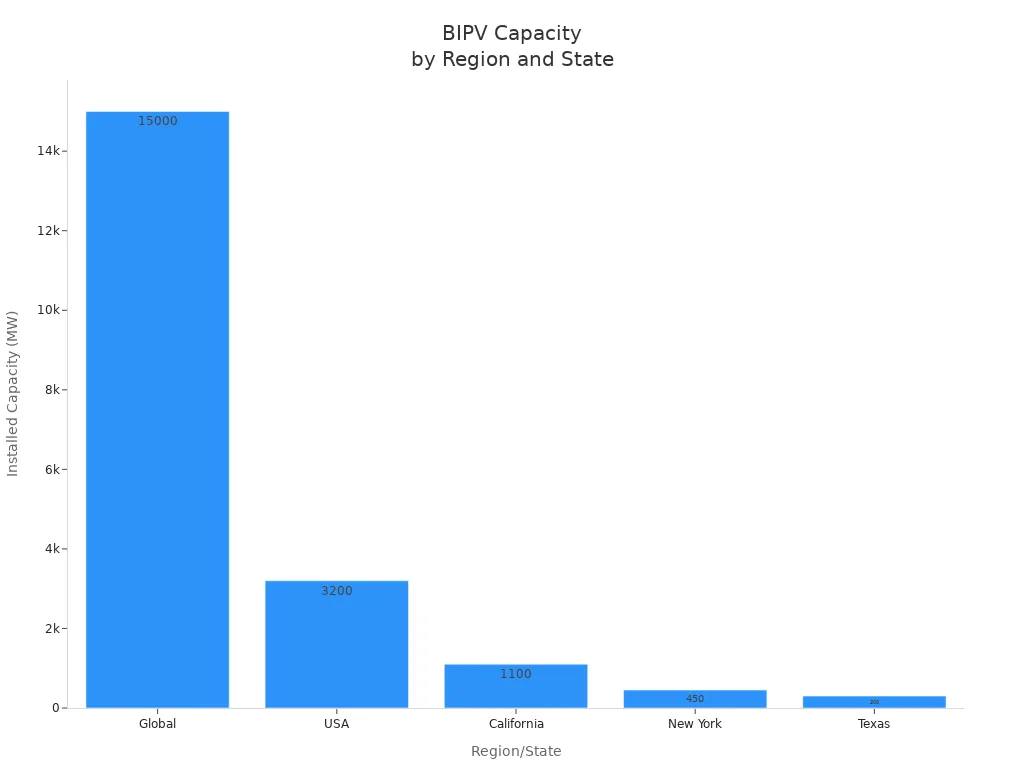
You want to customize solar panels to fit your building. You care about energy and aesthetics. Many projects are now utilizing BIPV systems, which combine solar technology with architectural style. The demand for BIPV is increasing because it enhances design while providing clean energy. Here is some new market data:
Statistic
Value
Global BIPV installed capacity
Over 15,000 MW
Urban area market penetration
65%
Roof-mounted systems
55%
Facade systems
30%
Average panel efficiency
16–22%
Lifespan of BIPV systems
25–30 years
New commercial buildings incorporating BIPV
Over 75%
You can use BIPV systems on rooftops and walls, as well as other parts of a building. These technologies allow you to customize solar panels by selecting color, shape, and transparency. You can align them with your design concepts. When planning, consider how BIPV can support your energy objectives and how it complements your building’s appearance. Nowadays, owners and architects are choosing photovoltaics for both power and style, seeking panels that seamlessly blend in and enhance the overall look.
Key Takeaways
Work with architects and solar engineers early in the design. This helps your BIPV system look good and make energy.
Pick the best BIPV module for your building’s needs. Think about how well it works, if it can bend, and if it fits your weather.
Make your solar panels special by choosing colors and how see-through they are. This makes your building look better and gives more energy.
Plan where you put BIPV panels to get the most energy. Try to keep them away from shade made by other buildings.
Check and take care of your BIPV system often. This keeps it working well for a long time and helps your building save energy and look nice.
Design Integration for BIPV
Collaborating with Architects
You should work with architects and solar engineers early. This helps you make a good plan for your building. When experts join together from the start, you mix technology and design. Working as a team lets you fix problems before they get big. It also makes sure your BIPV system fits your goals. Many experts say architects need to use sustainable design. They should include new technology like BIPV. If you add BIPV to the main design, you can reach energy and style goals. The BIPV market now wants this teamwork for the best results.
Matching Building Aesthetics
You can use BIPV modules to match your building’s style. Modern BIPV gives you many choices for color, texture, and transparency. This flexibility lets you make buildings that stand out or blend in. You can pick panels that fit your design and make your project special.
The high-tech look of PV in buildings is not always a problem. It can fit modern styles well. But, when adding PV to old or sensitive places, like historic centers or heritage sites, you must be careful. You need to balance how it looks and how it works. This is important for BIPV systems in architecture and building needs.
BIPV market trends show owners want panels that look good and work well. You can use BIPV design to make buildings attractive and efficient.
Structural Considerations
You need to think about how BIPV modules fit your building. The BIPV market has many choices for different buildings. You can choose panels that match your project’s size and shape. Good BIPV design means checking weight, support, and where panels go. This keeps your building safe and strong. As technology gets better, you have more ways to use BIPV in your design. BIPV market trends show new technology makes it easier to add solar panels to many buildings.
Customize Solar Panels for Building-Integrated Photovoltaics
Module Types and Technologies
You can pick from many BIPV modules for your building. Each BIPV technology has its own benefits. These work for different building-integrated photovoltaics uses. Here are the main choices you can find:
Roof-integrated systems take the place of regular roofing. You can use tiles, shingles, or seam modules. These fit pitched or flat roofs.
Façade and cladding systems use panels or ventilated façades. These modules act as outside cladding or spandrel panels.
Glazing and semi-transparent modules go in windows, skylights, or canopies. These let daylight in and make power.
Curtain wall and unitized façade modules mix PV with wall panels made in factories.
Flexible laminates and thin-film membranes cover curved surfaces. They can also update older buildings.
Building-integrated photovoltaic-thermal hybrids (BIPV-T) make electricity and collect heat. This gives better energy yield.
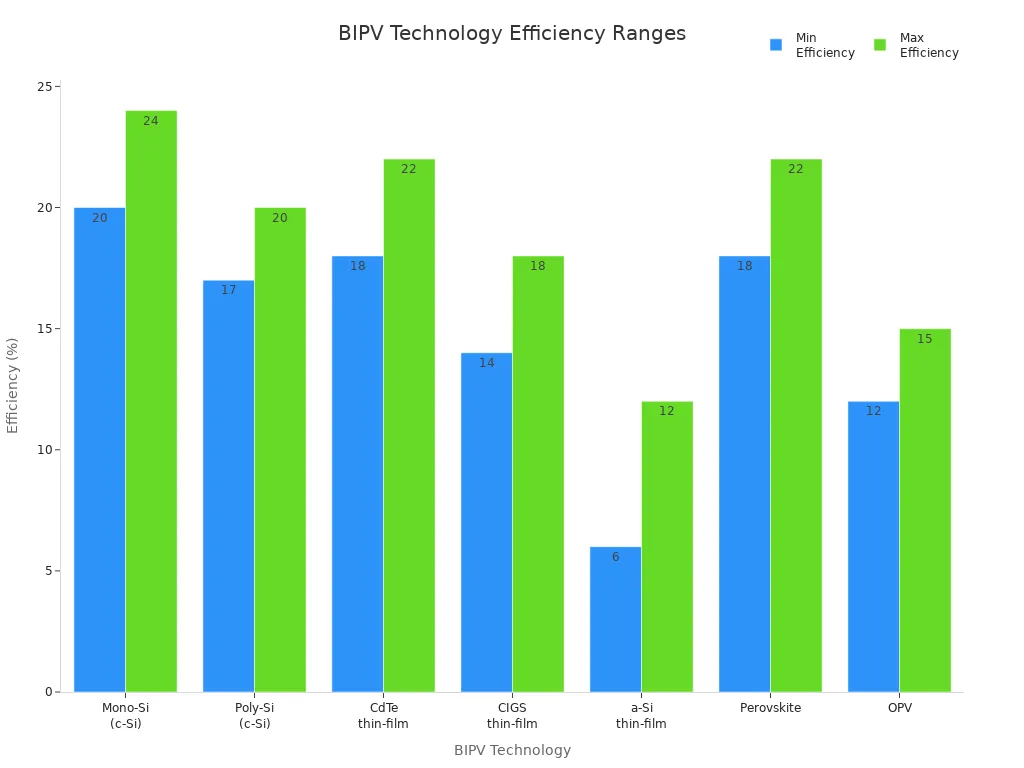
You need to match the BIPV technology to your building’s needs. Mono-crystalline silicon modules are very efficient. They work well for roofing tiles or opaque facades. Thin-film modules, like CdTe or CIGS, are flexible. They fit curved surfaces. Semi-transparent a-Si modules are best for tinted glazing and skylights. The chart below shows how BIPV technologies compare in efficiency.
You should think about your climate too. Thin-film modules work well in hot or low-light places. Crystalline modules are best when you need lots of power. Perovskite and organic PV are new choices. They offer tunable transparency and flexibility for advanced projects.
Color and Transparency Options
You can customize solar panels by picking color and transparency. These help you match your building’s style and energy goals. The table below shows how options change performance and looks.
Opaque modules give the most energy. You can pick many colors and textures to match your design. Semi-transparent modules let in some light. They balance looks and power. Transparent modules have the least visual impact. They make less energy. Colored glass options let you pick many colors. Energy output depends on transparency and color.
Tip: If you want the most energy, pick opaque modules. If you want more daylight, semi-transparent or transparent modules are better.
Special methods, like sandblasting and silk-screen printing, can add patterns or logos to BIPV glass. Some filters reflect visible light but let infrared light make power. These methods give you more design choices and help your building stand out.
Shapes and Sizes for Unique Designs
You can customize solar panels in many shapes and sizes. This lets you fit panels almost anywhere in your building. Here are some common formats:
Format
Typical Dimensions
Common Applications
Micro / IoT
52 × 52 mm – 300 × 400 mm
Asset trackers, sensors, wearables
Compact custom
680 × 680 mm – 1,200 × 800 mm
Balcony solar, BIPV tiles
Full residential
~1,700 × 1,000 mm (M10 format)
Standard rooftop PV
Oversized / BIPV
Up to 2,400 × 1,200 mm
Façades, curtain walls, skylights
Non-rectangular
Triangular, trapezoidal, L-shaped
Complex rooflines, special facades
You can ask for triangular, trapezoidal, or L-shaped panels. These are good for complex rooflines or unique facades. Custom shapes and sizes may need extra engineering and testing. You may need special contractors and new certifications. This can add cost and time to your project.
Many famous buildings use custom BIPV panels. For example, the Science Pyramid at Denver Botanic Gardens uses hexagonal BIPV cells on its facades. The +e Kita Day-Care Center in Marburg has a sawtooth roof with custom monocrystalline panels. These projects show how you can use building-integrated photovoltaics to make beautiful and efficient buildings.
Note: Custom BIPV panels cost more than standard solar panels. You pay for extra design, certification, and installation. But BIPV systems can replace other building materials. This helps balance the cost.
When you customize solar panels for your building, you open new design and energy possibilities. You can make a building that looks great and makes clean energy for years.
Optimizing BIPV Systems: Orientation and Placement
Sun Path and Building Orientation
You can get more energy from your BIPV system if you pick the right direction. The sun moves differently in each city. In Phoenix, AZ, a roof facing south and tilted at 30° makes much more energy than a flat or north-facing roof. It can give you 40–60% more power each year. In Seattle, WA, the difference is not as big, but a good direction still helps. If you use vertical south walls for BIPV, you get about 60–70% of the energy that a tilted rooftop system gives. East and west walls give you 40–55% of the best energy. North walls do not make much energy in most places in the northern hemisphere. Always think about where your building is and how the sun moves when you plan your photovoltaics system.
Minimizing Shading
Shadows can cut your BIPV system’s efficiency by more than 30%. You need to plan so shadows from buildings, trees, or other things do not block sunlight. Use special software to check for shadows and sunlight all year. Look at the height of nearby buildings and trees. Check how long the sun shines in your area. Here are some best ways to avoid shading:
Best Practice
Description
Pre-Installation Planning
Do a careful check of your building and electrical system to find the best spot for panels.
Shading Analysis Tools
Use computer models to see and reduce shadows from nearby things.
Installation Orientation
Try to face panels south and tilt them to get the most sunlight.
Tip: Always check for shading before you install your BIPV system. This helps you get the most energy from your panels.
Custom Panel Placement
You can put BIPV panels on many parts of your building. Use new technology to fit panels on roofs, walls, or windows. Custom placement lets you use every surface to make energy. Advanced tools help you design panels for special shapes and sizes. Flexible panels work well on curved surfaces or unique features. When you plan your system, think about how much sunlight each panel will get during the day. Good placement and smart technology help your BIPV system work better and last longer.
Flexibility and Applications of Building Integrated Photovoltaics
Facades, Roofs, and Windows
BIPV systems can go on many parts of a building. The most used places are facades, roofs, and windows. Each spot gives special benefits for energy and design. The table below shows how these choices are different:
Application Type
Description
Performance Metrics
Facades
Big south-facing facades on commercial buildings can hold lots of BIPV. They can give 10–40% of the building’s yearly electricity.
How much energy you get depends on the building and where it is.
Roofs
BIPV roofing tiles or shingles can take the place of normal roofs. They can give 60–80% of the power a home needs.
A regular 2,000 sq ft house can have 4–8 kWp of BIPV.
Windows
BIPV glazing puts photovoltaic cells inside glass for curtain walls and skylights.
You can pick the BIPV technology that fits your building best. This lets you reach your energy and design goals.
New Builds vs. Retrofits
BIPV works best if you plan for it in new buildings. You can add BIPV from the start, so it fits in well and costs less. If you add BIPV to old buildings, you must work with what is already there. This can make things harder and cost more money. BIPV takes the place of normal building materials and becomes part of the building. BAPV is different because it goes on top of what is already there. People use BAPV more often for old buildings. Multi-family homes and tall buildings are good for BIPV in new projects.
Tip: For the best results, plan BIPV early in your building design.
Integration with Building Systems
BIPV systems need to connect with other building systems like HVAC and lighting. This can be hard to do. If you do not manage heat well, BIPV can lose 10-15% efficiency compared to regular rooftop solar. You must make sure the electrical parts work together. BIPV acts as both a building material and a way to make energy. The BIPV market has some problems, like higher prices, special factories, and needing skilled workers. Even with these problems, BIPV helps buildings use clean energy. It also helps buildings get green awards like LEED and BREEAM by saving energy and using new technology.
Monitoring and Maintaining BIPV Systems
Performance Monitoring Tools
You need to watch your BIPV system to make sure it works well. Good monitoring tools show you how much energy your system makes. They help you find problems quickly. Many companies have smart tools for this. The table below lists some top tools and what they do:
You can check your system from your phone or computer. These tools send alerts if something is wrong. This helps you fix problems before they get worse.
Maintenance Planning
You should check your BIPV system often to keep it working well. Clean the panels to get rid of dust and dirt. Look at the wires and connections to make sure they are safe. Have a professional check your system once a year. Make a list of jobs and set reminders. This keeps your system safe and helps it last longer.
Tip: Write down each job and the date you do it. This helps you see patterns and make your system work better over time.
Ensuring Long-Term Efficiency
BIPV systems use special materials and custom designs. This makes them strong and helps them work well for many years. You get a better-looking building and save more energy. The table below shows how BIPV systems and regular solar panels are different:
Feature
BIPV Systems
Traditional Solar Panels
Lifespan
Over 25 years
Varies, typically less than BIPV
Maintenance Costs
Reduced due to dual functionality
Higher due to separate roofing and solar systems
BIPV systems make buildings look nicer.
They help save more energy.
They help you meet green building rules.
If you use PV materials instead of regular building materials, you can save money on building costs and make energy for your building.
You might pay more at first, but you save money later. You get energy, spend less on repairs, and your building looks better. Good monitoring and care help your system work well for a long time.
You can change solar panels for building integrated photovoltaics by doing a few important things:
Learn the main bipv design rules to keep things safe and strong.
Check your buildings and pick the best module type for them.
Get help from experts to make sure the electrical design is right and follows the rules.
Make a plan for putting in and taking care of bipv systems so they work well.
Bipv systems help buildings use less energy and look nice. Today, bipv projects show you can use solar roof tiles, glass windows, and facades to reach your green goals. You can find more help from places like the EnergyMatching Project or BIPVBOOST Project.
Tip: Look at bipv project examples to learn how building integrated photovoltaics can change your buildings.
Resource
Description
Overview of Building Integrated Photovoltaics Technologies and Market
Find out about colored bipv and how it works in different buildings.
FAQ
What is the main difference between BIPV and traditional solar panels?
You use BIPV as part of your building, like roofs or walls. Traditional solar panels sit on top of your building. BIPV blends with your design and replaces regular building materials.
Can you choose any color for BIPV panels?
You can pick from many colors. Some colors may lower energy output. Ask your supplier for samples and test how they look on your building.
How long do BIPV systems last?
Most BIPV systems last 25 to 30 years. You get strong materials that protect your building and make energy for a long time.
Do BIPV panels need special cleaning?
You should clean BIPV panels like regular windows or roofs. Use water and a soft cloth. Avoid harsh chemicals. Clean panels work better and last longer.