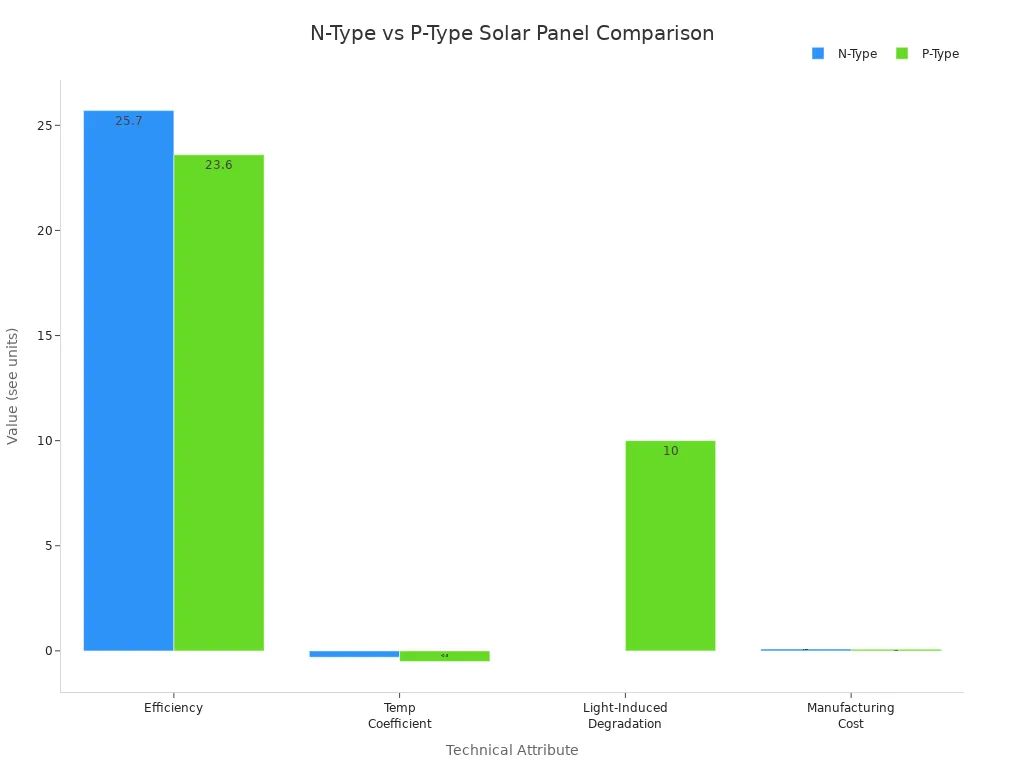
You should pick n-type solar panels if you want the best efficiency. They last longer and work well in small spaces. N-type panels perform better than p-type panels. Here is a table that shows their efficiency:
Panel Type
Efficiency Rate
N-Type
25.7%
P-Type
23.6%
N-type panels give you more value over time. After 25 years, n-type panels keep 88–90% of their power. P-type panels keep only 80–84% of their power. If you want a smart choice for the future, n-type panels are the best.
Key Takeaways
N-type solar panels work better. They can reach up to 25.7% efficiency. P-type panels reach only 23.6%. This means you get more power from the same area.
N-type panels break down slower. They lose only 0.4-0.5% of their power each year. This helps them last longer and stay reliable.
If your roof is small or you use lots of energy, n-type panels are best. They make more energy. You need fewer panels to meet your needs.
N-type panels work well in tough weather. They keep their efficiency in hot or dim places. This makes them a good pick for hard climates.
N-type panels cost more at first. But they save you more money over time. This is because they last longer and work better.
N-Type vs. P-Type Solar Panels
Efficiency and Output
When you compare n-type vs p-type panels, you see clear differences in efficiency and output. N-type solar panels reach higher efficiency rates, often around 25.7%. P-type panels usually reach about 23.6%. This means you get more power from the same space with n-type. In real-world conditions, n-type panels give you 8-12% more output under standard sunlight. On cloudy days, n-type panels keep 60-70% of their rated output, while p-type panels drop to 45-55%. You also see better output from n-type in high temperatures. The temperature coefficient for n-type is -0.24% to -0.32% per °C, so they lose less efficiency when it gets hot.
Attribute
N-Type Panels
P-Type Panels
Efficiency
25.7%
23.6%
Temperature Coefficient
-0.24% to -0.32%/°C
-0.35% to -0.40%/°C
Output in Low Light
15-20% higher
-
Degradation and Lifespan
You want panels that last. N-type panels degrade slower than p-type. N-type panels lose only 0.4-0.5% of their output each year. P-type panels lose 0.8-1.0%. Over 30 years, n-type panels keep more of their original efficiency. N-type panels do not suffer from Light Induced Degradation (LID). This means you get steady output and better reliability. P-type panels can lose up to 10% of their output in the first year due to LID. N-type panels often come with warranties up to 30 years or more. P-type panels usually last 25-30 years.
Tip: If you want panels that keep their output for decades, n-type is the better choice.
Cost Differences
N-type vs p-type panels differ in cost. N-type panels cost more to make, usually $0.25-$0.35 per watt. P-type panels cost less, around $0.18-$0.25 per watt. You pay more upfront for n-type, but you get higher efficiency and longer output. Installation costs for n-type are also higher, but the extra output and longer lifespan can save you money over time. P-type panels have lower installation costs because they use older, well-known technology.
P-type panels: Lower upfront cost, shorter lifespan, less output.
When to Choose N-Type Solar Panels
Limited Roof Space or High Energy Demand
Sometimes your roof is small. You want to get as much energy as you can. N-type solar panels are more efficient than other types. They make more electricity even if you have less space. Many city homes have small roofs. Every panel matters. N-type panels can reach over 22% efficiency. P-type panels usually have 15-18% efficiency. This means you need fewer panels to power your home.
You get more energy in small spaces.
You save money because you buy fewer panels.
You can meet high energy needs with less roof space.
If your house uses a lot of electricity, n-type panels help you. You do not need to cover your whole roof. The table below shows the difference:
Metric
N-Type Panels
P-Type Panels
Efficiency
22.5-26.1%
21.4-23.6%
First-Year Degradation
1%
2-2.5%
Annual Degradation
0.4%
0.45-0.55%
Capacity After 30 Years
87.4%
84.8%
Temperature Coefficient
-0.28%/°C
-0.45%/°C
Bifaciality
85%
75%
LID Impact
None
1-3%
N-type panels give you 8% to 12% more energy in 25 years. This extra energy helps you pay less for electricity.
Tip: If your roof is small or you need lots of power, n-type panels are the best choice.
Harsh Climates and High Temperatures
You might live where summers are hot or the sun is strong. N-type panels work better in these places. They lose less power when it gets hot. P-type panels lose more energy in the heat. N-type panels also work well on cloudy days or in the morning.
N-type panels keep 80-88% efficiency in low light.
P-type panels only reach 70-75% in the same weather.
N-type panels do not have light-induced degradation. This means they give steady power every year. They also handle high-voltage stress well. Your panels last longer and work better in tough weather.
Feature
N-Type Panels
P-Type Panels
Light-Induced Degradation (LID)
No LID, more stable
Loses 2–3% output in the first year
PID Resistance
Strong resistance to high-voltage PID stress
Weaker resistance
Cell Efficiency
22–24% efficiency
20–21% efficiency
Lifetime & Stability
Longer operational life, less recombination
Shorter lifespan, more recombination
Performance in High Temperatures
Lower temperature coefficient, less power loss
Higher power loss in hot climates
If you live somewhere hot or cloudy, n-type panels give you more steady energy. You do not have to worry about big drops in power.
Long-Term Investment Goals
You may want your solar panels to last a long time. N-type panels give you the best value for many years. They lose power slower than p-type panels. After 30 years, n-type panels keep about 87% of their starting power. P-type panels keep about 85%. This small difference grows over time.
N-type panels do not have boron-oxygen degradation. This keeps your system strong for years.
You get longer warranties, sometimes up to 30 years.
You save more money because your panels last longer.
N-type panels are smart if you want to invest for the future. You get more energy, less work, and better savings. You also help the planet by using fewer resources.
Note: N-type panels are great for families who will stay in their homes for a long time or for anyone who wants the best value.
You should pick n-type solar panels if your roof is small, you live in a hot or cloudy place, or you want your system to last many years. These panels give you better efficiency, stronger performance, and more savings.
Cost-Benefit Analysis for N-Type Panels
Payback Period and ROI
You want to know if the higher cost of n-type panels pays off. Start by looking at how much energy your panels produce each year. N-type panels give you 15-20% more energy over 25 years than p-type panels. This extra output means you save more on your electric bill. You can calculate your payback period by dividing the total cost of your system by your yearly savings. For example, a commercial system with n-type panels may have a payback period of 8 years, while a residential system could take about 15 years. The return on investment grows because n-type panels keep more of their power over time.
Metric
N-Type Panels
P-Type Panels
Energy Production
15-20% more over 25 years
Less than N-Type
Power Retention (10 years)
97.5%
95%
Lifespan
Over 30 years
Less than N-Type
Tip: The longer you use your panels, the more value you get from the higher cost.
Maintenance and Warranty
You want panels that last and do not need much work. N-type panels need cleaning every 2-4 weeks in dusty places, just like p-type panels. However, n-type panels lose less power from dirt. You should check your panels once a year. N-type panels show fewer problems in the first 10 years. They also keep a higher performance ratio, usually above 85%. P-type panels may drop to 80-83%. When you look at warranties, n-type panels stand out. Most brands offer a 20-year product warranty and a 30-year performance warranty. P-type panels usually come with a 12-year product warranty and a 25-year performance warranty.
Maintenance Aspect
N-Type Panels
P-Type Panels
Cleaning
Every 2-4 weeks in dusty environments
Similar, but more impact from soiling losses
Inspection
Annual; fewer issues in first 10 years
Annual; may show more issues
Performance Monitoring
Maintains 85%+ performance ratio
Maintains 80-83% performance ratio
Panel Type
Product Warranty
Performance Warranty
N-Type
20 years
30 years
P-Type
12 years
25 years
Real-World Value Examples
You can see the real value of n-type panels in actual projects. For a home system, the installed cost might be $24,000. You could get 1,400 kWh more energy each year, saving about $196. The payback period is around 15 years, and you gain $2,800 more over the system’s life. For a business, a 500kW system could cost $75,000. The extra energy each year saves $9,350, with a payback period of 8 years and a net present value advantage of $95,000.
System Type
Cost Installed
Annual Energy Difference
Annual Savings
Payback Period
NPV Advantage
Residential (8kW)
$24,000
1,400 kWh
$196
15.3 years
$2,800
Commercial (500kW)
$75,000
85,000 kWh
$9,350
8.0 years
$95,000
Note: N-type panels may cost more at first, but you save more money and get more energy over time.
Who Should Buy N-Type Solar Panels?
Homeowners with Specific Needs
You should consider n-type panels if you want the best solar panels for your home. These panels work well when you have a small roof or high energy bills. You get more electricity from each panel, so you need fewer panels to meet your needs. If you plan to stay in your home for many years, n-type panels give you long-term value. You also benefit if you live in a place with hot summers or cloudy weather. These panels keep their power even when the weather changes. You can find the best solar panels by looking at efficiency, durability, and how they perform in your climate.
Tip: If you want to choose the best solar panels for a small roof or tough weather, n-type panels are a smart pick.
Commercial and Industrial Uses
Businesses and factories often need a lot of power. You can use n-type panels to get more energy from less space. This helps if your building has a limited roof or you want to lower your energy costs. N-type panels last longer and need less maintenance. You save money over time because these panels keep working well for many years. Many companies use solar panel ranking lists to find the best solar panels for their projects. You should look for panels that have high efficiency and strong warranties.
N-type panels help you reach your energy goals faster.
You can trust these panels to work in harsh environments.
Getting the Best Solar Panels for Your Situation
You want to find the best solar panels for your home or business. Start by looking at these factors:
Efficiency: Higher efficiency means more power from each panel.
Durability: Choose panels that can handle wind, snow, and heat.
Performance in Different Climates: Check how panels work in hot or cold places.
Manufacturer’s Reputation: Pick panels from trusted companies with good reviews.
You can use a solar panel ranking to compare options. This helps you choose the best solar panels for your needs. If you want to find the best solar panels, look for n-type panels when you need top performance, long life, and strong warranties.
Note: You should always compare different panels and talk to a solar expert before you decide.
N-type solar panels give you better efficiency and last longer. They work well even when the weather is tough. You get steady power for 25 years. You also save money over time. The table below explains why experts like n-type panels:
Reason
Benefit
Efficiency and cost balance
More power and less loss as years pass
Mature supply chain
Easy to find and very reliable
Design optimization
Works well in hot and shady places
Project fit
Good for payback and long-term plans
Think about how big your roof is. Check your weather and how much energy you need. Compare prices or ask a solar expert before you decide.
FAQ
What makes n-type solar panels different from p-type panels?
N-type panels use a different silicon base. You get higher efficiency and less power loss over time. These panels also resist common problems like light-induced degradation.
Are n-type solar panels harder to install?
You install n-type panels the same way as p-type panels. Most installers know how to work with both types. You do not need special tools or extra steps.
Do n-type solar panels work well in cold weather?
Yes, n-type panels perform well in cold climates. You get steady power even when temperatures drop. Snow and ice do not harm their efficiency.
How long do n-type solar panels last?
You can expect n-type panels to last over 30 years. Most brands offer long warranties. You get reliable power for decades.
Are n-type solar panels worth the extra cost for small homes?
If you have limited roof space or high energy needs, n-type panels give you more power per square foot. You save money in the long run because you need fewer panels.