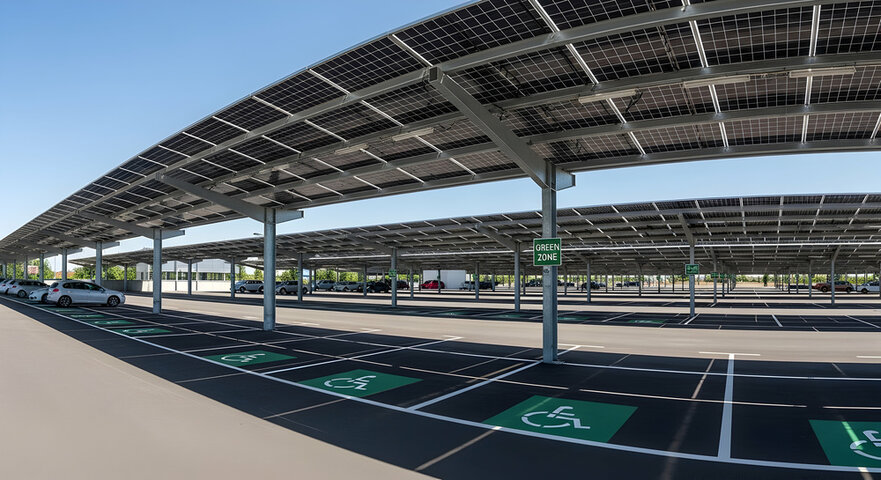
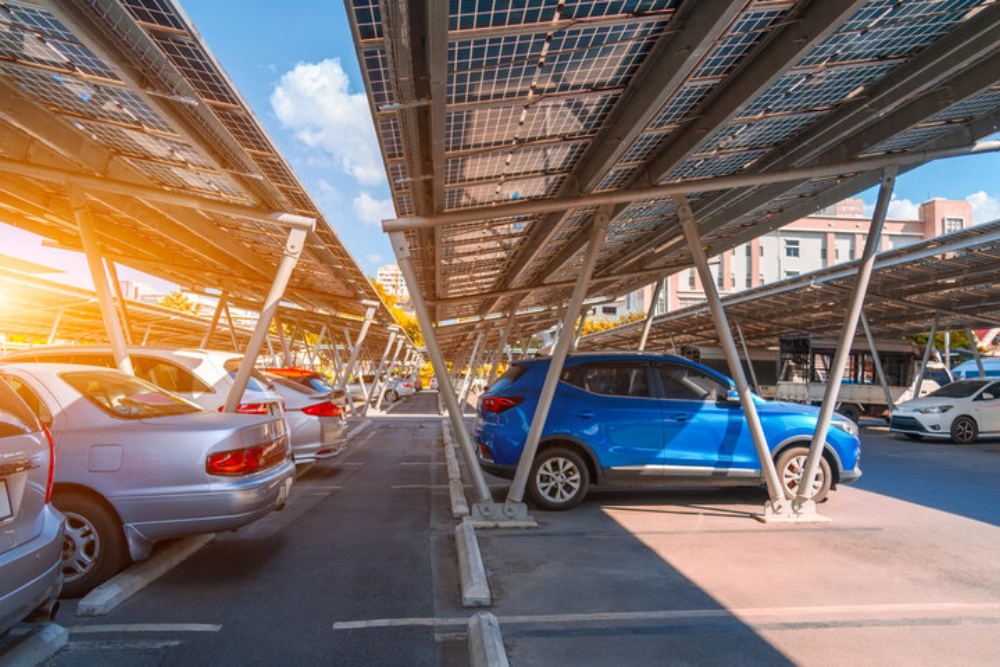
Solar power carports give you two main benefits. They keep your car safe from sun and rain. They also make clean energy for you. Good planning helps you save money and get enough energy. How much energy you get depends on the carport’s size and setup. For example, a big commercial lot with over 20 kW can make more than 26,000 kWh each year.
| Carport Size | Average Capacity | Annual Energy (kWh) | Cars Covered |
| Single-car | 2 – 4 kW | 2,600 – 5,200 | 1 |
| Double-car | 6 – 9 kW | 7,800 – 11,700 | 2 |
| Commercial lot | 20+ kW | 26,000+ | 5+ |
Key Takeaways
Solar carports keep your car safe and make clean energy. They help you save money on your electric bills.
Pick the best size and direction for your solar carport. This helps it make more energy and work better.
Use solar design software to check how much energy you need. It helps you plan your solar carport well.
Clean the panels often and look for shade on them. This keeps your solar carport working its best.
You can add EV charging stations to your solar carport. This makes it more useful and brings in people who care about the environment.

Solar Power Carports Overview
What Are Solar Carports?
You can see solar carports at homes, businesses, and parking lots. A solar carport is a parking spot with solar panels on top. It looks like a normal carport but does more. It protects your car and makes energy. Builders use strong steel or aluminum to hold the panels up. There are different styles like cantilever, single-post, and double-post. These styles help you pick what works best for your space.
| Category | Description |
| By Design | Cantilever, Single-post, Double-post |
| By Materials | Steel, Aluminum |
| By Size | Residential carports (1–4 cars), Commercial carports (large scale) |
Solar parking canopy systems work for homes and big businesses. You can use a solar panel carport for one car or many cars in a large lot.
How Solar Carports Work
Solar carports use photovoltaic panels to make electricity from sunlight. When sunlight hits the panels, it makes direct current (DC) power. An inverter changes DC power into alternating current (AC). You use AC power in your building or send it to the grid. Installing a solar carport means putting up panels, wiring, and connecting the inverter. You get solar power where you park your car. Solar parking canopy setups work best when panels are placed at the right angle.
Dual Benefits: Protection and Energy
Solar carports give you two big benefits. They keep your car safe from sun, rain, snow, and hail. This helps your car stay cool and stops paint and seats from getting damaged. Solar carports also make clean electricity. You save money on bills and help the planet. Solar parking canopy systems use space you already have to make energy. You get more freedom, save money, and your property value goes up. Solar carports help businesses and communities by making parking lots more useful.
Tip: Solar carports protect your car and make solar energy, so they are a smart choice for homes and businesses.
| Feature | Traditional Carports | Solar Carports |
| Functionality | Give shade and make parking easier | Give shade and make energy from sunlight |
| Energy Savings | No energy savings | Help save energy and lower electricity bills |
| Environmental Impact | Little impact, no energy made | Lower carbon footprint by making clean energy |
Sizing Solar Carport Systems
Assessing Energy Needs
Before you get a solar carport, you need to know your electricity use. First, look at your power bills to find your average monthly usage. Next, see how much sunlight your solar parking canopy gets each day. You should also check local utility rates to learn how much you can save. Use all this information to pick the right size for your solar carport. Many people use solar design software to help with these steps. These tools let you make a model of your solar carport, check for shading, and guess your savings.
| Software Name | Key Features | Best For | Pricing | G2 Rating |
| Solar Design Software | 3D modeling, shading analysis | Fast-growing solar businesses | Pay-as-you-go | 4.3 stars / 2 reviews |
| PV*SOL | PV simulation, battery storage | Solar designers and engineers | License-based | 4.3 stars / 10 reviews |
| PVsyst | PV simulation, databases | Engineers and researchers | License-based | 4.7 stars / 17 reviews |
Tip: You can use these tools to plan for the best solar energy and efficiency.

Space and Structural Factors
The size of your solar carport depends on your space and materials. Steel frames are good for big solar carports because they hold more weight. But steel needs protection from rust. Aluminum frames are lighter and do not rust easily. They cost more and may not hold heavy panels. The structure type matters too. Single-pole designs fit small lots. Double-pole designs work for homes and public places. Continuous structures are best for big industrial parks and last longer.
| Material | Characteristics | Suitability |
| Steel | Strong, cost-effective, needs protection | Best for large solar carports |
| Aluminum | Light, resists corrosion, costs more | Good for wet areas, less load-bearing |
| Structure Type | Description | Ideal Use |
| Single-Pole | One pole for support | Small commercial lots |
| Double-Pole | Two poles for stability | Homes and public spaces |
| Continuous | Connected units | Industrial parks |
Cost vs. Output Balance
You want your solar carport cost to match your energy goals. Solar carport systems cost between $3.17 and $3.24 per watt. Rooftop systems cost less, but solar carports give you extra benefits. Commercial solar carports pay for themselves in 5 to 8 years. They give you a 12-15% yearly ROI. Residential solar carports take 7 to 12 years to pay off. They give you an 8-12% ROI. If you cover 20 or more parking spaces with a solar parking canopy, you get the best return. More spaces mean more energy and bigger savings. You should think about adding more solar panel carport structures for the best results.
| System Type | Cost per Watt | Payback Period | Annual ROI | Lifecycle Value |
| Carport Solar Commercial | $3.24 | 5-8 years | 12-15% | 25-30 years |
| Rooftop Commercial | $1.84 | 4-6 years | 10-13% | 20-25 years |
| Carport Solar Residential | $3.17 | 7-12 years | 8-12% | 25-30 years |
The size of your solar carport and the number of panels change your energy and savings.
Adding more solar parking canopy structures increases your ROI.
Always check the best number of solar carports for your property.
Solar Carport Orientation and Tilt
Getting the orientation and tilt right for your solar carport can boost energy generation by 20-30%. You want your solar carport to catch as much sunlight as possible. This helps you get maximum efficiency and better solar power generation from your system.
Optimal Direction for Panels
You should always think about the direction your solar carport faces. The best direction depends on your energy needs and your site. Most people in the Northern Hemisphere point their solar carport south. This direction lets your panels get the most sunlight during the day. You also need to look at the sun’s path and any buildings or trees nearby. Every solar carport design is different, so you should choose the direction that fits your space and goals.
The best orientation depends on your specific energy needs.
The angle and position of your solar carport matter for energy generation.
Each solar parking canopy has unique benefits, so there is no single best direction.
Best Tilt Angles by Location
The tilt angle of your solar carport changes how much sunlight your panels get. You should match the tilt angle to your location’s latitude. If you live near the equator, you need a small tilt. If you live farther north or south, you need a bigger tilt. This table shows the best tilt angles for different places:
| Latitude Range | Recommended Tilt Angle |
| Below 5° | 5° |
| 5° to 10° | Equal to latitude |
| 10° to 20° | Latitude × 0.9 |
| Above 20° | Latitude × 0.85 |
You can use these numbers to set your solar carport for the best solar energy generation. The further you are from the equator, the higher you should tilt your solar panel carport.
Minimizing Shading
Shading can lower the output of your solar parking canopy. You want to keep your solar carport free from shade as much as possible. Here are some ways to do this:
Use tools like 3D modeling software to check for shade.
Place your solar carport away from trees and tall buildings.
Adjust the tilt to match your latitude and the sun’s angle.
Design your solar parking canopy so that one row does not block another.
Group panels with similar shade patterns together.
Leave enough space from the edges and other objects.
Trim or remove trees that block sunlight.
Raise your solar carport if ground objects cause shade.
Split your solar carport across different areas if needed.
Plan for future changes that might cause shade.
Tip: You can get more energy and better savings by checking for shade before you build your solar carport.
By choosing the right orientation and tilt, and by reducing shading, you help your solar carport reach its full potential for energy generation.

Energy Output Calculations
Key Formulas and Variables
You can figure out how much energy your solar carport makes with a simple formula. This formula helps you plan your solar parking canopy and guess your savings. You need to know the rated power of your panels. You also need the average hours of peak sunlight. The efficiency factor is important too. It shows how dust, temperature, and shading affect your system.
| Component | Description |
| STC Rating | Rated power of the solar panels under Standard Test Conditions (in watts) |
| Peak Daily Sunlight Hours | The average number of hours of peak sunlight received per day |
| Efficiency Factor | A factor (0.75) to account for real-world conditions that may reduce output |
| Output Formula | Output = STC Rating x Peak Daily Sunlight Hours x 0.75 |
You can use this formula to guess daily, monthly, and yearly energy output. The efficiency factor helps you get a better answer because real solar carport output is usually less than the perfect number.
Tip: Always use the efficiency factor when you do your math. This helps you avoid guessing too high for your solar carport’s energy.
Example Calculations
Let’s look at an example step by step. You want to know how much energy your solar carport makes each month and year.
Find your solar panel’s wattage. For example, you have a 300 W panel.
Estimate the average sunlight hours your solar parking canopy gets each day. Let’s say you get 5 hours.
Use the efficiency factor. Most solar carport systems use 0.75.
Calculate daily output: Output = 300 W x 5 hours x 0.75 = 1,125 Wh or 1.125 kWh per day.
Calculate monthly output: Monthly Output = 1.125 kWh x 30 days = 33.75 kWh.
Calculate yearly output: Annual Output = 1.125 kWh x 365 days = 410.625 kWh.
If you add more panels or build a bigger solar panel carport, multiply the output by the number of panels. For example, a solar carport with 20 panels will make 20 times more energy.
Note: Real output is often lower than the nameplate rating. Studies show actual energy can be about 24% less than predicted. Dust, high temperatures, and shading lower your solar carport’s performance.
Factors Affecting Performance
Many things change how much energy your solar carport makes. You should think about these when planning your solar parking canopy.
| Variable | Impact on Energy Production |
| Direction and Tilt Angle | Increase by 15% |
| Shading | Significant decrease |
| Temperature | Affects voltage and output |
| Cleanliness of Panels | Reduces sunlight absorption |
Direction and tilt angle: If you set your solar carport at the right angle and direction, you can boost output by up to 15%.
Shading: Even small shadows from trees or buildings can lower your solar parking canopy’s output a lot.
Temperature: High temperatures reduce voltage and power output.
Cleanliness: Dust and dirt block sunlight, making your solar carport less efficient.
Other things matter too, like solar irradiance, weather, and where you live. Seasons also change your output. Summer days are longer and sunnier, so your solar carport makes more energy. Winter days are shorter and cloudier, so you get less energy. Your solar carport’s output will change every month.
Solar irradiance and weather affect how much sunlight reaches your solar carport.
Dust and shade from nearby objects can lower your solar parking canopy’s performance.
Where you live and local features change the sunlight you get.
Seasonal patterns mean your solar carport makes more energy in summer and less in winter.
Tip: Clean your panels often and check for shade. This keeps your solar carport working well.
You can use these steps and tips to guess your solar carport’s output and plan for changes during the year. This helps you manage your energy use and savings.
Solar Carports: Challenges and Solutions
Managing Excess Energy
Solar carports can make more electricity than you use. You can turn this extra power into something good. Net metering lets you sell unused energy back to the grid. You get credits on your bill and help others with clean energy. Solar carports also help you earn money and lower your bills. You can attract customers who care about the environment without needing more space.
Net metering gives you credits for extra power.
You help the grid and make less pollution.
Solar carports save you money and help your business grow.
Tip: Ask your utility company if net metering is offered in your area.
Integrating EV Charging
You can put electric vehicle charging stations in your solar carport. This makes your parking area more useful and ready for the future. Solar energy can power EV chargers, especially when electricity costs more. You can earn more money by joining grid programs or demand response plans. Adding EV chargers to solar carports may get you extra rewards and tax breaks.
| Benefit | Description |
| Time-of-Use Optimization | Use solar energy for EV charging when utility rates are high. |
| Grid Services Revenue | Join programs that pay you for helping the grid. |
| EV Charging Integration | Add EV chargers easily to your solar carport. |
| Incentive Stacking & Tax Optimization | Get more financial benefits by combining solar and EV charging. |
| Future-Proofing Commercial Assets | Prepare your property for more EVs and new technology. |
Note: Adding DC Fast Chargers to your solar carport helps you get ready for more EVs in the future.
Maintenance Tips
Taking care of your solar carport keeps it working well for a long time. Clean your panels often with a soft brush and gentle soap. Look for rust or damage on metal parts. Trim trees and bushes so they do not block sunlight. Watch your energy output to find problems early. Hire experts for checks and deep cleaning. Remove snow in winter to keep panels clear. Use coatings that stop rust. Check bolts and concrete for cracks. Keep electrical systems safe and working.
Clean panels and remove dirt often.
Look for rust, cracks, and loose bolts.
Watch energy output and check wires.
Hire experts for deep checks and repairs.
| Maintenance Task | Frequency |
| Annual inspections | Once a year |
| Biannual cleanings | Two times a year |
| Solar panel cleaning | When needed |
| Checking electrical connections | When needed |
| Inspecting solar inverters | When needed |
| Replacing worn parts | When needed |
Tip: Use skilled workers who know solar and canopy building for the best results.
You can get more energy from your solar carport by picking the right size. You should also set the best direction for your carport. Use good math to figure out how much energy you will make. Before you build, look at your site and follow these steps:
| Step | Description |
| Obtain Permits | Ask local officials for approval. |
| Site Preparation | Make the ground flat and check if the soil is strong. |
| Address Challenges | Fix problems with your site early. |
Getting help from experts gives you solutions that fit your needs. You also get a clear idea of costs. Solar carports help you save money for many years. They lower your utility bills and make your property worth more. This helps you get the most value and return for your project.
FAQ
How much does a solar carport cost?
You pay between $3.17 and $3.24 per watt for most solar carports. The total price depends on size, materials, and location. You save money over time with lower energy bills.
How often should you clean solar panels?
You clean your solar panels two times a year. Dust, leaves, and bird droppings lower energy output. Use a soft brush and water for best results.
Can you use solar carports for electric vehicle charging?
You can add EV chargers to your solar carport. Solar energy powers your car and helps you save money. Many businesses use this setup to attract more customers.
What affects the energy output of your solar carport?
Sunlight hours, panel direction, tilt angle, and shading change your energy output. Clean panels and good placement help you get the most power.