If you want your solar setup to work well in 2026, pay attention to some important Solar Panel Parts and accessories. Here is what matters most:
| Component Type | Why It Matters |
| Inverters | Make sure your system changes solar energy well, even on tricky roofs. |
| Racking Systems | Hold your panels tight and point them at the sun. This helps them last longer and make more power. |
| Storage Options | Let you use more solar power and keep lights on during blackouts. |
| Monitoring Systems | Help you see how your solar panels work and find problems fast. |
Monocrystalline solar panels give you good efficiency and last a long time. They can work for over 25 years with little loss each year. Pick strong materials and install your solar system carefully for the best results. New things like tandem cells and better batteries make solar power more dependable than ever.

Key Takeaways
Pick high-efficiency solar panels like monocrystalline or tandem cells. These panels give more energy and last longer.
Buy good inverters, especially microinverters, for your system. Microinverters help each panel work well, even if some are in shade.
Choose strong racking systems to hold your panels safely. Good racks keep panels facing the sun for more energy.
Use safe wiring and connectors made for solar systems. This helps stop energy loss and keeps your system safe.
Add monitoring systems to watch how your solar setup works. These systems help you find problems early and keep things running well.
Essential Solar Panel Parts
Solar Panels Overview
You want your solar system to work hard for you every day. The most important solar panel parts start with the panels themselves. These panels turn sunlight into electricity. In 2026, you can choose from some amazing new options. High-performance modules like TOPCon and heterojunction cells give you more power, even when the sky is cloudy. Tandem solar cells combine silicon with perovskite layers. These panels can reach over 30% efficiency, which means you get more energy from the same space.
You also see bifacial panels and tracking systems. Bifacial panels grab sunlight from both sides, so you get extra energy. Tracking systems move your panels to follow the sun. This helps you make the most of every sunny hour. If you want a smart system, look for panels that work with AI and IoT. These technologies help your solar setup run better and cost less to maintain.
Here’s a quick look at the latest advancements you should know about:
High-performance solar modules like TOPCon and HJT cells boost energy conversion.
Bifacial panels and tracking systems capture more sunlight.
Hybrid systems with battery storage give you power even when the sun goes down.
Smart solar panels use AI and IoT for better performance.
When you pick your solar panels, think about how long they last and how much energy they make. The right panels give you reliable power for years.
Inverters and Microinverters
You need inverters to change the electricity from your solar panels into power you can use at home. This is one of the most important solar panel parts. You can choose between string inverters and microinverters. String inverters connect all your panels in a group. If one panel has a problem, the whole group slows down. Microinverters work with each panel on its own. If one panel gets shaded, the others keep working at full speed.
Let’s compare the two types:
| Feature | String Inverter | Microinverter |
| Performance | Limited by the weakest panel, good on unshaded roofs. | Each panel works at its best, great for all roof types. |
| Shade Tolerance | Poor; one shaded panel affects the whole group. | Excellent; shading on one panel does not hurt the others. |
| Monitoring | System-level only. | Panel-level monitoring. |
| Reliability | One failure stops the whole system. | No single point of failure; others keep working. |
| Scalability | Hard to add more panels later. | Easy to add panels any time. |
Microinverters have become very reliable. They fail less than once in 800 units in the first two years. String inverters fail about once in 350 units during the same time. Over a longer period, string inverters can fail almost 9 times out of 1,000, while microinverters fail less than once out of 1,000. If you want a system that keeps running even if one part breaks, microinverters are a smart choice.
Racking and Mounting Systems
You need strong racking and mounting systems to hold your solar panels in place. These components keep your panels safe and pointed at the sun. There are several types you can pick from:
| Type of System | Description |
| Ground-Mounted Systems | Used for big projects on open land. |
| Rooftop Systems | Most common for homes and businesses. |
| Tracking Systems | Move your panels to follow the sun for more energy. |
| Floating Mounting Systems | Sit on water to save land and reduce evaporation. |
You also see fixed-tilt systems that hold your panels at one angle. Tracking systems can move on one or two axes. These can boost your energy production by 20 to 30 percent.
The way you install your racking system matters a lot. Good racking spreads the weight of your panels so your roof stays safe. It also keeps water from pooling, which helps prevent leaks and mold. High-quality materials last longer and protect your investment. If you use strong racking and smart installation, your solar panels will stay secure for many years.
Tip: The reliability of your solar system depends on every part. Don’t cut corners on racking or mounting components. Quality here means safety and long life for your panels.
When you put all these solar panel parts together—panels, inverters, and racking—you get a system that works well, lasts long, and gives you the most energy for your money.
Wiring and Connectors for Solar Power System
Wiring Types and Functions

You want your solar system to be safe and work well. The right wiring is very important. Copper wiring is best because it lets electricity move easily. This means less energy is lost as heat. Your solar panels can work better. Stranded wires bend easily. They are good for places where wires need to move, like in mobile solar systems. Wires that are too thin can get too hot and cause trouble. Always use the right wire size for your solar project.
Picking the right solar cable is very important. It helps your solar power system work safely and well. Cables must handle tough weather and have the right amp rating. This stops them from getting too hot and keeps your system safe.
Here’s what you should look for:
Pick the right wire size for your solar panels’ current.
Thicker wires are safer and make upgrades easier later.
Solar cables last longer because they stand up to sun, water, and heat.
Connectors for Safety and Efficiency
Connectors join your solar panels, inverters, and batteries. Good connectors keep your system safe and help it work well. MC4 connectors are common because they lock tight and stand up to bad weather. Cheap connectors can get too hot and may even start fires. Good connectors lower resistance and stop energy loss.
Check out these trusted connector brands for 2026:
You want connectors that can handle rough weather and last a long time. Check your connectors often to find problems before they get worse.
Buying Tips for 2026
When you buy solar wiring and connectors, pick ones made for solar use. Use copper wires for the best results. Make sure your wires are thick enough for your system. Choose connectors from brands people trust. If you want to grow your solar setup, buy extra wiring and connectors now. This saves you time and money later.
Tip: Never use random parts in your solar system. Always use solar-rated wiring and connectors for safety and value.
Good wiring and connectors help your solar system stay strong, safe, and work well for many years.
Charge Controllers and Batteries
![Charge Controllers and Batteries]()
Role of Charge Controllers
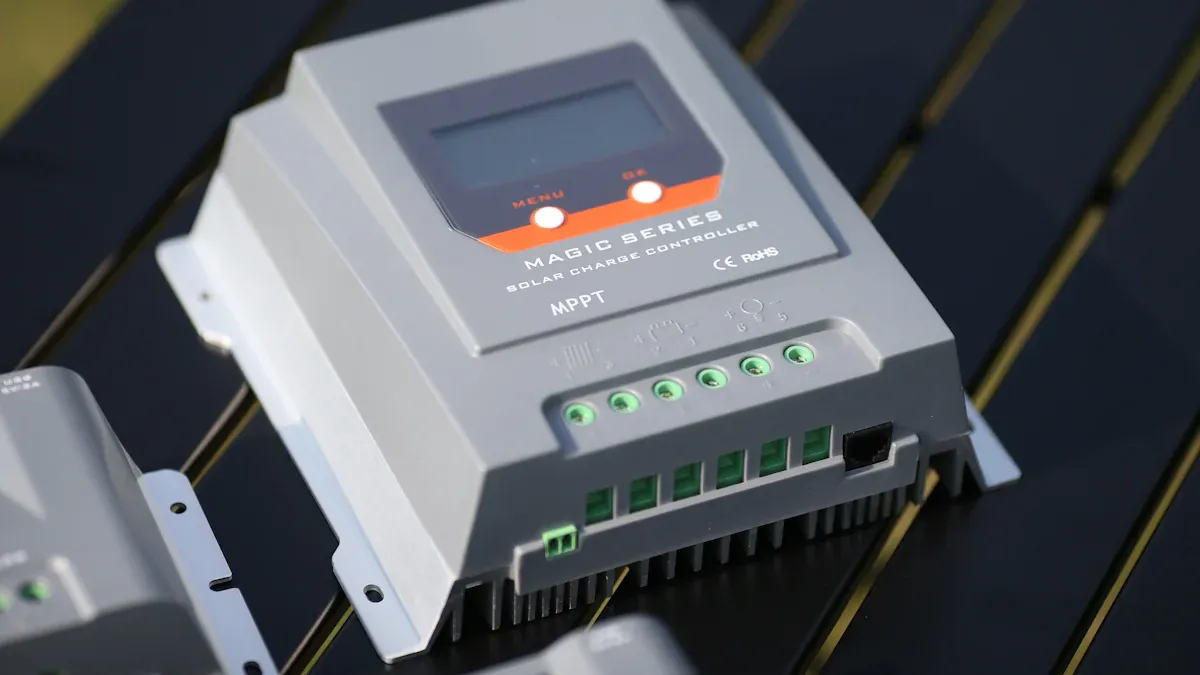
You want your solar panel system to work well for years. Charge controllers help keep your system safe. They act like smart traffic cops for your batteries. Here is what they do:
They stop batteries from getting too full and hot.
They keep batteries from draining too much when there is no sun.
They help batteries last longer by keeping them healthy.
A charge controller works like a smart valve. It controls how much electricity goes to your batteries. This keeps your batteries safe and helps your solar system run well.
| Function | Description |
| Prevents Overcharging | Stops your battery from getting too much power when it is full. |
| Avoids Deep Discharge | Turns off the battery if the charge gets too low. |
| Improves Battery Life | Controls charging and use to make batteries last longer. |
Battery Options for Solar Panel System
You have many choices for solar batteries. The right battery makes your solar system more reliable. Here are some popular options for 2026:
| Battery Model | Cycle Life |
| NEEXGENT NX48200 | More than 6,000 cycles at 80% DOD |
| Tesla Powerwall 3 | More than 5,000 cycles |
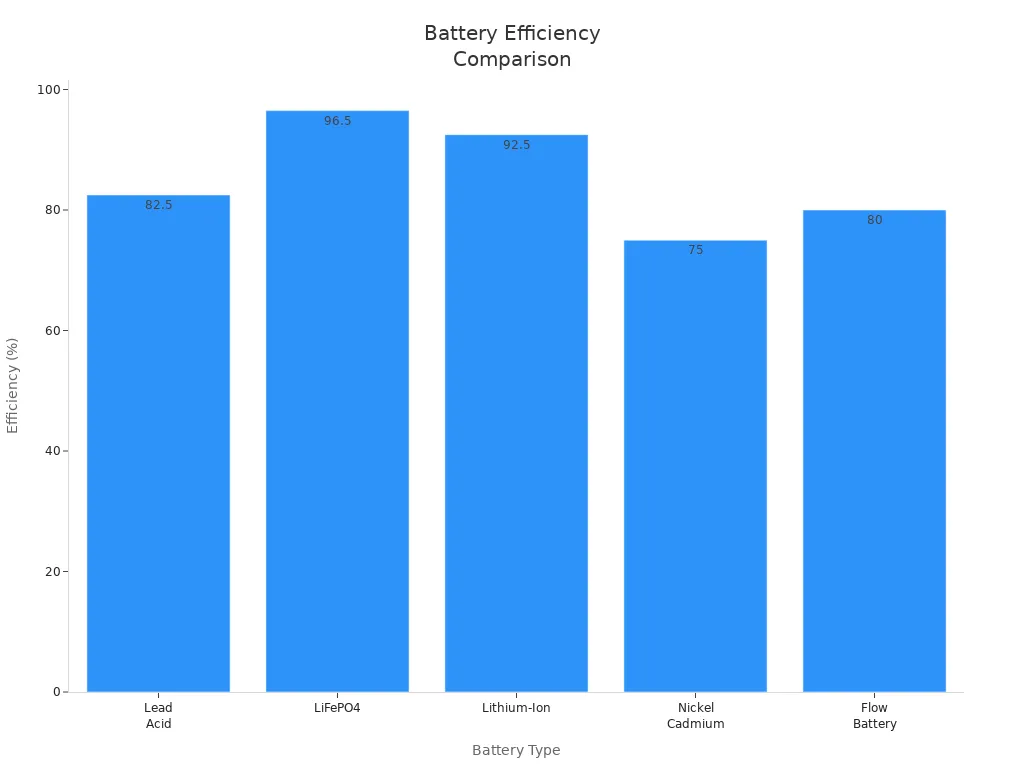
You can compare batteries by how long they last, how well they work, and their price:
| Battery Type | Lifespan (Cycles) | Efficiency | Cost | Maintenance | Best Use Case |
| Lead Acid | 500–1,000 | 80–85% | $ | Medium | Budget systems, backup |
| LiFePO4 | 2,000–5,000 | 95–98% | $$$ | Low | Home storage, daily use |
| Lithium-Ion | 1,500–3,000 | 90–95% | $$$ | Low | Residential or small business |
| Nickel Cadmium | 1,000–2,000 | 70–80% | $$ | Low | Bad weather, industry |
| Flow Battery | 10,000+ | 75–85% | $$$$ | Medium | Big energy storage |
![Bar chart comparing efficiency of five battery types for solar systems]()
Modern solar batteries are very efficient and can be used deeply. Most lithium-ion batteries let you use almost all their power. Good batteries can last 4,000 to 6,000 cycles. You can add more batteries if you need more energy later.
Storage Solutions for Longevity
You want your solar system to last a long time. Here are some tips to keep your batteries working well:
If you follow these steps, your batteries will last longer. Your solar system will stay strong. A good storage system gives you peace of mind and helps you get the most from your solar panels.
Monitoring and Safety Accessories
Performance Monitoring Equipment
You want your solar panels to work well every day. Performance monitoring equipment lets you see how your panels are doing right now. These tools help your solar system run its best. You can find problems early, like shade or broken parts. Fixing problems early saves money and keeps your panels making power.
Here’s what monitoring tools do for you:
You make sure your solar panels turn sunlight into electricity well.
You find and fix problems before they get worse.
You keep your panels working great for a long time.
You get more value from your solar panels.
Performance monitoring shows how your panels react to weather and changes. You can change your setup to get better results. This helps your solar system stay strong and reliable.
Safety Devices and Surge Protection
You want your solar panels to last a long time. Safety devices protect your system from voltage spikes and surges. These can happen from lightning or changes in your home’s power. Surge protection keeps your panels safe and helps them last longer. Without these devices, your solar system could fail in the first ten years. Most problems come from inverters and electronics, not the panels.
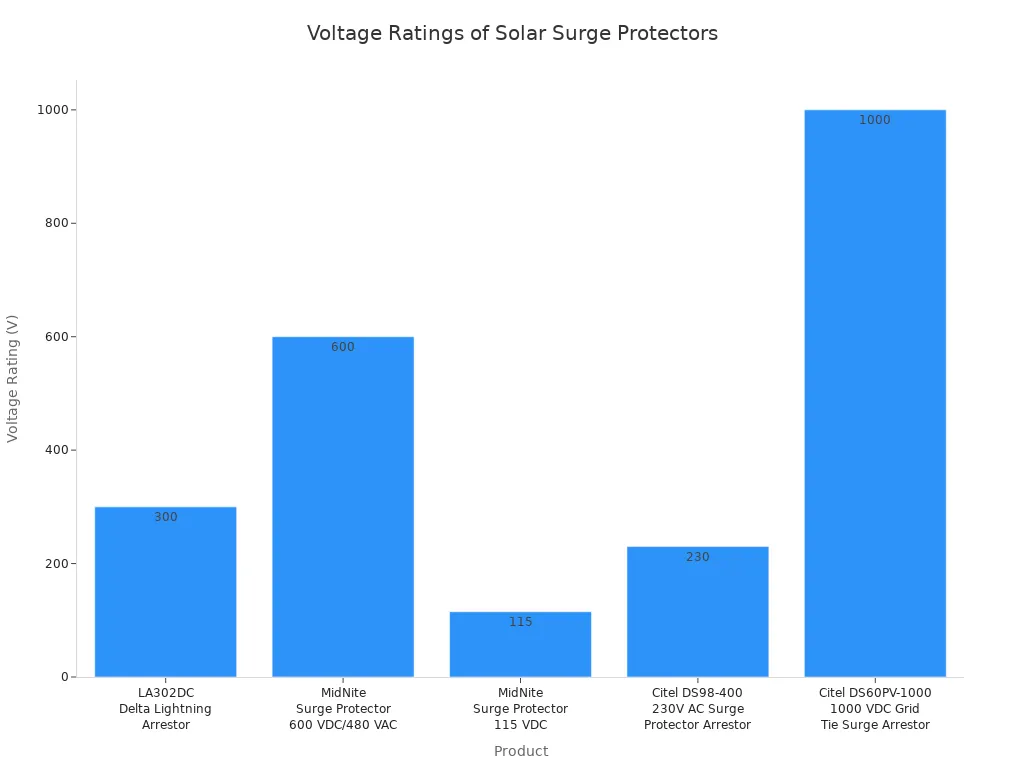
Check out these top surge protection devices for 2026:
| Product | Voltage Rating | Type | Stand-Out Features | Brand |
| LA302DC Delta Lightning Arrestor | 0-300 V DC | Lightning Arrestor | Small size, protects up to 300 V DC | Delta |
| MidNite Surge Protector 600 VDC/480 VAC (MNSPD600) | 600 V DC / 480 VAC | Type 2 SPD | Good for high-voltage grid-tie systems | MidNite Solar |
| MidNite Surge Protector 115 VDC (MNSPD115) | 115 V DC | Type 2 SPD | Works outside, has LED lights | MidNite Solar |
| Citel DS98-400 230V AC Surge Protector Arrestor | 230 V AC | Surge Arrestor | Strong build, protects AC grids | Citel |
| Citel DS60PV-1000 1000 VDC Grid Tie Surge Arrestor | 1000 V DC | Grid Tie Arrestor | Protects very high voltage systems | Citel |
![Bar chart comparing voltage ratings of recommended solar surge protection devices]()
Tip: Surge protection keeps your solar panels safe from sudden spikes. It helps your system work well for many years.
Smart Accessories for Control
Smart accessories give you more control over your solar panels. In 2026, you can use AI-driven monitoring to check weather, energy use, and panel health. Solar tracking systems follow the sun and can boost your energy by up to 35%. New batteries, like lithium-ion and sodium-ion, give you better backup power.
Smart tools help you save energy and money. You can watch your solar panels and energy use in real time. You can set big appliances to run when your panels make the most power. Smart lighting and climate controls help you waste less energy. You can even charge your electric car with solar power. Home security systems now work with solar panels, making your home safer and more efficient.
With smart accessories, you get more energy, more savings, and less trouble from your solar panels.
Boosting Solar Panel System Efficiency
Integration of Solar Panel Parts
You want your solar system to work together like a team. When you connect each part the right way, your solar array gives more power and lasts longer. First, check if your current array can use new parts. Modular solar components make it simple to add panels or storage. If you want to watch how your solar array works, install smart gateways or IoT devices. These tools help your system share data and let you see info from anywhere.
Here’s a table to help you plan your solar setup:
| Strategy | Description |
| Compatibility Issues | Check your array’s layout and size before adding more solar parts. Modular parts help a lot. |
| Communication and Monitoring | Use gateways or adapters for better data sharing. IoT devices give you remote control. |
| Battery Storage Integration | Ask an expert if you need new batteries. You might need to change inverters or add controllers. |
| Compliance with Regulations | Learn local rules before you change your solar array. Experts can help you follow the law. |
When you use advanced solar parts, you get real benefits. You can save 15–30% on cooling energy and boost your PV power by 5–15%. In hot places, your solar array can make 10–20% more energy. You also help the planet by cutting your building’s carbon footprint by up to 25%.
Maintenance and Upgrades
You want your solar array to work well for many years. Regular care is important. Clean your solar panels every week or month, depending on your weather. If you live where it rains a lot, you can clean less. Dusty places need more cleaning. Always check your solar setup for damage or wear.
Here’s a simple list to keep your system working:
Watch your solar array’s output with smart tools.
Check your solar panels, inverters, and mounting parts often.
Get a pro inspection every five to ten years.
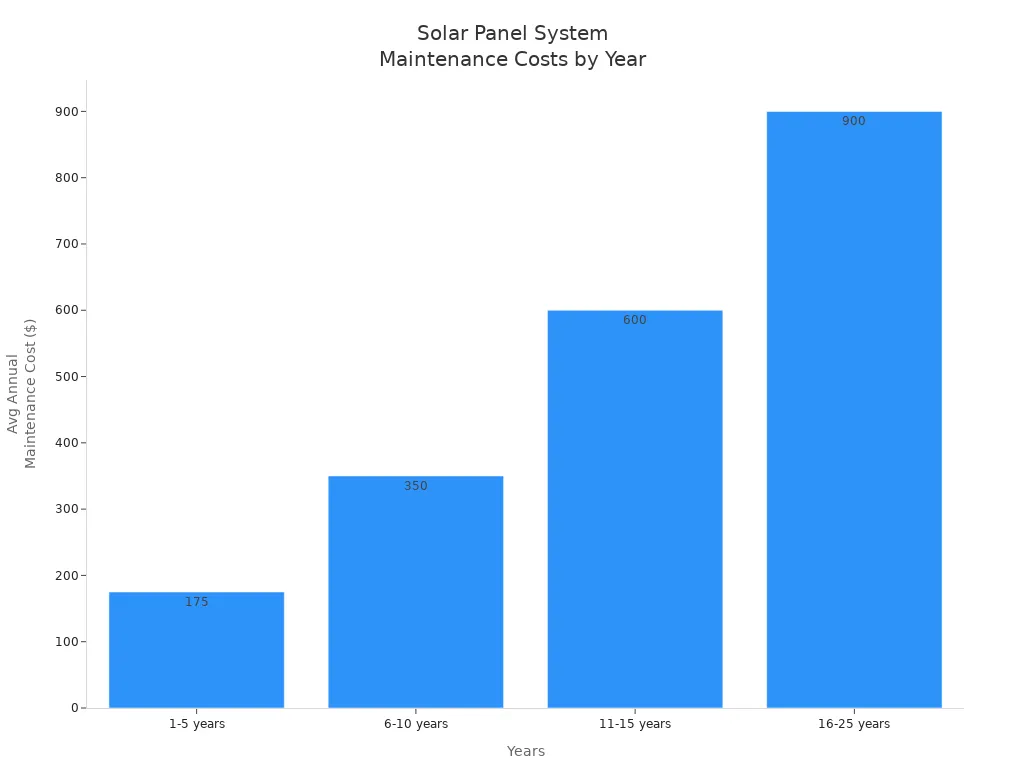
A good solar plan includes cleaning, checking, and fixing your array. You should also plan for upgrades. Here’s what you can expect over time:
| Years | Maintenance Costs (Annual) | Key Activities |
| 1-5 | $150-200 | Basic cleaning, inspection, performance monitoring |
| 6-10 | $300-400 | Inverter updates, small part replacements |
| 11-15 | $500-700 | Inverter swap, fix panel wear |
| 16-25 | $800-1,000 | Replace panels, update wiring, upgrade monitoring |
![Bar chart showing average annual maintenance costs for solar panel systems across four time intervals]()
If you follow these steps, your solar array will stay strong and efficient. You get more energy, fewer problems, and a solar system that works for you every day.
You want your solar system to work for a long time and help you save money. Pick high-efficiency panels, strong inverters, good batteries, and smart monitoring tools. When you buy parts, look for good warranties and trusted brands. Make sure the parts have UL certification. Check that all the parts work well together. This makes upgrades easy later.
Tip: If you use quality parts, you will have fewer problems. You will pay less for power and get more energy for many years.
If you buy the best parts now, you can get free energy and save a lot of money for a long time.
FAQ
What is the most important part of a solar panel kit?
You need to focus on the solar panels and the inverter. These two parts make sure your solar panel kit works well and gives you the most power for your home.
How often should I clean my solar panels?
You should clean your panels every few months. If you see dust or bird droppings, clean them sooner. Clean panels make more energy.
Can I add more panels to my system later?
Yes, you can add more panels if your inverter and racking allow it. Many solar panel kits let you expand your system as your energy needs grow.
Do I need batteries for my solar setup?
You do not always need batteries. If you want backup power during blackouts or at night, batteries help. They store extra energy for later use.
How do I know if my solar system is working right?
You can use a monitoring app or device. These tools show you how much energy your system makes. If you see a drop in power, check for shade or dirt.