You want the best solar panels for your project. If you have a large roof or need commercial power, 540W panels give you higher output. For smaller homes or limited space, 425W panels often fit better. Solar panels comparison helps you see which size matches your goals. Think about your roof size, budget, and how much energy you need. Choose the best solar panels for your space and future plans.
Key Takeaways
Pick 540W panels for big roofs or business use. They give more power and work better.
Pick 425W panels if your roof is small. They fit well and still give enough energy.
Look at the warranty and how strong the panels are. Longer warranties and less damage over time save you money.
Check the price for each watt. 540W panels can cost less if you buy many. 425W panels may be better for small jobs.
Make sure the panels work with your inverter and mounts. This helps them work their best.

Solar Panels Comparison Table
Specs Overview
When you look at solar panels comparison, you want to see how different models stack up. Many top brands like Canadian Solar, JA Solar, and LONGi offer both 540W and 425W panels. The main differences come down to power output, efficiency, size, and cost per watt. You can use the table below to see a clear comparison.
| Feature | 540W Solar Panel | 425W Solar Panel |
| Power Output | 540W | 425W |
| Efficiency | Up to 22.5% | Up to 21.8% |
| Dimensions (mm) | 2278 x 1134 x 35 (typical) | 1722 x 1134 x 30 (typical) |
| Weight (kg) | 28-32 | 20-23 |
| Cost per Watt | Lower (bulk installs) | Slightly higher |
| Temperature Coefficient | -0.34%/°C to -0.38%/°C | -0.34%/°C to -0.38%/°C |
| Wind Load | 2400PA | 2400PA |
| Snow Load | 5400PA | 5400PA |
You see that 540W panels give you more power in a single panel. They also tend to have a slightly higher efficiency. The size is larger, so you need more roof space. The cost per watt is usually lower for 540W panels, especially if you install many at once. For 425W panels, you get a more compact size, which fits better on smaller roofs. The cost per watt can be a bit higher, but you may save on installation if your space is limited.
Tip: Always check the exact dimensions and weight before you buy. Not all 540W or 425W panels are the same size.
Warranty and Durability
Warranty and durability matter when you plan your solar panels comparison. You want panels that last and keep producing energy for many years. Most leading brands offer strong warranties for both 540W and 425W panels.
540W panels often come with a product warranty of 12 to 25 years. The output warranty can last 25 to 30 years. The degradation rate is about 0.45% per year after the first year.
425W panels, like the SunPower A-Series, usually offer a 25-year warranty. This covers both product and performance in many cases.
Both panel types handle tough weather. You get wind load ratings of 2400PA and snow load ratings of 5400PA. This means your panels can stand up to strong winds and heavy snow.
When you make a comparison, look at both the warranty period and the degradation rate. A lower degradation rate means your panels will keep producing more power over time. You also want to check the cost per watt, since a longer-lasting panel can save you more money in the long run.
If you want the best value, compare the specs, warranty, and cost per watt for each panel size. This helps you choose the right panel for your roof and your budget.
Power Output
Energy Production
When you pick solar panels, you want to know how much energy they make. A 540W panel makes more electricity than a 425W panel if both get the same sunlight. One 540W panel gives you more energy each day and year than one 425W panel. For example, with good sunlight, a 540W panel can make about 2.7 kWh every day. A 425W panel makes around 2.1 kWh each day.
Note: The real amount of energy depends on where you live, your roof’s angle, and the weather. You should check how many sunlight hours you get to guess your total energy.
How well your solar panels work also depends on how clean they are and how often you take care of them. Dirt, shade, and snow can lower the energy your panels make. You should keep your panels clean for the best results.
System Sizing
You need to plan your solar system based on how much energy you use and how big your roof is. If your roof is big, you can use fewer 540W panels to reach your energy goal. If your roof is small, you may need more 425W panels to get the same amount of power.
Here is a simple table to help you compare how many panels you need:
| Target System Size | 540W Panels Needed | 425W Panels Needed |
| 5 kW | 10 | 12 |
| 10 kW | 19 | 24 |
Panel clipping happens if your inverter cannot handle all the power from your panels. You should make sure your inverter matches your panels so you do not lose energy. Sometimes, using more panels with lower wattage lets you change your system design more easily. Higher wattage panels help you save roof space and make installation faster.
You should think about your energy needs, roof size, and budget when you plan your system. This helps you get the most out of your solar panels.
Efficiency Comparison
Conversion Rates
You want your solar panels to make lots of electricity from sunlight. This is called panel efficiency. Higher efficiency means more power from the same sunlight. Here are the average efficiency rates for 540W and 425W solar panels:
| Solar Panel Model | Efficiency Rate |
| 540W Bifacial | 20.9% |
| 425W Panel | 23.6% |
The 425W panel has a higher efficiency rate than the 540W panel. This means it can turn more sunlight into electricity, even though it has less wattage. You should also think about how heat affects panel efficiency. When it gets hotter than 25°C, solar panels lose some efficiency. For example, if a panel has a temperature coefficient of -0.35%/°C, it will lose 0.35% efficiency for each degree above 25°C. In hot places, this can lower how much electricity your panels make. Always check the temperature coefficient when you compare panels.
Tip: If you live somewhere hot, pick panels with a lower temperature coefficient for better results.
Space Utilization
Panel efficiency also changes how much roof space you need. If your roof is small, you want panels that give you more power in less space. High-efficiency panels help you get the most energy from a small area. For example, if you use 400-watt panels instead of 300-watt panels, you can save about 25% of your roof space for the same energy. This matters if you want to meet your energy needs but do not have much room.
When you choose solar panels, look at both the efficiency rating and the size. Higher efficiency lets you use fewer panels and still reach your energy goals. This makes your system look nicer and can lower installation costs.
Installation Factors
![Installation Factors]()
Size and Weight
You need to know the size and weight of your solar panels before you install them. Most 425W panels use 60 cells and fit well on homes. These panels usually measure about 65 inches by 39 inches and weigh between 33 and 50 pounds. You can lift and move them more easily. Many 540W panels use 72 cells. These panels are longer and heavier. You may need extra help or special tools to install them.
You should always check if your roof can hold the weight of the panels you choose.
Roof Space
Your roof size decides how many panels you can install. If you have a small roof, 425W panels fit better. You can place them in more ways to cover your roof. If you have a large roof, 540W panels help you reach your energy goals with fewer panels. You save time on installation and wiring.
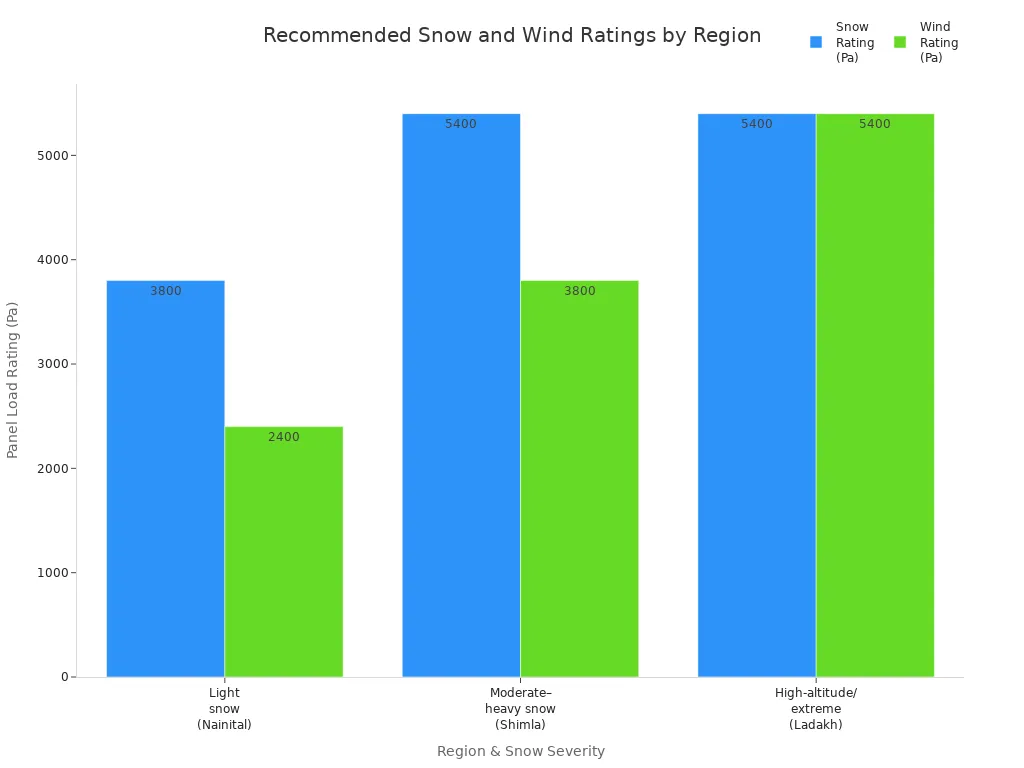
You also need to think about snow and wind. Panels must handle the weather in your area. Here is a table that shows the recommended snow and wind load ratings for different regions:
| Region & Snow Severity | Panel Snow Rating | Panel Wind Rating | Notes |
| Light snow (town cores) | ≥ 3800 Pa | ≥ 2400–3800 Pa | 30–35° tilt; standard anchors |
| Moderate–heavy snow (urban, hills) | ≥ 5400 Pa | ≥ 3800 Pa (5400 Pa for exposed roofs) | 35–40° tilt; stronger clamps |
| High-altitude/extreme | ≥ 5400 Pa | ≥ 5400 Pa | 40–45° tilt; heavier rails |
![Bar chart comparing recommended snow and wind load ratings for solar panels in regions with light, moderate-heavy, and extreme snow conditions.]()
Tip: If you live in a place with heavy snow or strong wind, pick panels with higher load ratings.
System Compatibility
You want your solar panels to work well with your inverter and mounting system. Most 425W panels match standard inverters for homes. You can use common mounting rails and clamps. Many 540W panels need larger inverters and stronger mounts. You may need to check with your installer to make sure everything fits.
You should also look at your roof type. Flat roofs, metal roofs, and tile roofs may need different mounting hardware. Always ask your installer which panels and mounts work best for your roof.
Cost and Value Comparison
Upfront Cost
When you look at solar panel prices, you want to know how much you will spend at the start. The price per product for 540W panels is usually lower when you buy in bulk. You can save money if you have a large roof or a commercial project. For smaller installations, 425W panels may cost a bit more per watt. You might pay a higher price per product, but you can fit these panels on roofs with limited space.
Here is a table to help you see the difference:
| Panel Type | Average Price per Product | Cost per Watt | Typical System Cost (5kW) |
| 540W | $220–$300 | $0.41–$0.55 | $2,200–$3,000 |
| 425W | $180–$250 | $0.42–$0.59 | $2,160–$3,000 |
You should always compare the price per product and cost per watt before you choose. This helps you find the best deal for your budget.
Long-Term Value
You want your solar panels to last and save you money over time. Both 540W and 425W panels have similar lifespans. Most panels work for 25 to 30 years and keep at least 80% of their original efficiency. You will pay maintenance costs of $150 to $300 each year. These costs stay about the same for both panel sizes.
Efficiency and durability help you save more in the long run. High-efficiency panels make more electricity, so you get a faster payback period. Durable panels need fewer repairs and keep working well for many years. When you do a solar panels comparison, look at how much energy each panel makes and how long it will last. This helps you see which panel gives you better value.
Tip: Choose panels with strong warranties and low degradation rates. You will get more savings over the life of your system.
Choosing the Best Solar Panels
Residential vs. Commercial
You need to pick solar panels that match your building. Homes often use panels with high efficiency and small size. Monocrystalline panels work well for houses. They make more power from less space. Businesses or big buildings can use polycrystalline panels. These cost less and cover larger areas. Thin-film panels are good for curved or odd-shaped surfaces. They do not make as much energy.
| Type of Solar Panel | Efficiency Rating | Best Use Case | Advantages | Disadvantages |
| Monocrystalline | 17% - 22% | Limited roof space | Higher efficiency, longer lifespan | More expensive |
| Polycrystalline | 15% - 17% | Large installations | Lower cost, easy to produce | Lower efficiency, more space |
| Thin-film | 10% - 13% | Irregular surfaces | Lightweight, flexible | Shorter lifespan, less power |
Check the panel type before you choose. This helps you find the best solar panels for your needs.
Limited Space Solutions
If your roof is small, you still have choices. You can use different ways to get more energy:
Compact solar panels
Solar building facades
Solar pergolas
Solar canopies
Ground-based solar installations
Balcony solar (plug-and-play micro systems)
High-efficiency roof or terrace kits
Lightweight awnings, canopies, and solar railings
Window and portable solar systems
Shared rooftops and virtual net metering
You can mix these ideas to use your space well. High-efficiency panels help you reach your energy goals with fewer panels. Look for the best solar panels that fit your roof and needs.
Budget Considerations
You want solar panels that fit your budget. Your choice depends on your space and how much energy you need. If you have little space or need lots of power, focus on wattage. If you have lots of space and want to save money, look for lower prices. Think about the total cost, savings over time, and how the panels fit your life.
| Buyer Type | Focus Area |
| Limited space or high energy demand | Prioritize wattage |
| Plenty of space and tight budget | Prioritize price |
| Overall consideration | Total system cost, long-term ROI |
Check the quality of the solar panels and the installer. Pick Tier-1 brands with long warranties. Make sure your installer has the right license and good reviews. Use Google Reviews and Yelp to see what other people say. Long warranties mean the company trusts its products. Always read the terms and conditions to know what is covered.
Tip: The best solar panels give you strong performance, last a long time, and are a good value. Take your time to compare choices and ask questions before you buy.
You should pick a solar panel size that fits your roof, money, and how much energy you use. 540W panels are good for big roofs or business buildings. 425W panels are better for small homes or places with little space. Before picking, look at system size, how much energy you get, the equipment, and the price. Try not to make mistakes like choosing the wrong size or not knowing what the ratings mean. Use guides to check the specs, cost, and warranty. If you compare quotes and cost per watt, you can save money and get good energy for later.
FAQ
What is the main difference between 540W and 425W solar panels?
You get more power from a 540W panel than a 425W panel. The 540W panel is larger and works best for big roofs or commercial spaces. The 425W panel fits smaller roofs and homes.
Can I mix 540W and 425W panels in one system?
You should avoid mixing different wattage panels in one string. Mixing can lower system performance. If you must mix, use separate strings and check with your installer for inverter compatibility.
Which panel size is better for limited roof space?
You should choose high-efficiency 425W panels for small roofs. These panels give you more energy per square foot. You can reach your energy goals with fewer panels and less space.
How do warranties compare between 540W and 425W panels?
Most 540W and 425W panels offer similar warranties. You usually get 25 years for performance and 10 to 25 years for product defects. Always check the warranty details before you buy.
Do larger panels cost less per watt?
You often pay less per watt for 540W panels, especially in bulk. This can lower your total system cost for large installations. For small projects, the price difference may be smaller.