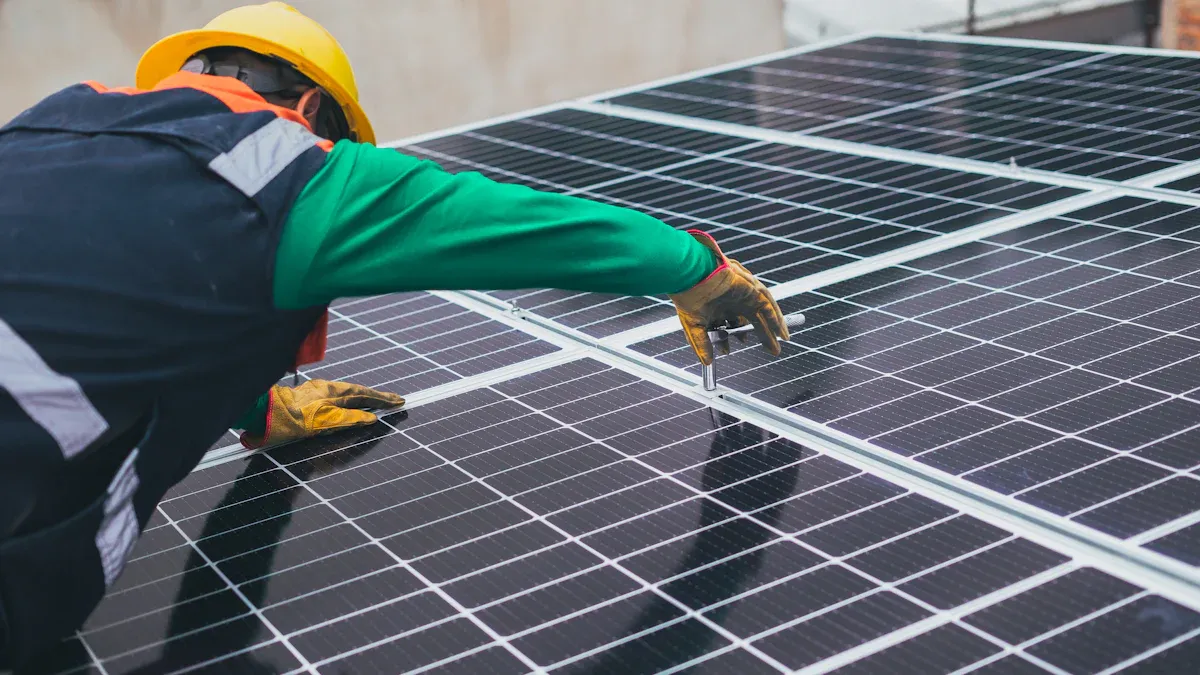
You can find out how fast your solar panels wear out by checking how much energy they make each year. To effectively Measure the Degradation Rate, checking often helps your system work well and keeps your money safe. Studies show that the yearly wear rate is different for each group:
| Study Source | Degradation Rate |
| 53 different plants | 0% to 0.29% |
| U.S. PV fleet | ~0.75% per year |
When you check the wear rate, you can find problems early and make good choices about fixing things. This way, your panels keep working well and you save money as time goes on.
Key Takeaways
Check how much energy your solar panels make every year. This helps you see if they are getting weaker. You can find problems early and keep them working well.
Use tools like apps and sensors to get good data about your solar panels. This data helps you know if your panels make less energy.
Clean your solar panels two times a year or more. Dirt and leaves can block sunlight. Clean panels make more energy.
If you see your panels making much less energy or strange error messages, get help from a pro. Fixing problems early can save you money and make your panels last longer.

Understanding Solar Panel Degradation
What Is Degradation?
Solar panel degradation means your panels slowly stop making as much electricity from sunlight. This happens over a long time. Each year, you may see a small drop in how much energy they make. Many things can cause this to happen:
Delamination: The layers inside the panel can pull apart, mostly near laser scribing spots. This makes the panel work less well.
Light-induced changes: Sunlight can change the silicon cells, especially when you first use the panels.
UV exposure: Ultraviolet rays from the sun can hurt some parts inside the panel, mostly in some designs.
Thermal cycling: When it gets hot and cold each day, tiny cracks can form in the panel.
Aging of materials: Plastic parts inside the panel can turn yellow or get hard. The back layer can break and let water in.
Environmental stress: Heat, wet air, and dust can make the panels wear out faster, especially in tough places.
Different panels last for different times. Monocrystalline panels can last more than 30 years. They have the lowest solar panel degradation rates. Polycrystalline panels last about 25 to 30 years. Thin-film panels last 10 to 20 years and wear out faster.
Tip: Hot weather, wet air, and strong sunlight can make panels wear out faster. Cleaning your panels and keeping them cool helps slow this down.
Why Monitoring Matters
You want your solar panels to last a long time. Checking them often helps you find problems early. If you find issues soon, you can fix them before they get worse. This saves money and keeps your system working well.
Panels can still make 80% to 92% of their first power after 25 years if you take care of them.
If you do not fix small problems, your energy can drop by 20% to 30%.
Emergency repairs cost a lot more than regular check-ups.
Some panels in France still made almost 80% of their first power after 31 years. This shows that watching your panels and taking care of them really helps. When you check your system, you protect your money and help your panels last longer.
Key Data for Measuring Degradation Rate
Tracking Energy Output
You need to track how much energy your solar panels make each year. This is called annual kwh production. You can collect this data from your inverter or a special energy meter. Most systems show daily, monthly, and yearly kwh numbers. Write down the kwh produced at the end of each year. This helps you see if your panels are making less energy over time.
| Measurement Level | kWh Produced |
| Inverter 1 | 175.77 kWh |
| Inverter 2 | 251.88 kWh |
| Inverter 3 | 213.90 kWh |
| Site Level | 642.09 kWh |
| Measurement Difference | < 1 kWh (92% of days) |
| Average Relative Error | 0.32% |
You should also check the performance ratio. This compares the actual kwh output to what you expect based on sunlight. If you see a drop in kwh or your electricity bills go up, your panels may have a problem.
Tip: Real meter readings give the best results. Try to use readings from your own system, not just estimates.
Environmental and System Factors
Many things can change how well your panels work. You need to think about the weather, temperature, and how much sunlight your roof gets. Extreme weather, like hail or strong winds, can hurt your panels. High humidity, dust, and dirt can also lower performance. If 20% of your panel is covered in dust, you might lose 30% to 40% of your kwh output.
High temperature can make your cells degrade faster.
Humidity can cause corrosion and lower performance.
UV rays from the sun can damage the materials in your panels.
Dust and sand block sunlight from reaching the cells.
You should keep a record of these factors. This helps you understand if a drop in kwh is from normal annual degradation or from outside problems.
Note: Normalizing your data is important. You can use sunlight and temperature data to adjust your kwh numbers. This makes your annual degradation rate more accurate.
Using Sensors and Meters
You can use different sensors to measure how well your panels work. Pyranometers measure sunlight. Temperature sensors check how hot your panels and the air are. Some systems use wind and humidity sensors too. These tools help you see if changes in kwh are from the weather or from the panels themselves.
Irradiance sensors measure sunlight in watts per square meter.
Temperature sensors track both the panel and the air.
Pyranometers give you a good idea of how much sunlight hits your panels.
Energy meters show you the exact kwh your system makes.
If you use these tools, you can spot problems early. You will know if your annual degradation is normal or if you need to fix something. Good monitoring helps you keep your solar system working at its best.
How to Measure the Degradation Rate
![How to Measure the Degradation Rate]()
Setting Up Monitoring Tools
You need special tools to watch how your solar panels work. These tools help you measure the degradation rate. They also keep your system working well. Here are some steps to set up your monitoring system:
Plan and Choose Equipment
First, look at your solar setup. Write down what you have. Think about how you will use the internet for tracking.
Use Manufacturer Monitoring Apps
Download the app from your solar panel company. Make an account. Add your system to the app.
Install Extra Monitoring Hardware
Put in current transformers and sensors. These give you good data for pv cell inspection and forecasting.
Set Up Alerts and Notifications
Turn on alerts for big problems. Set up messages for any changes.
Establish Baseline Performance
Watch your system for a while. Learn what normal looks like.
Create a Monitoring Routine
Make a schedule. Check your system every day, week, month, and season.
There are many tools and ways to watch your solar panels. The table below shows some of the best choices:
| Tool/Method | Description |
| Anomaly Detection System | Uses machine learning to find problems in off-grid solar systems. |
| Performance Monitoring Method | Compares expected and real output to see long-term changes. |
| Degradation Loss Assessment | Checks real-time sensor data for signs of degradation. |
| MPPT with Degradation Monitoring | Looks at I/V curves to track panel health. |
| Real-time PV System Monitoring | Measures each panel and string for ongoing checks. |
| Fault Identification System | Finds broken parts without going to the site. |
| Degradation Rate Assessment | Uses clear-sky days to guess how fast panels wear out. |
| Internal Loss Mechanism Diagnosis | Studies current and voltage curves to find inside problems. |
| Inverter Efficiency Analysis | Checks how weather and equipment change power output. |
Tip: Use a photovoltaic production meter for the best readings. This tool tells you the real kWh your system makes.
Recording and Comparing Data
You need to write down your solar panel data every year. This helps you measure the degradation rate and see if performance drops. Write down the kWh your system makes at the end of each year. Use a simple table to keep track:
| Year | Performance (kW) | Notes |
| 2022 | 7.6 | Blip over 7.6kW was battery charging |
| 2023 | 11.4 | Unusually rainy year, new inverter installed |
To make sure your data is right, follow these steps to watch your solar panels:
Clean your data to remove mistakes or odd numbers.
Normalize your numbers so you can compare them each year.
Add weather and system data to your records.
Compare your panels to others nearby if you can.
You can also use SCADA data, weather records, and notes about trees or buildings that block sunlight. This helps you see if changes come from normal wear or outside problems.
Note: Collecting data the same way every year makes your degradation calculation better. Always use the same tools and ways to watch your solar panels each year.

Calculating Annual Degradation
Now you can measure the degradation rate using your yearly data. The most common way is to use the percent difference between each year’s production. Here is how you do the degradation calculation:
Write down your yearly kWh from your photovoltaic production meter.
Subtract this year’s kWh from last year’s kWh.
Divide the difference by last year’s kWh.
Multiply by 100 to get the percentage.
For example:
Year 2 degradation = 100 × (101,017 - 99,669) / 101,017 = 1.334%
Year 3 degradation = 100 × (99,669 - 99,268) / 99,669 = 0.402%
Year 4 degradation = 100 × (99,268 - 98,785) / 99,268 = 0.487%
Year 5 degradation = 100 × (98,785 - 98,314) / 98,785 = 0.477%
You can also use a formula to guess how much power your panels will make later. If your panel starts at 400W and loses 0.5% each year, after 25 years it will have about 349W left. Here is how you do the math:
| Year | Remaining Capacity (W) | Calculation |
| 1 | 398 | 400 × (1 - 0.005) |
| 2 | 396 | 398 × (1 - 0.005) |
| 25 | ≈ 349 | 400 × (1 - 0.005)^25 |
Most solar panels lose between 0.5% and 1% of their power each year. After 25 years, you can expect your panels to make 85% to 90% of their first output. If you see a much bigger drop, you may have a problem that needs fixing.
Callout: Regular forecasting and careful degradation calculation help you plan for repairs and upgrades. This keeps your system strong and saves you money.
By following these steps to watch your solar panels, you can measure the degradation rate with confidence. Good records and the right tools and ways to watch your solar panels make your results reliable. You will know when to act and how to keep your solar system working for many years.
Interpreting Results and Next Steps
Normal vs. High Degradation
You want to know how long do solar panels last and how quickly do solar panels degrade. Most panels lose about 0.5% to 1% of their power each year. This means after 25 years, your panels should still make about 80% to 90% of their first energy. The lifespan of your panels depends on their type and how you care for them. Premium panels can last longer and lose less power over time.
| Panel Type | Annual Degradation Rate | Efficiency After 25 Years |
| Premium | 0.25% - 0.3% | 93% |
| Standard | 0.5% | 88.7% |
| Budget | 0.8% | 82.5% |
If you see your panels losing power faster than these numbers, you may have high degradation. Weather, UV rays, and temperature swings can cause faster losses. You should analyze data from monitoring platforms and use real-time estimation to check if your panels match normal rates. The importance of monitoring solar panels comes from catching problems early and protecting your investment in renewable energy.
Note: If your panels drop below 80% of their first power before 20 years, this is not normal. You may need to take action.
Maintenance and Professional Help
You can help your solar panels reach their full lifespan with good care. Regular cleaning and inspections keep your system strong. Real-time inspection tools and real-time estimation help you spot issues fast. Here are some tips to keep your renewable energy system healthy:
Clean your panels at least twice a year, using soft tools.
Trim trees and bushes to stop shade and damage.
Check your panels and wires for cracks or dirt.
Use monitoring systems to track performance and get alerts.
Know your warranty terms to avoid problems.
Sometimes, you need a professional. Call for help if you see:
A solar expert can find hidden problems and fix them. This protects your system’s lifespan and keeps losses low. Good care helps you enjoy the benefits of renewable energy for many years.
You can help your solar panels last longer by watching how much energy they make each year. Checking your panels often helps you find problems before they get worse. Clean your solar panels on a regular schedule and use tools to check their performance.
Look for any drop in power.
Wipe the panels with care.
Get help from an expert if you see damage.
Taking care of your panels now keeps them working well for many years.
FAQ
How often should you monitor your solar panels for degradation?
You should check your solar panels once a month. Checking often helps you find problems early. You can use special tools to watch for changes in energy. When you check your panels, they work better and you save money.
What tools do you need for monitoring solar panels?
You need a monitoring app, a photovoltaic production meter, and sensors. These tools help you see how much energy your panels make. The app lets you check data on your phone. Sensors show sunlight and temperature. Using these tools gives you clear answers.
Can weather affect solar panel monitoring results?
Weather can change your results. Rain, clouds, and dust can lower energy. Checking your panels helps you know if drops are from weather or from the panels. You should use sensors to watch sunlight and temperature. This helps you know when to clean your panels.
Why is monitoring important for solar panels?
Checking your panels helps keep them strong. You can see how much energy they make and find problems early. Watching your panels helps you plan repairs and upgrades. You protect your money by checking your panels. You can use your solar panels for many years.
How do you monitor solar panel performance over time?
You should check how much energy your panels make each year. Write down the kWh every year. Use apps and meters to help you. Compare your numbers each year. This helps you see if your panels lose power. You can spot changes and fix problems fast.
Tip: Using sensors and apps to check your solar panels helps you find problems early. You can watch for changes and keep your panels working well.
| Monitoring Tool | Use |
| Monitoring App | Track solar panel data |
| Production Meter | Monitor energy output |
| Sensors | Monitor sunlight and temperature |